
The most cinematic arrival is not necessarily the most luxurious. A helicopter can bring an island closer, a boat can bypass a difficult road and an exceptional chauffeur can make a complicated airport feel effortless. What matters is not the vehicle but the complete access chain: legally and operationally sound, honestly timed, discreetly handled and backed by an equally considered alternative when weather, health or a delayed flight changes the plan.
Private access is a complete itinerary
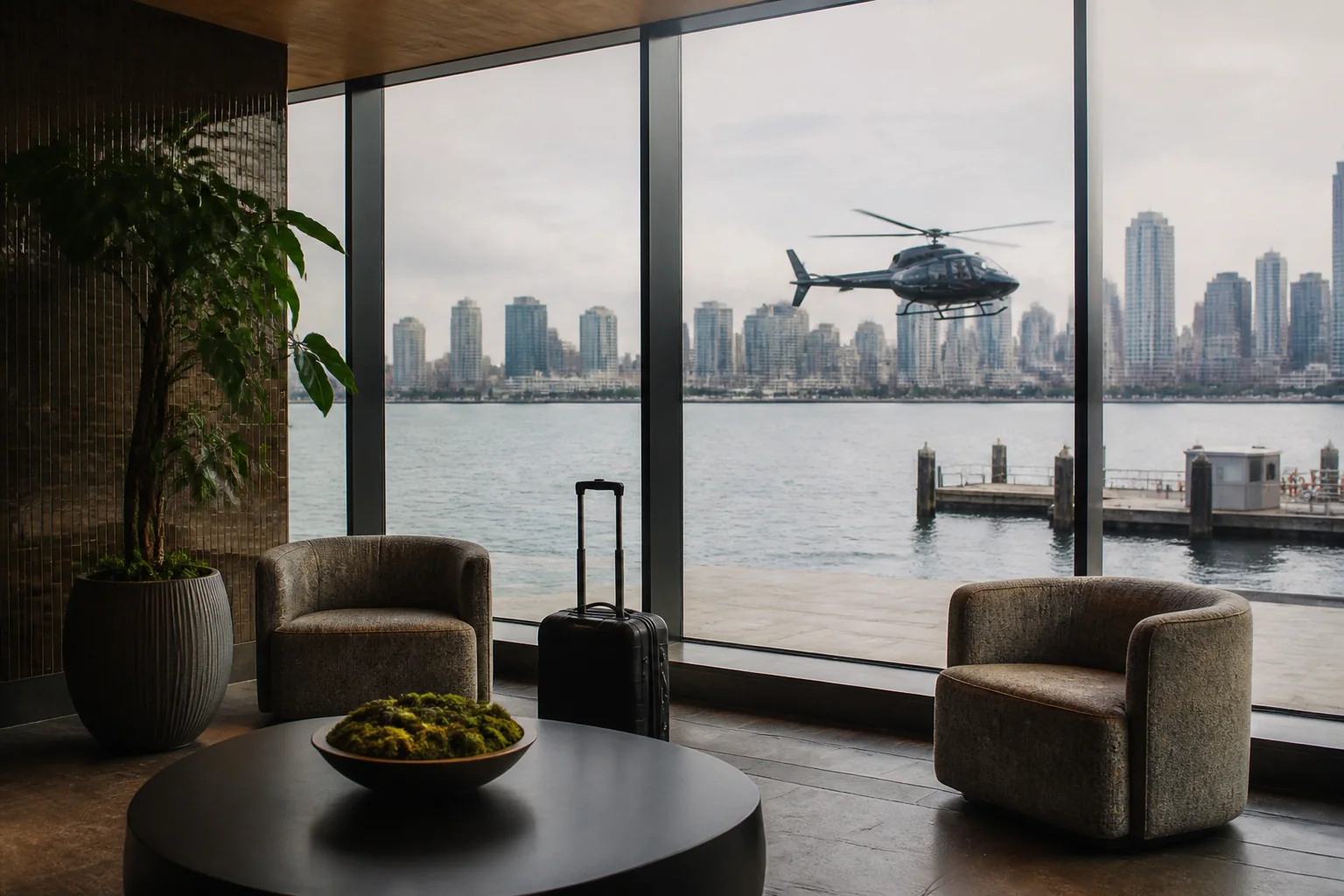
An “on-site helipad” is only one link between the aircraft door and the suite. Immigration, baggage reclaim, terminal transfers, security, the positioning journey and the final walk all sit around it. A boat jetty may still involve a tender; a limousine may wait at the wrong terminal. Ask for every handover, its owner and its realistic duration.
A remarkable arrival becomes a luxury service only when the invisible seams work. The photograph advertises a moment; the itinerary must explain the entire movement.
A 20-minute helicopter sector can require an hour of preparation and a separate airfield. A seven-minute launch may depart only at fixed times. Measure from a credible arrival at the commercial gate to check-in at the hotel, including formalities, walking, waiting, baggage and recovery buffers. Request two timelines: the preferred route and the resilient one.
The relevant question is not which option wins under perfect conditions, but which still makes sense after a late long-haul flight or an unexpectedly slow border queue.
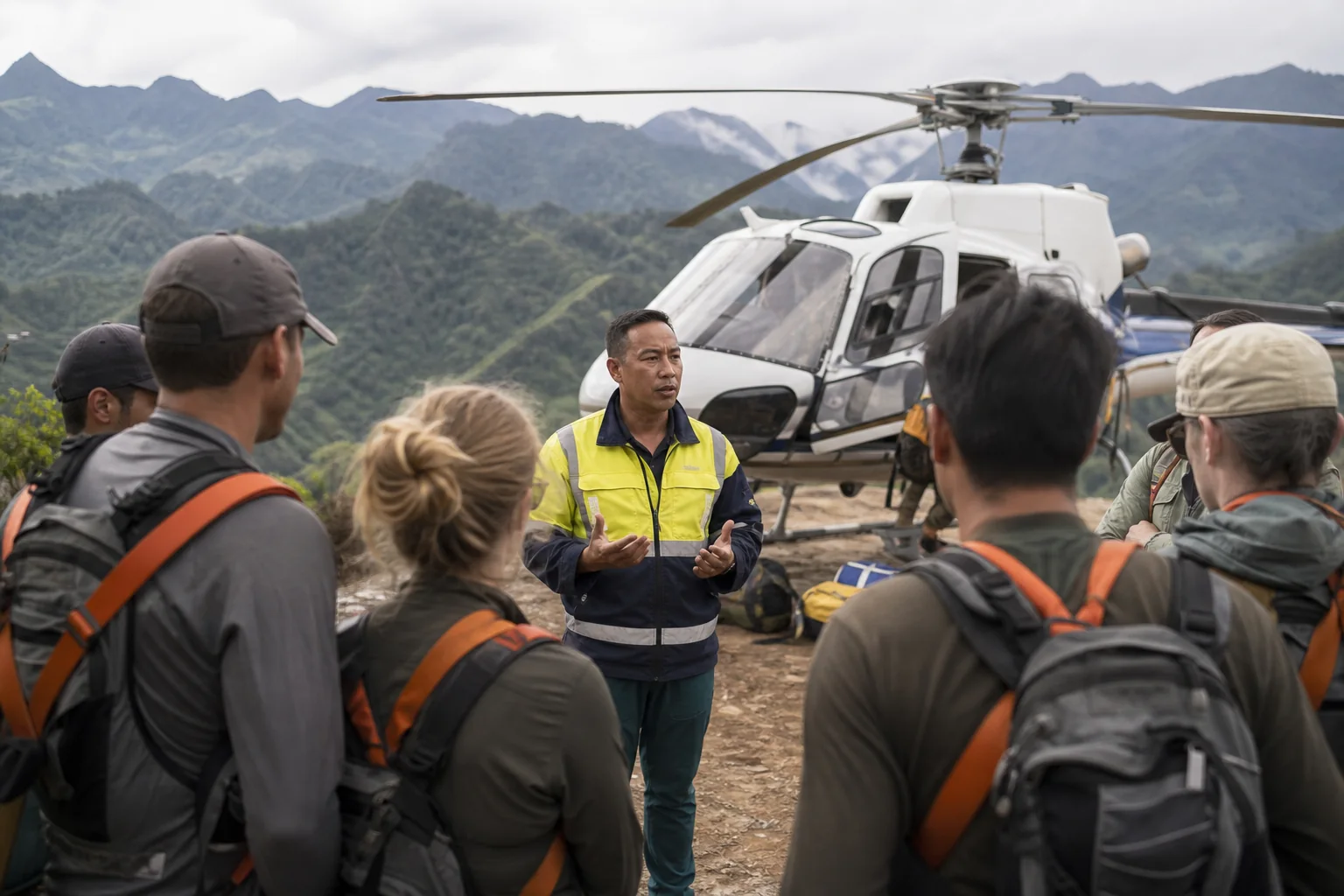
Translate helicopter access into operating facts
The phrase may describe an approved landing site on the grounds, a nearby public heliport or simply a landing option arranged by the hotel. Confirm the exact location, operating entity, permitted use and onward transfer. Is the site available for the proposed commercial passenger operation and aircraft type Are there daylight, noise, weather or community restrictions A painted circle does not establish approval or availability. Precise written details carry more value than a confident sentence in a resort brochure.
The UK Civil Aviation Authority treats helicopter safety as a combination of operations, airworthiness, passenger protection, oversight and risk mitigation. For a traveller, that means identifying the actual air operator, proposed aircraft and commercial operating basis rather than accepting the name of a broker.
Who makes the final operational decision What passenger data are required and who delivers the briefing A fine hotel may arrange a third-party flight perfectly well; its hospitality reputation does not turn the property into an aviation operator.
Wind, visibility, cloud, thunderstorms or local conditions can delay or cancel a flight. Responsible providers do not sell certainty and leave the decision with the operational authority. Establish when that decision is made, how guests are informed and what happens automatically next. Is a road vehicle dispatched,
a room held near the airport or a boat departure protected A premium arrival deserves equally precise cancellation handling. A conservative no-go decision is evidence of safety culture, not a service failure to be overcome by influence.
A landing site that functions in daylight may not accept arrivals after sunset. Airports, communities and hotels can have operating windows or noise limits. An evening scheduled flight is therefore not automatically compatible with a helicopter connection. Ask for the latest realistic connection threshold, not the final theoretical departure. Immigration, baggage and terminal changes should be modelled with sensible buffers. On island itineraries, choosing an earlier commercial arrival often improves the experience more than buying the fastest final sector.
Smaller aircraft have exact limits for seats, passenger weight, baggage volume and total payload. Hard cases, golf bags, prams and medical devices may alter the solution. Requests for passenger weight can be operationally necessary, not an etiquette lapse. Obtain the number, dimensions and type of permitted bags in writing, and establish whether excess luggage moves by road.
If bags travel separately, confirm custody and delivery time. Landing beautifully without medication or evening clothes is not a seamless arrival.
After landing, guests may encounter gravel, steps, an exposed ramp or another vehicle. Confirm distance, surface, shelter and assistance with boarding and disembarking. Does luggage arrive at the same time Is there a quiet waiting area and a lavatory A rooftop arrival loses its glamour if a tired guest must negotiate several levels without a lift.
Sophisticated planning follows the body from the airline seat all the way to a chair in the suite, not merely to a pin on a map.
Clothing, loose articles, approach path, hearing protection, seating and unexpected situations should be explained clearly by the operator before boarding. Guests need to disclose relevant mobility or health requirements early enough for a proper suitability assessment. A concierge should facilitate, not replace, operational communication. Privacy also matters: sensitive passenger information should reach only those who need it for safe delivery. Discretion and safety reinforce one another when roles, data and expectations are organised before travel day.
Boat access begins with the actual voyage
The International Maritime Organization’s passenger-ship framework illustrates how construction, operation, crew training and contingency planning combine in marine safety. Small resort craft may be governed by national or local regimes instead, but the principle remains useful. Identify the vessel type, operator, crew, local authorisation, route and passenger capacity. Is this an enclosed launch,
open speedboat, ferry or tender “Private boat” describes exclusivity. It does not by itself confirm ride quality, regulatory status or suitability for a particular sea passage.
A fixed quay provides a different boarding experience from a floating pontoon. A tender may require a transfer on moving water; a beach arrival can mean spray, unstable footing or stepping into the shallows. Ask for current photographs of both boarding points, plus steps, handrails, ramp gradient and alternate arrangements at low tide. Infrastructure matters more than scenery after dark, with young children or for anyone with reduced mobility. “Boat accessible” is not sufficiently precise for an informed decision.

A bay that is placid in the morning can feel very different later in the day. Season, route, hull and seating position affect motion, spray and journey time. A responsible team may not promise exact operating limits to a guest, but it should identify the decision maker and the tested fallback.
Align the scheduled flight with that fallback rather than assuming the boat will always run. The finest marine arrival is one chosen for pleasure and efficiency, not a single fragile connection on which every subsequent booking depends.
Ask about typical duration, shade, forward-facing seats, an enclosed cabin, ventilation and drinking water. Travellers prone to motion sickness should discuss personal medical questions with a qualified professional in advance; some remedies cause drowsiness or interact with medicines. Heat, dehydration and alcohol rarely improve the crossing. A hotel can provide cold towels and gracious care,
but it cannot guarantee a flat sea. Recommending a longer road transfer when conditions are poor can be the more luxurious response.
Confirm whether cases travel on the same vessel, under cover and under supervision. Passports, essential medicines, electronics and valuables should not disappear into an undefined pile. If hold baggage is delayed, will the final hotel launch wait Separate transport requires labels, a named handover and a credible delivery time. Diving gear, prams and professional camera equipment may need advance approval. A small water-resistant bag of essentials is a sensible precaution, not an admission that premium logistics have failed.
EU passenger guidance explains rights to accessible information and assistance on regulated transport, while acknowledging safety and infrastructure constraints. Bespoke hotel transfers require a specific assessment. Provide dimensions of wheelchairs and devices, transfer ability and assistance needs without relying on a vague label. Confirm the airport, vehicle, heliport or pier, boarding method, baggage support and hotel entrance as separate steps. “The resort is accessible” does not answer whether its boat, aircraft or last section of path is suitable.
Every handover must work for the guest
The least theatrical option often contains the greatest range in quality. Identify the licensed carrier and the actual vehicle, seating, climate control and luggage capacity. The driver needs flight monitoring, an unambiguous meeting point, a reachable dispatcher and sensible rest planning. On long routes, road condition, stops and realistic duration matter more than the optimistic output of a map app.
A prestigious badge on the bonnet cannot compensate for weak local knowledge or an itinerary that assumes every kilometre will flow.
An airport service can transform wayfinding, baggage handling and handovers. It should not be marketed as a blanket means of bypassing immigration, customs or security. Clarify where the representative can meet the guest, which controlled areas are accessible and whether any fast-track service is specifically confirmed. Terminal changes need their own description.
The most important detail is often a live operational phone number for arrival day. The name board is visible; coordinated continuation is the real product.
Age, weight and local law determine child seats and restraints in cars, while air and marine operators have their own rules. Confirm the model and correct installation instead of accepting “child seat requested” as completion. Keep bottles, nappies, hearing protection and a change of clothes accessible.
After an overnight flight, a longer but quiet road transfer may be kinder than another noisy, tightly timed connection. Design comfort from the perspective of the youngest passenger, including waiting rooms, lavatories and safe handovers.
Pregnancy, recent surgery, cardiac or respiratory disease, restricted mobility, severe motion sickness and some medical devices may matter for particular modes of transport. This article is not personal medical advice. Share only necessary information with the operator and refer individual decisions to an appropriately qualified professional. Also examine emergency access at the destination.
A remote resort does not become medically connected because its arrival is dramatic; clinical support and evacuation require a separate, realistic plan.
VIP transfers generate passport details, flight numbers, mobile contacts, weight information and exact timings. Ask who receives those data, which subcontractors are involved and how long information is retained. Name boards, crew social posts or conspicuous vehicle branding may be unwelcome. Security preferences should be expressed early and factually without disrupting regulated procedures. Real privacy is quiet architecture: minimal disclosure, one agreed communications channel and no public performance of the guest’s arrival.
Disclose the operator, price and disruption plan
“Our helicopter” or “our boat” may be shorthand for a contracted service. That is normal, provided the structure is transparent. Who supplies the transport, takes payment and sets terms for delay, cancellation or damage Has the hotel made a reservation or sold a package Put the operating company, contact and material conditions in the confirmation.
Responsibility should not begin to shuttle between concierge and carrier only after disruption. Clear contracting is part of the service, not an administrative footnote.
Request taxes, landing or berthing fees, positioning, waiting, night surcharges, empty legs, baggage movement and gratuity policy. Is the quotation per vehicle, vessel, flight hour or passenger When does it become firm, and which currency basis applies A weather cancellation may be refundable, rebookable or chargeable; the road alternative may also cost extra.
Present preferred and fallback costs together so the traveller is not forced into an emotional decision while standing at an airport after a long flight.
Replace vague reassurance with thresholds. Who monitors the airline flight When is the helicopter or boat reconfirmed At what point does the plan switch to road, and who informs the guest Is a vetted airport hotel available after the last connection Will dinner,
spa appointments or onward arrangements be moved automatically The UK FCDO’s travel checklist recommends preparing for the unexpected and retaining access to booking and insurance information. For a bespoke transfer, that principle should appear in the itinerary itself.
A premium policy does not automatically cover every private aviation or marine arrangement. Review destination, activity, medical treatment, evacuation, baggage and missed-connection consequences. With separate contracts, who carries the cost of a lost onward sector Keep the policy number, emergency line and transport terms available offline. Insurance cannot replace operator due diligence, but it can prevent a disruption becoming a financial chain reaction. Check cover before the non-refundable payment rather than during the final week before departure.
A helicopter may save meaningful time, but it also creates noise and substantial emissions over a short distance; a private speedboat can disturb sensitive coasts. Ask whether the mode solves a real access problem or stages an arrival. A shared launch, electric craft or excellent car may be the better answer. Residents, wildlife and other guests share the consequences.
Luxury is not the automatic use of every technically possible shortcut. It is the confidence to choose the option whose benefit justifies its impact.
A thrilling final transfer can conceal friction in every excursion, medical need or onward journey. Establish what is genuinely available on site and how much movement the programme demands. Seclusion may be perfect for rest and awkward for daily appointments. The right location is not a status symbol; it is a fit with the purpose of the trip.
Access and stay should be evaluated as one design. The most impressive arrival cannot rescue a hotel that is inconvenient for everything the guest actually wants to do.
Commission a one-page access brief
Ask the advisor to record operator, vehicle or craft, meeting point, telephone numbers, baggage limits, mobility requirements, duration, operating window, price, cancellation terms and Plan B on a single page. Add the weather authority, last viable connection, insurance reference and owner of every handover. This document is worth more than a page of superlatives. Deluxetargets can align the preferred solution with hotel, scheduled flights and traveller profile; final operation remains subject to the licensed providers and conditions on the day.