
Private dining
The finest private dinner starts before the menu is written. It begins with a choice: should the evening be led by the intimacy of a home, the motion of the sea, the story of an estate, the energy of a kitchen, the gravity of history—or simply the people around the table
Private begins with the purpose of the evening
Privacy can be architectural: a room, a gate, a deck reserved for one party. But the evenings that matter possess a deeper coherence. The setting, the host's role and the rhythm of the meal all point in the same direction. A private room that feels like an unused conference suite is less exclusive than a discreet corner in which every detail has purpose.
The useful question is not merely, “Where can we dine alone?” It is, “What should our guests remember?” Perhaps it is the ease of being at home in an unfamiliar place, a conversation with a winemaker or the glow of a harbour after the boat has stopped moving. Choose that memory first and the right format becomes much easier to see.
Every format directs attention. On a yacht, the horizon leads. At a chef's table, the kitchen does. In a historic salon, the room has its own voice; at an estate, provenance shapes the conversation. A villa can make the company itself the centre of the night. Luxury is not the accumulation of all these ideas. It is the confidence to choose one and let everything else support it.
Villa, yacht, wine estate or chef’s table
A villa is especially persuasive for families, close friends and journeys that unfold over several days. Nobody is waiting for a car after dessert. Children can eat earlier, older relatives can retire without leaving the occasion and the sitting room can become a bar when the table clears. At its best, the evening feels like an exceptionally well-run home, not a restaurant transported into a rental property.
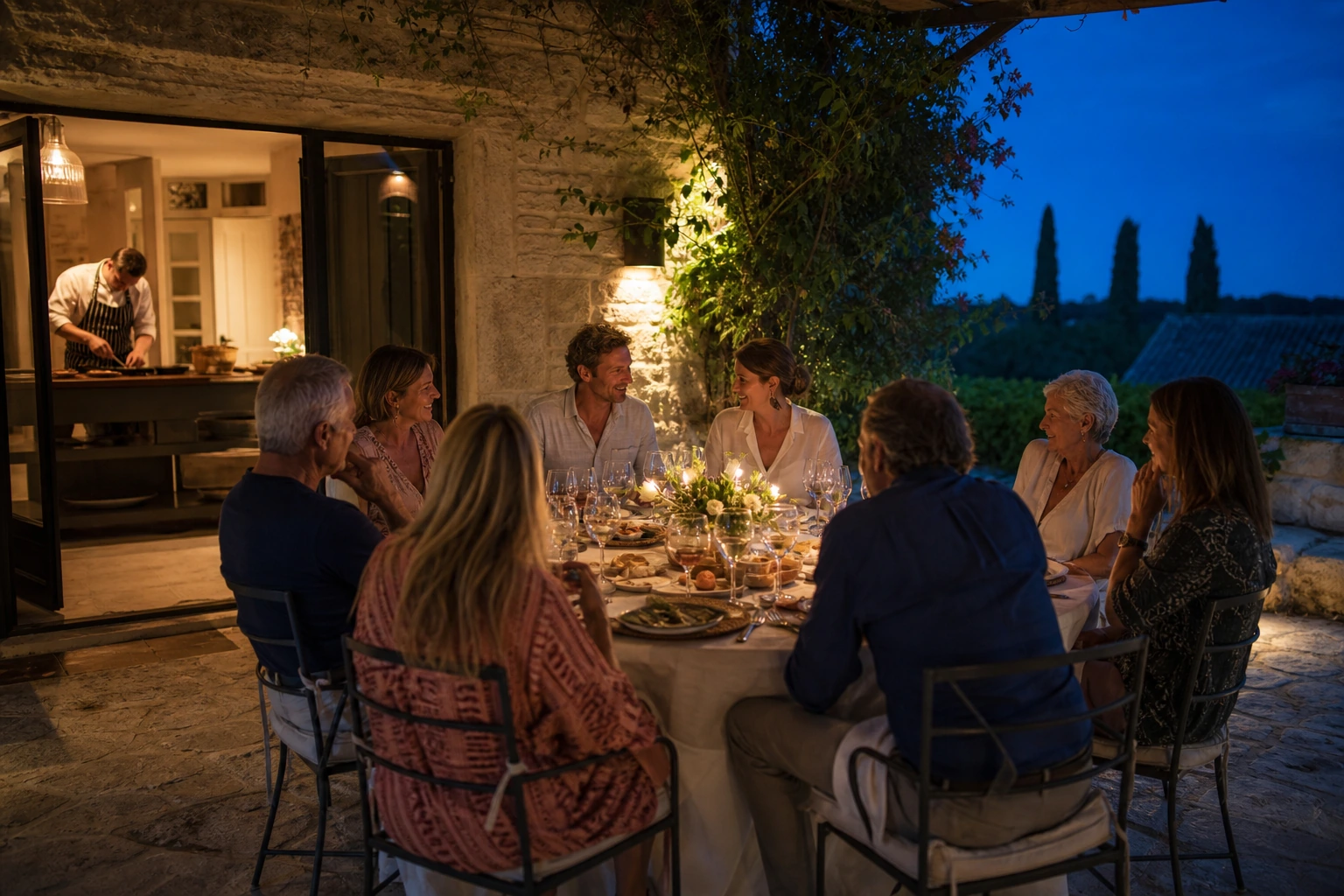
That distinction affects the menu. A sequence of a few beautifully judged courses, perhaps with dishes passed around the table, often suits the mood better than a long tasting performance. Service should be observant but lightly held. Grand floral architecture and an army of waiters can erase the very intimacy the villa was chosen to provide.
A group expecting visible culinary theatre, exact restaurant choreography or a formal corporate tone may be happier in a professional private room. The domestic kitchen must also be capable of the proposed menu. Ask about neighbours, shared entrances and staff circulation: “at the villa” is not, by itself, a guarantee of seclusion.
Dinner afloat is memorable when the route serves the meal—a drink under way, anchoring before the main course, quieter light as the shoreline comes alive. The sea is not a backdrop. It is a moving condition, and the captain, crew, vessel and weather retain authority over every plan.
A lighter menu, fewer service moments and dishes designed for short, stable journeys usually make more sense than a long formal banquet. For guests prone to motion sickness, small children or anyone hoping to make an extended speech, the romance of the format can become a demand.
Do not begin with sunset time. Ask where the yacht can lie quietly enough for service, what the galley can finish well and which equal alternative is ready if conditions change. A serious operator answers specifically. A purely romantic answer indicates that the image has been planned more thoroughly than the dinner.
An estate dinner works when land, cellar and kitchen form one narrative. A private cellar gives the wine a contemplative intimacy; a table among vines allows the landscape to carry more of the evening. The best host opens a window onto soil, season and people rather than explaining every bottle at length.
Too many tastings before dinner can exhaust the guests' attention. A smaller number of meaningful wines, well-spaced stories and food rooted in the place create a more vivid memory than a procession of trophy vintages.
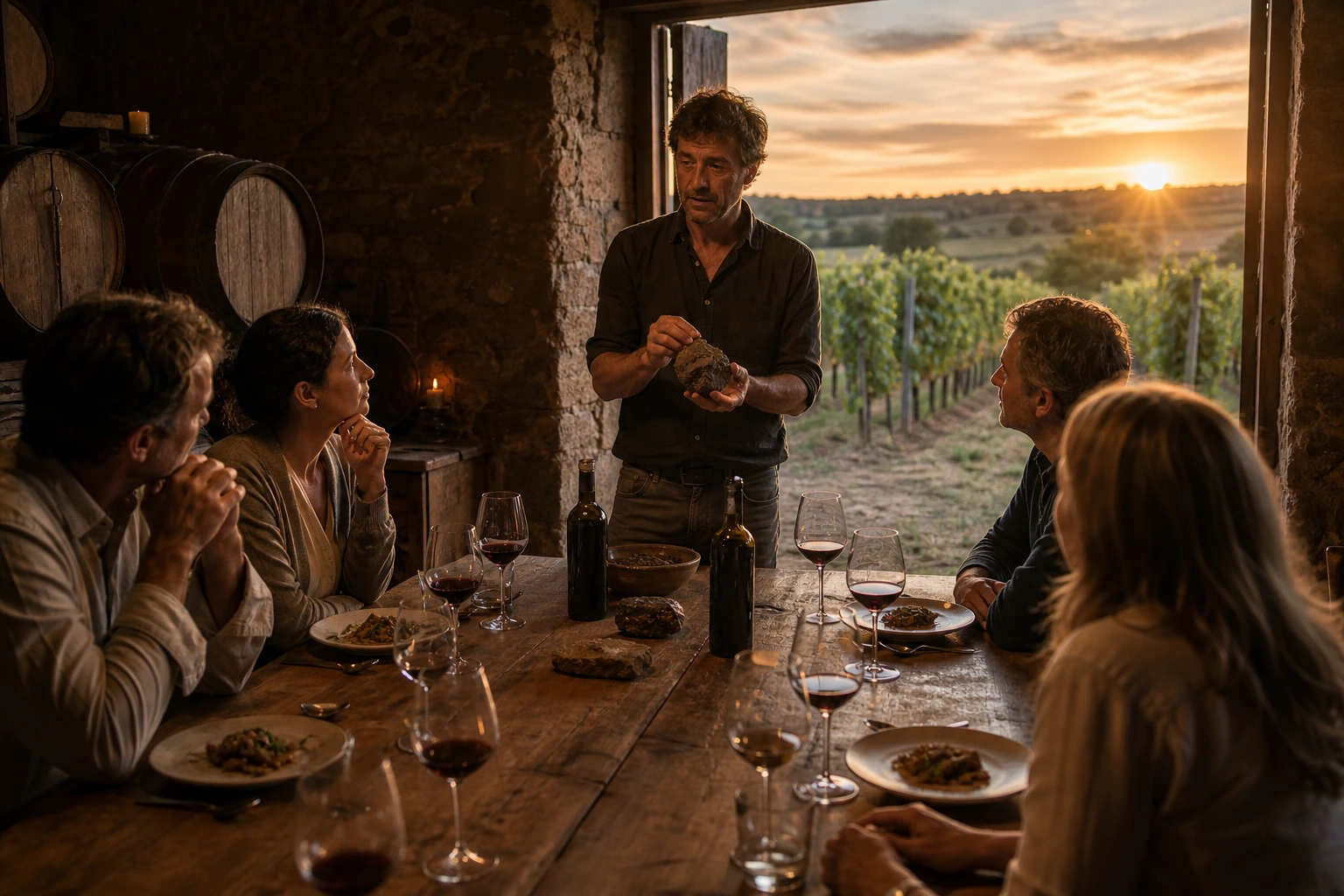
A remote property requires a thoughtful arrival and an effortless return. Guests should not be expected to drive dark country roads after dinner. Within the estate, distance matters too: a magnificent vineyard is not the right dining room if every plate, guest and member of staff must travel an impractical route to reach it.
At a chef's table, attention faces forward. Hands, heat, timing and last-minute decisions become part of the experience. It suits curious diners who want to ask questions and see how a kitchen thinks. The privilege is not simply isolation; it is access to the work.
That also defines its limit. Kitchen energy can compete with private conversation. Noise, warmth and the progression of courses set the tempo. A chef's counter is a poor stage for speeches and not necessarily the best choice for guests who chiefly want time with one another.
Choose the counter when the chef and process are the occasion. Choose a private room when you want the restaurant's cooking but your own company at the centre. A great property may offer both, yet they produce fundamentally different nights.
Garden, salon, atelier or private restaurant room
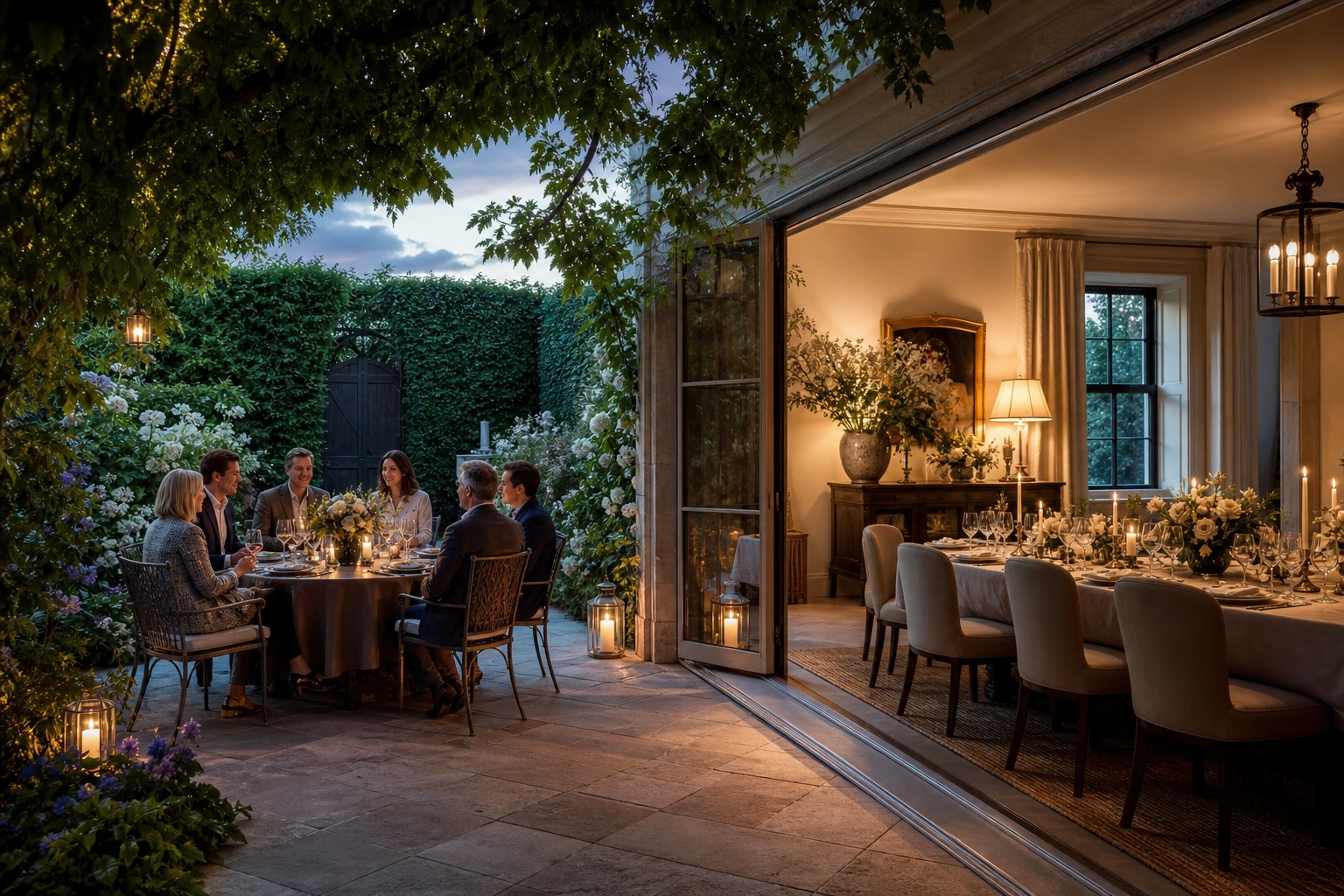
A well-chosen hotel garden combines a sense of nature with a professional kitchen, service team and nearby interior. For anniversaries and multigenerational groups, that hidden support can be more luxurious than a remote production. Still, the word “garden” can mean anything from a secluded loggia to a lawn beside a busy pool.
Inspect sightlines and pedestrian routes as carefully as the view. Ask whether other guests will pass, how sound travels and where the evening moves if conditions change. The true measure is not how the table looks at six o'clock, but whether its atmosphere survives the whole night.
A terrace can allow drinks and the first course outside before dinner continues indoors. Planned as a graceful progression, this feels far better than a hurried weather retreat. In warm destinations, shade, breeze and acoustic distance often matter more than the widest panorama.
A palazzo, château or old townhouse lends gravity to an occasion. Architecture and patina can replace elaborate decoration, making the format apt for a significant birthday, a proposal or a conversation that deserves ceremony.
Historic rooms are rarely neutral shells. Acoustics, air conditioning, candles, music, furniture movement and step-free access may be restricted. Trying to force contemporary event production onto them usually destroys the quality that made them desirable.
It may sound less adventurous, but it often performs best: a door of one's own, a proven kitchen, a practiced service team and a room shaped for conversation. For business dinners, sensitive family moments and ambitious menus, this can be more genuinely luxurious than an elaborate outdoor construction.
Check its separation from the main dining room, lighting, ventilation, cloakroom and route to the restrooms. Ask whether one team will remain with the group. Privacy should not become neglect.
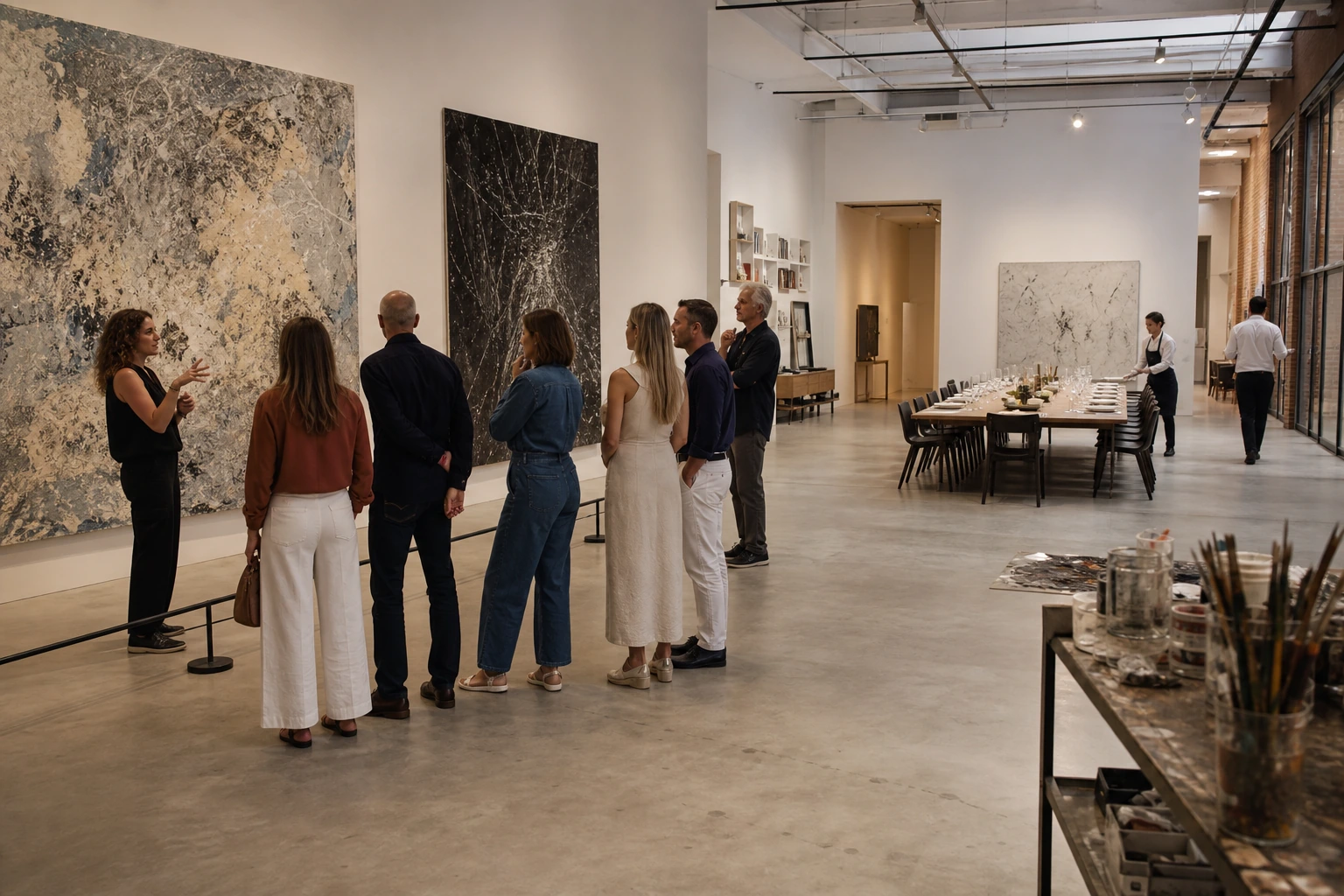
A dinner among art should never try to outshine the collection. A short reception, a knowledgeable encounter with a few works and a restrained table can carry more meaning than a full-scale gala. In an atelier, the conversation matters more than the scenery.
Rules governing food, drink, photography and circulation protect the place. They are not inconveniences but part of the privilege. A strong concept accepts them elegantly and gives guests a closer relationship with the setting.
Remote dining has immediate emotional force, and the greatest operational fragility. Wind, sand, temperature, darkness, access and departure can quickly become more important than the food. The best design is quiet: robust glassware rather than delicate props, a shorter menu instead of intricate choreography, warm pools of light rather than a glaring installation.
Plan B and the guests determine the format
A conference room is not an acceptable substitute for a dune or beach. The alternative needs its own complete identity and should be shown in advance. Only then can a weather decision be made early, without making guests feel the uncertainty behind the scenes.
For family closeness, consider a villa. For movement and horizon, a yacht. For provenance and conversation, an estate. For culinary curiosity, a chef's table. For outdoor elegance with reliable support, a hotel garden. For ceremony, a historic salon. For discretion and precision, a restaurant's private room. For cultural access, a museum or atelier. For an intense sense of place, beach or desert—provided the retreat is equally convincing.
A group need not be constrained by its youngest or oldest member; good design keeps everyone within the occasion. Short routes, an earlier children's course, stable seating, a quiet indoor space and flexible departures expand the possibilities. Any format that works only for one perfect photograph is rarely generous hospitality.
Real privacy includes arrival, sightlines, staff, neighbouring guests, photography and personal data. A discreet side entrance can be more valuable than a spectacular table. For prominent or commercially sensitive parties, names and purpose should be shared only with the smallest necessary team.
A dish needs different stability at sea than in a restaurant. Delicate plating loses temperature in a garden. A villa can invite sharing; a chef's table can reward greater technical detail. The right question is not, “What is the most prestigious ingredient?” It is, “What will taste best here, in this rhythm?”
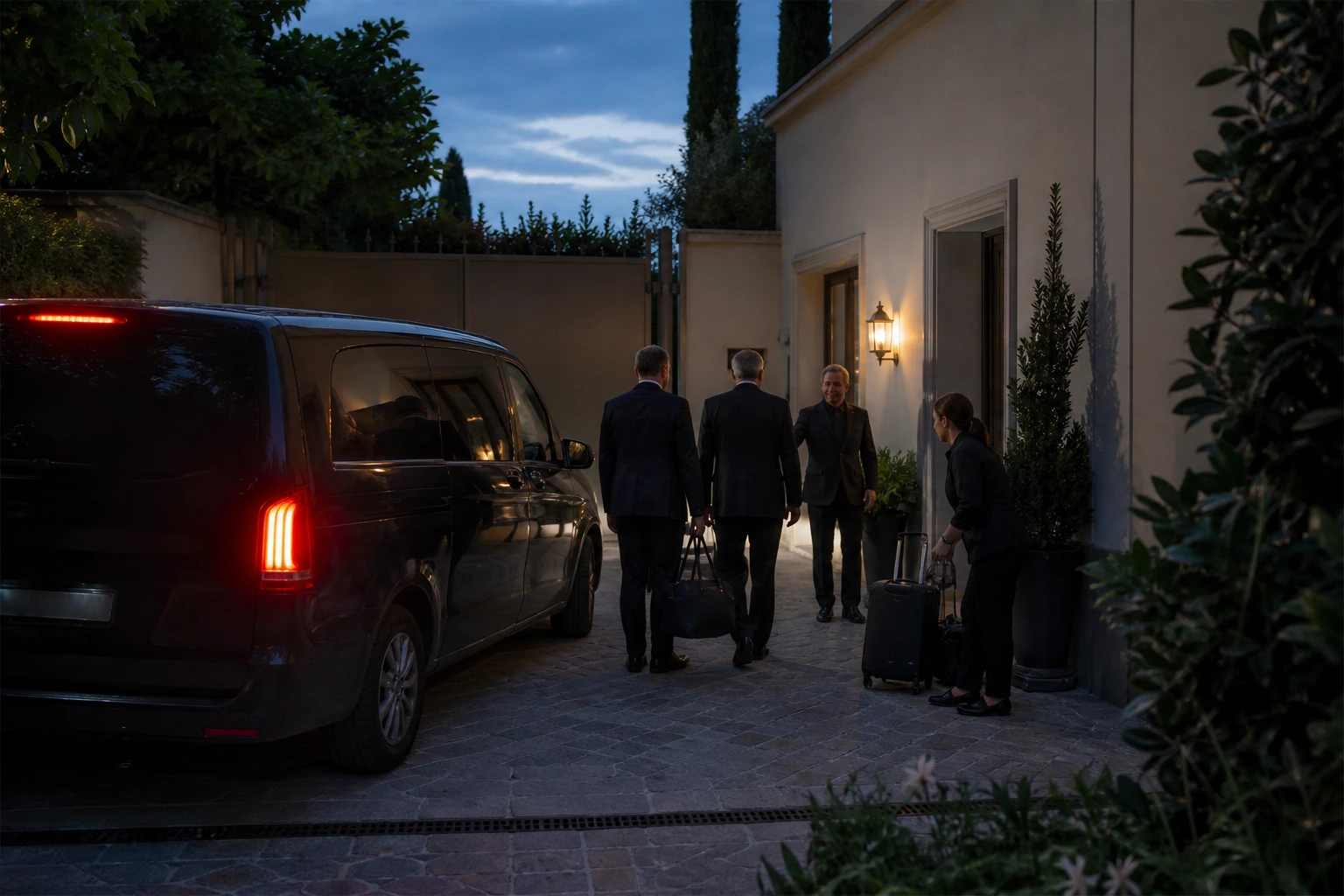
The host's work is to welcome, connect and enjoy—not to receive deliveries or negotiate weather. One accountable professional must own the operation across venue, kitchen and service. The moment the host becomes production manager, the evening loses its sense of ease.
Three questions expose a beautiful but weak idea
Where is the final touch made to each plate What will guests experience if the conditions change Who can decide on the night without involving the host Precise answers reveal an experience behind the image. Evasion suggests that only the scenery has been sold.
Record exclusivity, guest numbers, the exact space, timings, menu, drinks, transfers, accessibility, photography and music rules, weather alternative, decision deadline, price, taxes, service, cancellation and named contacts. Allergies and dietary needs require their own documented process.
First, understand the occasion and guests. Second, identify what should lead the evening. Third, choose the format. Fourth, find a place that performs it credibly. Only then develop menu, design and special moments. Starting with decoration usually means planning against the room.
We compare more than the most photogenic option. The right answer might be a long table in a Venetian garden, a cellar in Tuscany, a kitchen seat in Geneva or the discreet room of an exceptional restaurant. What matters is that the place carries the evening—so the guests never have to.
Private dining stays in the memory when privilege feels natural: the right room, a small number of intelligent decisions, excellent food and unhurried time together. The rarest luxury is not spectacular access. It is an evening in which nothing comes between the guests and their conversation.