
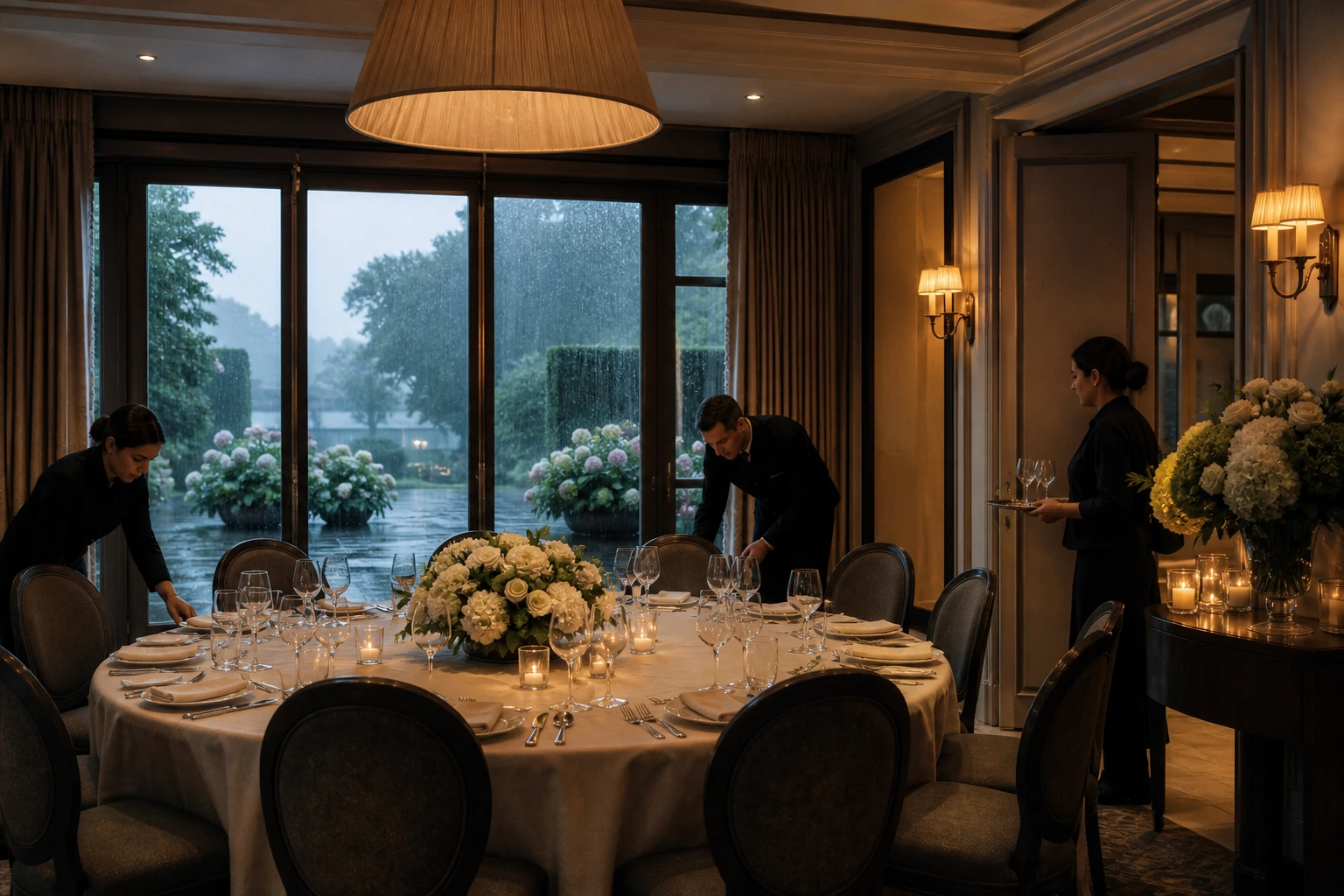
A private dinner is not a restaurant table with more flowers. It is a temporary hospitality operation in which kitchen, service, light, guests and weather must meet at one place and one time. The evening feels effortless only when decisions have already been made backstage: who has authority, where food is finished, when the venue moves indoors and what menu can genuinely survive the promised duration.
Occasion, guests and allergies determine the menu
A credible brief contains the occasion, guest profile, timeline, menu, allergies, venue, kitchen, service route, light, sound, weather trigger, Plan B, named decision-makers and cost approvals. It describes not only the desired mood but the red lines. If the host is deciding about rain, missing chairs or an allergen during drinks, planning has failed.
A birthday, proposal, business dinner, multigenerational gathering and quiet villa evening need different choreography. A long tasting menu may delight eight wine enthusiasts and exhaust a family. Define what guests should remember: conversation, food, place, surprise or a speech. Give the principal experience time and make every other element support it.
Names are not enough. The team needs languages, ages, mobility, dietary requirements, seating relationships and formal roles. One controlled version prevents kitchen, service and host from using conflicting lists. Every change carries a date and owner. Discretion means limiting information to those who need it—not hiding critical facts inside private messages.
The UK Food Standards Agency treats allergen information and management as a food-business responsibility. Collect medically relevant allergies, intolerances, religious requirements and dislikes in writing and in separate fields. The responsible kitchen confirms feasibility, cross-contact risk and communication. A service note saying “no nuts” is not a controlled kitchen response.
For each course, establish which guest receives which plate and how it is identified without public labelling. Kitchen lead and service lead use the same approved matrix. Late changes do not scatter across several chats. If there is uncertainty, the dish waits until the qualified person has resolved it. Speed never outranks a safe answer.
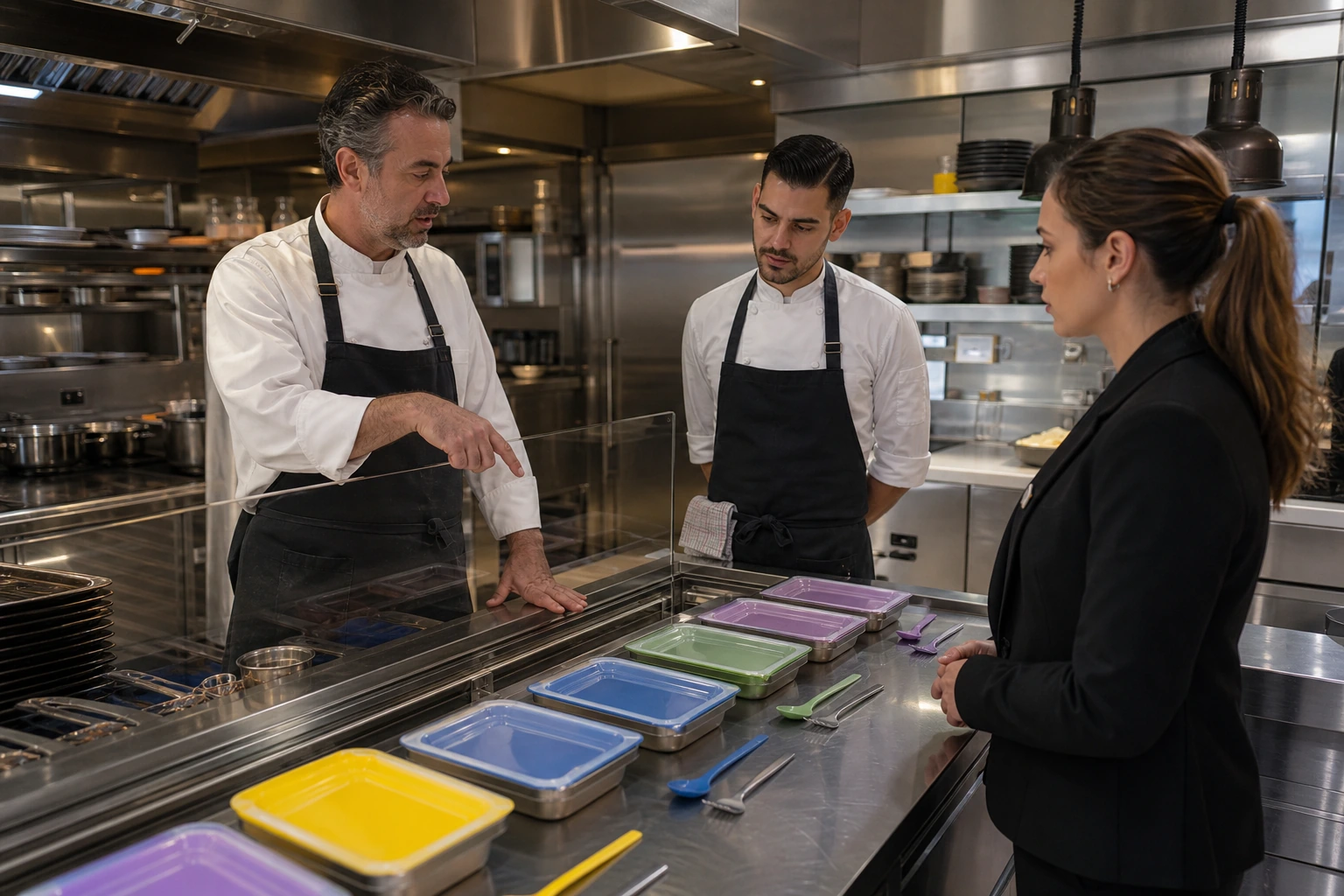
Every extra course adds preparation, service, wine, cutlery and an interruption to conversation. Five exact moments may feel more luxurious than ten miniatures. Map drinks, seating, courses, speeches, dessert and coffee against honest timings. A kitchen thirty metres away requires a different sequence from a chef's table beside the pass.
Vegetarian, vegan, alcohol-free and allergen-adjusted guests should not receive a plate assembled from removed components. Ask the chef for a parallel arc with comparable temperature, texture, value and number of courses. A guest recognises immediately when their menu was solved after the main one. Equivalence matters more than visual sameness.
Age, bedtime, childcare and sitting tolerance belong in the brief. Children may eat a shorter good menu earlier and return for dessert; family-style service may outperform tweezers and speeches. Confirm high chairs, cutlery, safe circulation and a quiet adjacent room. “Children's menu” does not describe a workable family evening.
Site, kitchen and invisible service routes
View and exclusivity come after kitchen, toilets, access, power, water, safe surfaces, accessibility and shelter. A cliff without a service area or a beach with no weatherproof route turns elegance into visible logistics. The site inspection follows a plate, a guest using a mobility aid and a server clearing glassware—not merely the photographer's angle.
An indoor room offers control but may be acoustically hard or too formal. A terrace preserves infrastructure and air while remaining exposed to wind and temperature. An open garden needs paths, power, lighting and genuine weather shelter. Name the product in the proposal. “Outdoor dinner” is not a sufficient specification.
Where are preparation, refrigeration, washing, pass and final finishing Is food cooked, regenerated or simply plated on site How long is the route The answers change crisp elements, sauces, ice, seafood and serving temperature. Even a brilliant chef cannot make poor infrastructure disappear. Write the menu for the real production environment.
The FDA notes that time and ambient temperature affect perishable food served outdoors. A professional event must follow local law and the responsible caterer's food-safety system. Ask about cold and hot holding, transport, hand washing, covers and waste. A decorative buffet left standing in heat is not generosity.
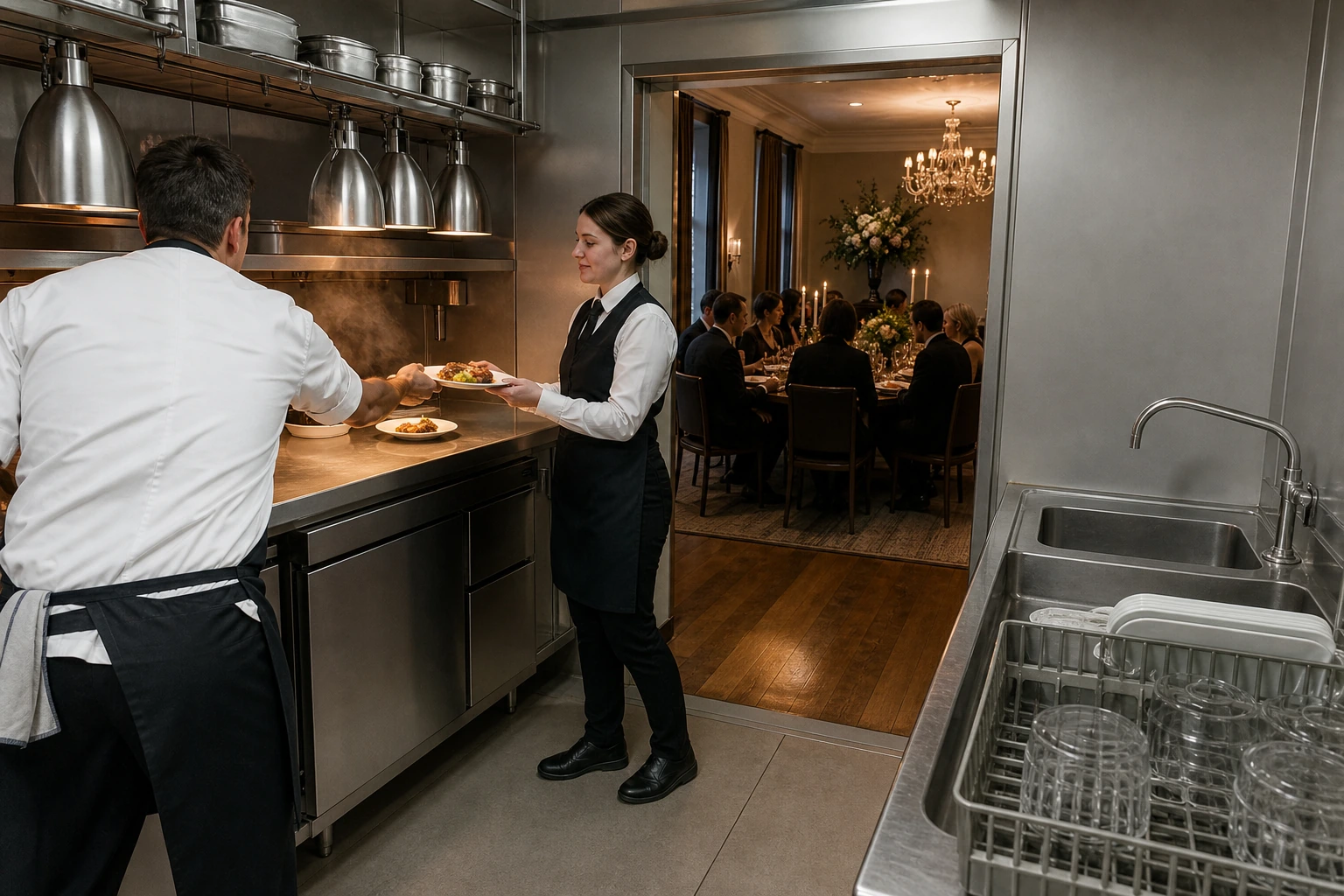
Staff need a clear entrance, staging space, clearing point and path that does not cross guests or speeches. Doors should not swing behind chairs, and empty bottles should not travel through the principal view. Draw the table, bar, kitchen and routes. Quiet service comes from short, conflict-free distances—not simply from reducing staff.
Distance, steps, light, cleanliness and night access influence comfort more than linen colour. A guest with limited mobility needs a continuous route from arrival to seat and bathroom. A buggy does not solve a staircase. Request the actual route and a dignified alternative rather than accepting a generic “accessible” label.
Temporary lights, heaters, music, kitchen equipment and charging create electrical load and trip routes. The UK's HSE explicitly addresses electrical safety and emergency planning for events. Qualified equipment, weather protection, cable management and local fire rules belong to the responsible operator. Candles appear only where they are permitted and supervised.
Light, acoustics and table are social choreography
Guests need to see one another, recognise food and move safely. One bright overhead source destroys atmosphere; candlelight alone can erase plates and steps. Build layers: soft facial light, focused table light, safe paths and restrained architecture. Dimming and colour temperature are tested before the event, not adjusted during the main course.
A beautiful table can remain intimate under camera-capable lighting. Decide whether professional imagery is needed, what moments may be recorded and when the camera leaves. Flash and constant posing interrupt conversation and service. Consent and discretion are handled in advance. The best photograph is never more important than the evening guests experienced.
Wind, water, stone, generators and adjacent music change intelligibility. Visit at the actual event time. A long table requires a different sound plan from a round one. Music supports arrival and transitions rather than filling every silence. If speeches need a microphone, it should be discreet and tested—not opened from its box after guests sit.
A round table connects a small group; a long table photographs beautifully but separates its ends. Several tables create movement and demand seating logic. Place host, couples, languages, tensions and guests of honour deliberately. Place cards can remove uncertainty without making the evening feel like a banquet. Relationships are not solved at the moment of seating.
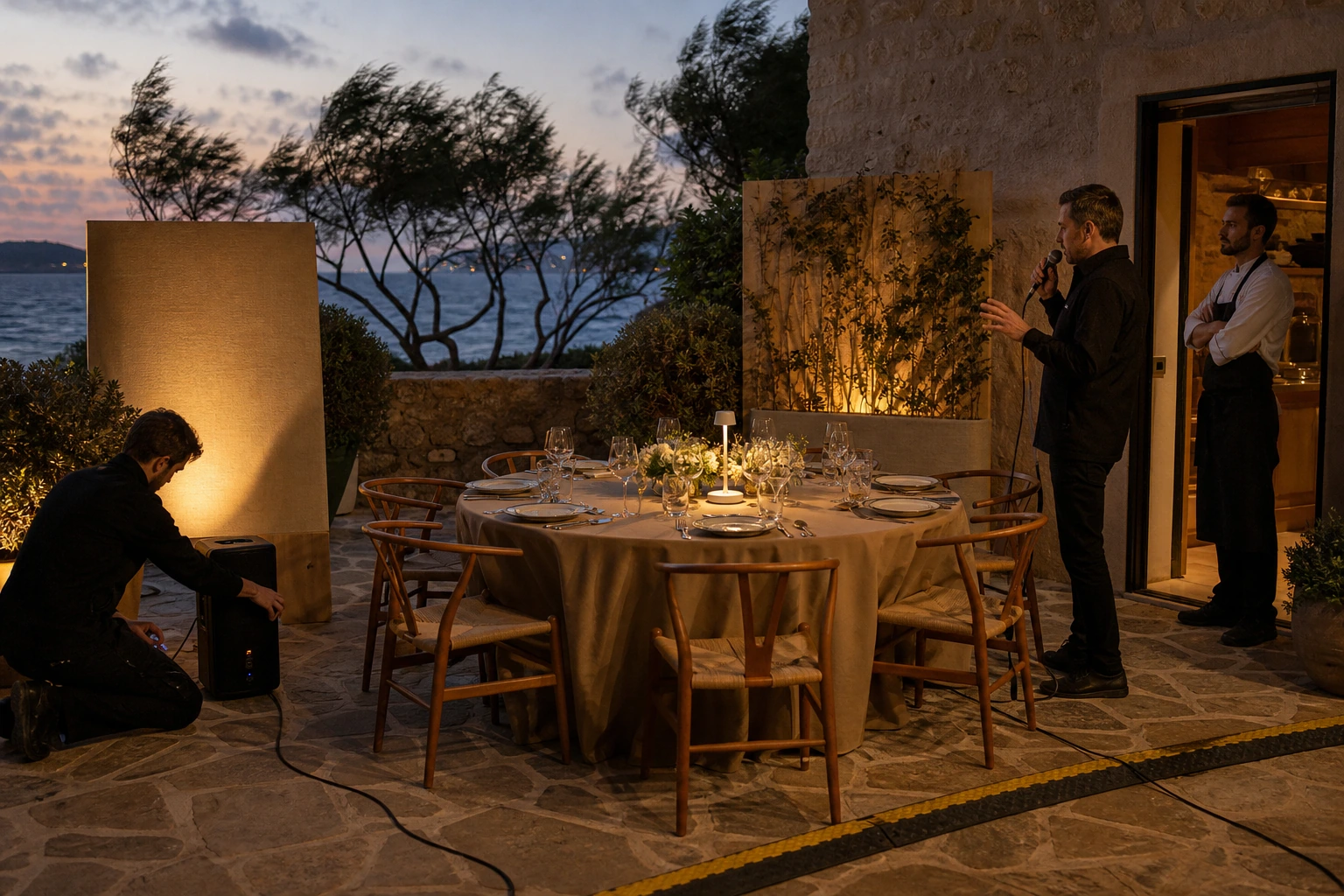
Narrow garden chairs, crowded edges and a cold evening shorten every menu. Check seat height, cushions, arms, table legs, clearance and wraps. Heaters should not add noise or uneven heat. Test comfort from the perspective of the oldest or most sensitive guest, not the production team working during setup.
Scent, pollen, height and volume affect food and sightlines. Strong blossoms compete with wine and may touch allergy concerns. Low arrangements or a few sculptural elements are often stronger. Use local seasonality and heat-tolerant material. Floristry also needs a delivery and removal route; the perfect vessel cannot block service.
Invitation, drinks, speeches and the host’s role
Dress, surface, temperature, transfer and likely finish belong in guest communication. “Elegant casual” is insufficient on gravel in wind unless shoes and a layer are mentioned. Give departure time, not only dinner time. At a villa or yacht, meeting point and safety instructions are explicit. Guests should arrive prepared, not overwhelmed by production detail.
An open-ended reception sounds generous but moves the kitchen and appetite. Set an arrival window, a seating cue and the person who gives it. Canapés respect both appetite and allergy plan without replacing dinner. The host welcomes; the event and service leads hold the clock.
A speech before dinner, between courses or before dessert changes the room differently. Confirm number, length and technical needs. Kitchen and service pause intentionally; a finished plate should not cool behind an improvised twenty-minute tribute. Emotional surprises can remain surprises to guests while the event lead knows their timing.
Wine should support menu and people. Set level of interest, budget, origin preferences and desired explanation. Not every course needs another glass; rare bottles require temperature, decanting and a backup. Build a serious non-alcoholic pairing in parallel. No guest should need to explain why they drink less or not at all.
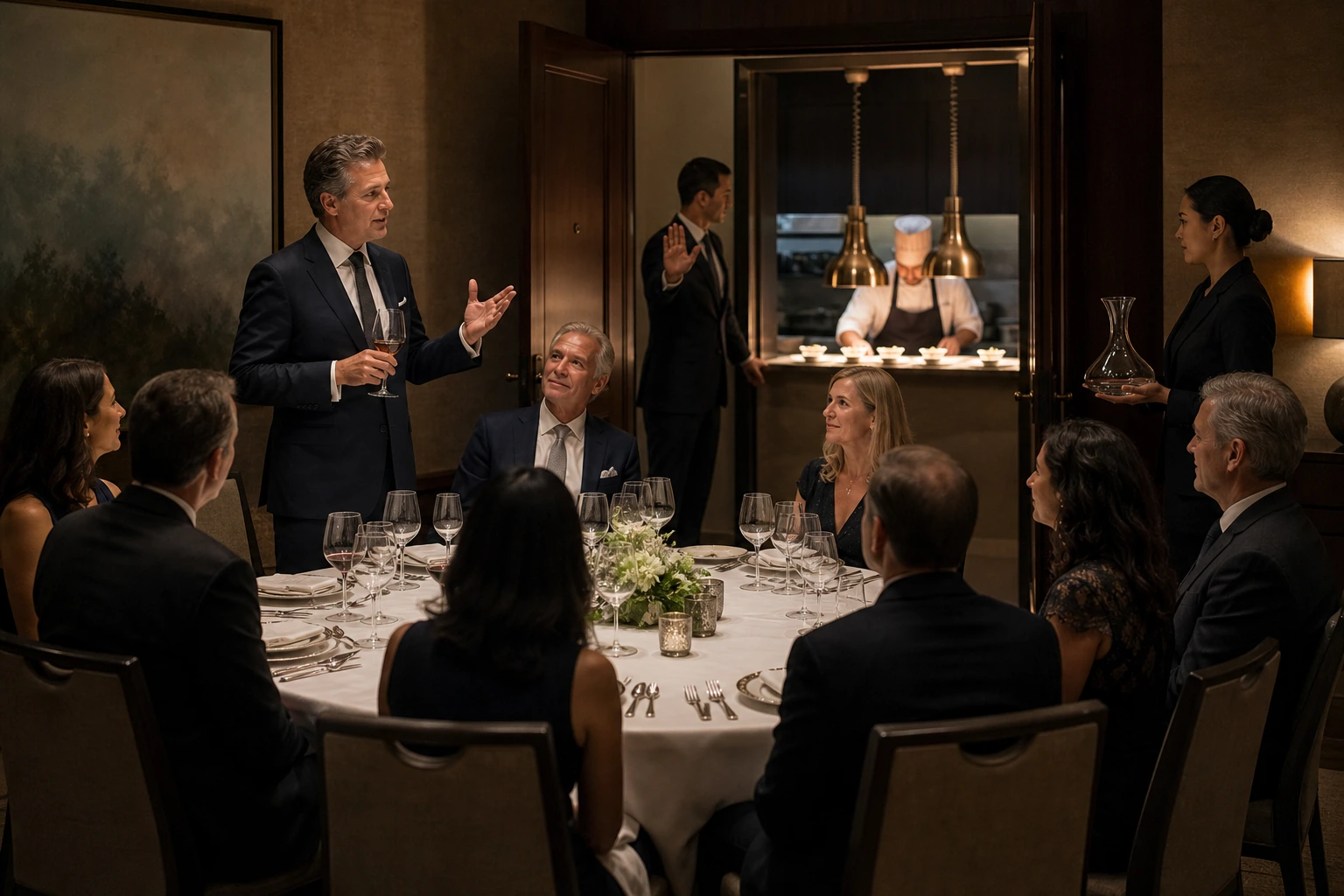
The host welcomes, connects people and lives the evening. They should not monitor weather, kitchen pass and playlist. A named event lead receives decision authority and understands budget and red lines. Escalate only changes that alter the meaning of the occasion or incur significant cost. That is the operational heart of hospitality.
Name client, event lead, chef, service lead, venue owner and technical lead. State who approves menu, weather move, safety response and additional spend. Suppliers report through one route. A group chat is communication, not governance. Before service, all leads attend one concise briefing from the same final document.
Plan B needs a time and decision authority
“We will move inside if it rains” is not a plan. Define forecast source, decision time, responsible person, operator criteria and final reset window. Wind, temperature, wet ground and lightning are separate questions. Do not begin a room move during drinks. An early decision makes Plan B feel intentional; a late one makes it feel like defeat.
The US National Weather Service recommends a lightning safety plan and a safe building or enclosed shelter for outdoor events. A fabric canopy or tree is not the equivalent. Local authorities and the venue operator determine the action. Explain the move calmly and clearly. Safety is not a host preference to negotiate.
A store room with stacked furniture is not an alternative to the garden. Inspect capacity, view, light, climate, acoustics, table form and service route in both places. Decoration should transfer cleanly or be prepared in advance. If the indoor option is consistently weaker, a dinner designed there from the beginning may be better than a promise dependent on the sky.
Privacy, cost, contracts and operating brief
Does private mean an exclusive room, closed terrace, dedicated team or merely a held table Can hotel guests pass, boats approach or drones see the setting Confirm sight, sound, access and staffing. Public or corporate guests may need name protection, photo restrictions and controlled guest data. Exclusivity is a verifiable operating condition.
Alongside food and drink, show venue fee, minimum spend, labour, technology, flowers, furniture, transport, setup, weather reset, overtime, taxes and gratuity. Additional spend needs approval thresholds. A low headline price may rely on compulsory services. Compare proposals only at the same guest count, duration and responsibility level.
What happens when the client cancels, weather forces a move, authorities restrict access or a supplier fails Which costs are already committed Moving indoors is not cancellation, although it may trigger labour. Written cut-offs and ownership protect the relationship and the budget. A force-majeure paragraph alone does not explain what guests will experience.
At a complex venue, event, service and technical leads walk the evening at the relevant hour. They test arrival, light, route, power, music, microphone, toilets and Plan B. A plate follows the kitchen path. A small villa dinner may not need a full rehearsal, but it still needs one accountable person to inspect the real site.
The final page states occasion, count, host, sites A/B, timeline, menu version, allergen owner, seating, service style, light, music, speech, weather decision, emergency contact and spend authority. Plans and menus sit in appendices. Every lead confirms the same version. Brevity here is not missing information; it is operational clarity.
If the kitchen is distant, weather alternative poor, guests want to move or the occasion is informal, a private restaurant room may be superior. A chef's table provides proximity without temporary infrastructure; a great lunch uses natural light. Private dining is luxurious when it improves meaning and connection—not merely the invoice.
We would approve venue and responsibility structure before menu and styling. Two equal weather scenarios, a controlled allergen matrix and a realistic service route matter more than a spectacular rendering. The evening succeeds when guests never see the planning and the host is not asked a single operational question.