
Private aviation
A private jet becomes convincing when it removes a specific logistical constraint. Without that task, it remains a very expensive aircraft with a beautiful cabin.
The mission comes before aircraft and price
Route, passengers, time window, baggage, airports and appointments define the task. Only then should an aircraft category be selected. Beginning with a model risks too much cabin, too little range or the wrong airport.
A convenient nonstop between well-connected cities is difficult to beat. A group reaching two remote destinations around one fixed meeting faces another calculation. Value appears door to door.
Zurich to London may be an excellent scheduled journey for one traveller when the nonstop, lounge and car fit. Four people carrying specialist baggage, meeting outside the city and continuing that evening from another regional airport create a different mission. Air miles may look similar; road time, connections, waiting and the consequence of a missed appointment do not.
Safety, passenger data, customs, immigration, slots and airport procedures remain. Private terminals may make the process discreet and shorter without removing any authority requirement.

The air carrier operates under its Air Operator Certificate. A broker searches, compares and arranges. Contract, payment, responsibility and actual operator need clear identification.
A platform can display many jets without holding the operating approval. The relevant certificate is the one under which aircraft and crew perform this mission.
Runway length and strength, opening hours, fire category, customs, handling, weather and noise restrictions govern access. A smaller jet may land nearer; a larger one may require the distant main airport.
Road journey, terminal, flight, handling and onward transfer belong on both sides of the comparison. Charter saves little when a nonstop premium service exists and airports are equally convenient.
Three cities in two days may involve far fewer detours privately. Slots, crew duty, parking and weather create new dependencies. An ambitious programme needs margin rather than a perfect spreadsheet minute.
The aircraft is chartered as a whole. More guests spread the total while seats, luggage and comfort still fit. Per-person arithmetic alone overlooks ground travel, positioning and return structure.
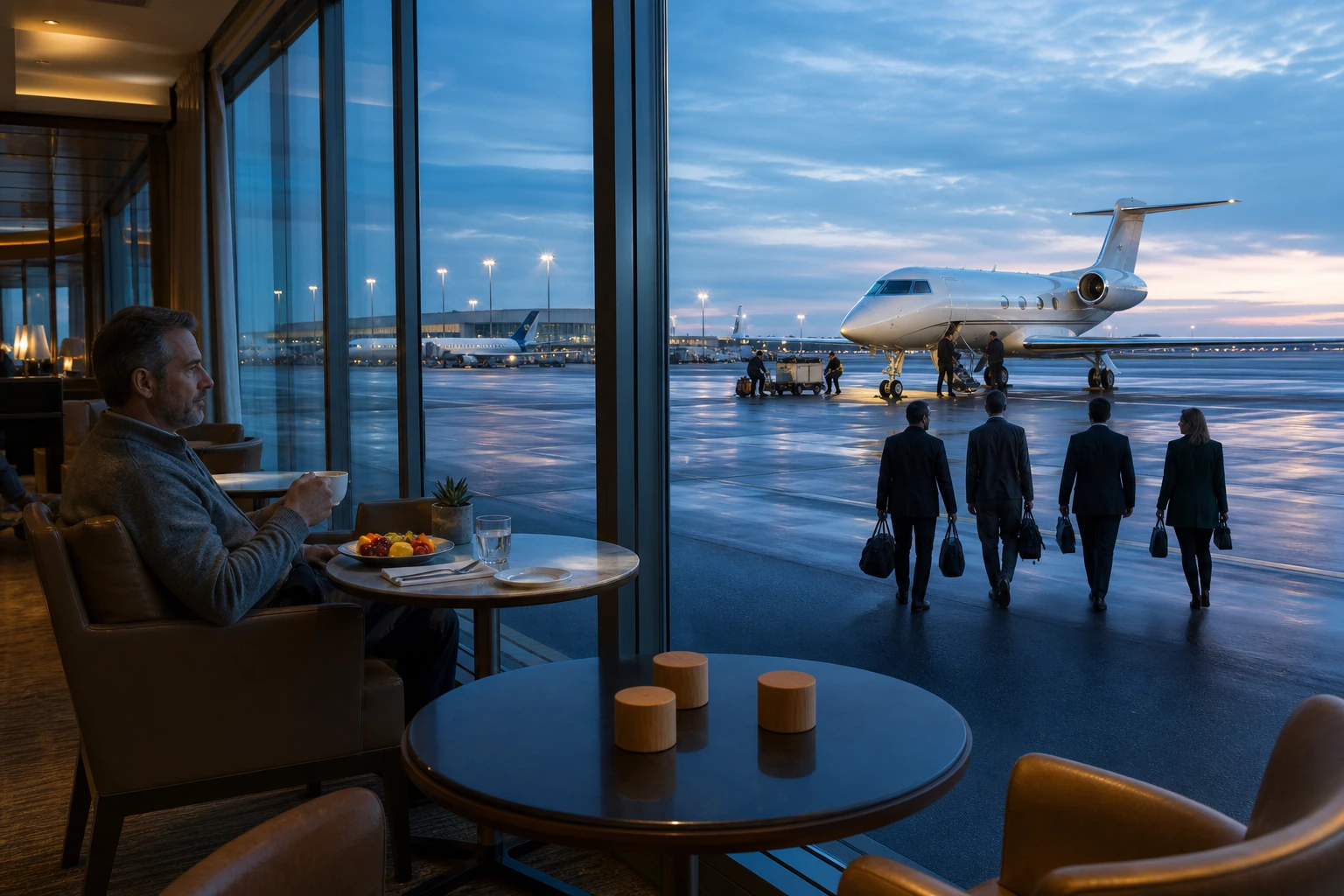
One passenger carries nearly the same aircraft and crew system as a small party. Critical timing or discretion may justify it. For ordinary city journeys, first or business class often offers stronger value.
Cabin, range, baggage and personal requirements
Light, midsize and heavy are broad groups rather than consistent cabins. Height, width, lavatory, seats, noise, Wi-Fi and baggage vary. Exact type and configuration belong in writing.
Passengers, bags, wind, temperature, reserves, runway and alternate airport affect performance. A fuel stop changes time, cost and comfort. The actual operation decides.
Skis, golf bags, sample cases and pushchairs need geometry as well as kilograms. A small aircraft with many seats may have little hold space. Dimensions and quantities should precede the quote.
Documents, entry rules, operator policy, cleaning and airport procedures still apply. Private flying may reduce stress, but species, weight and route must be accepted.
No unfamiliar passengers and a controlled manifest create discretion. Crew, handlers, authorities and airport systems remain involved. Confidentiality should be assessed as a process, not an advertising word.

Private conversation, a table, power and a calmer flow can protect working time. Bandwidth, calls, noise and seating differ by jet. A working day needs technical confirmation.
A normal charter does not automatically carry medical crew, oxygen or certified equipment. Travellers requiring care need a specialised and approved mission. Comfort is not medical capability.
The total price appears in the operation
Occupied time, minimums, positioning, crew, handling, airports, parking, catering, de-icing, tax and night charges may enter. A sound quote gives the total and identifies variables.
If the jet must arrive empty or return after departure, the mission pays for movement the guests never see. A locally based aircraft can cost less despite a higher hourly figure.
Will the aircraft wait, reposition empty or be replaced Crew rest, parking and time between appointments determine the answer. The cheapest structure may also be the least resilient.
Fine food is possible, but galley, flight length, airport and supplier set limits. Special requests and allergies need notice. Luxury means suitable execution, not an imaginary restaurant menu.
Winter can require treatment, repositioning or an alternate airport. Anyone expecting a fixed price needs precise contractual rules for necessary additional operations.

Mechanical or operational issues may require substitution. A smaller hold, different airport or fuel stop is not cosmetic. Permitted category and refusal rights should be defined.
How quickly can replacement be found, who pays the difference and what protects the appointment A broker with market reach may help, but the contract establishes the duty.
The accepted quote identifies the payment counterparty, operator and AOC, aircraft or permitted substitute, known charges, positioning, waiting or overnight logic and the triggers for price changes. It also explains cancellation, delay, mechanical failure, refund and replacement. An appealing hourly figure without these terms is not a total mission price.
Jet cards, scheduled travel and climate responsibility
Programmes may simplify process, price and availability while imposing zones, peak days, minimum hours and aircraft rules. Prepayment is valuable only when provider, agreement and travel pattern align.
A nonstop service, strong lounge, first or business class, driver and fast track can be exceptionally efficient. Where the timetable fits, scheduled aviation offers deep redundancy and better resource use.
Private aviation produces substantial mission emissions and other climate effects. Productivity is not a physical reduction. Impact, necessity, party size and alternatives should be considered separately.

When charter or scheduled travel fits better
| Travel mission | Usually stronger | Reason |
|---|---|---|
| Nonstop city pair, one or two guests, flexible timing | Scheduled first or business | Deep redundancy and better resource use |
| Several guests, secondary airport, fixed appointment | Test full charter | Ground travel and timing risk may fall |
| Several stops in one day | Test full charter | The timetable follows the mission |
| Visible empty sector and flexible traveller | Empty leg only opportunistically | The price advantage depends on the primary flight |
Several travellers, remote airports, complex stops, special baggage, pets, serious discretion or a valuable fixed appointment create functional benefit. The mission should demonstrate it concretely.
One or two guests, a direct premium flight, well-located airports and flexible times usually favour the airline. Declining charter is then not economy, but better travel design.
We calculate the journey before choosing the jet. Operator, airports, cabin, baggage, time, disruption risk and final price must solve a real task. Only then does private aviation become useful logistics rather than an expensive symbol.