
A finca promises space, autonomy and a private rhythm. A luxury hotel gathers service, dining and relief from logistics in one place. Yet labels settle very little: a fully staffed villa may deliver more service than a small hotel, while a spectacular country house may demand more organisation than expected. The right choice follows the occasion and the people, not the more romantic photograph.
Finca and hotel are two operating models
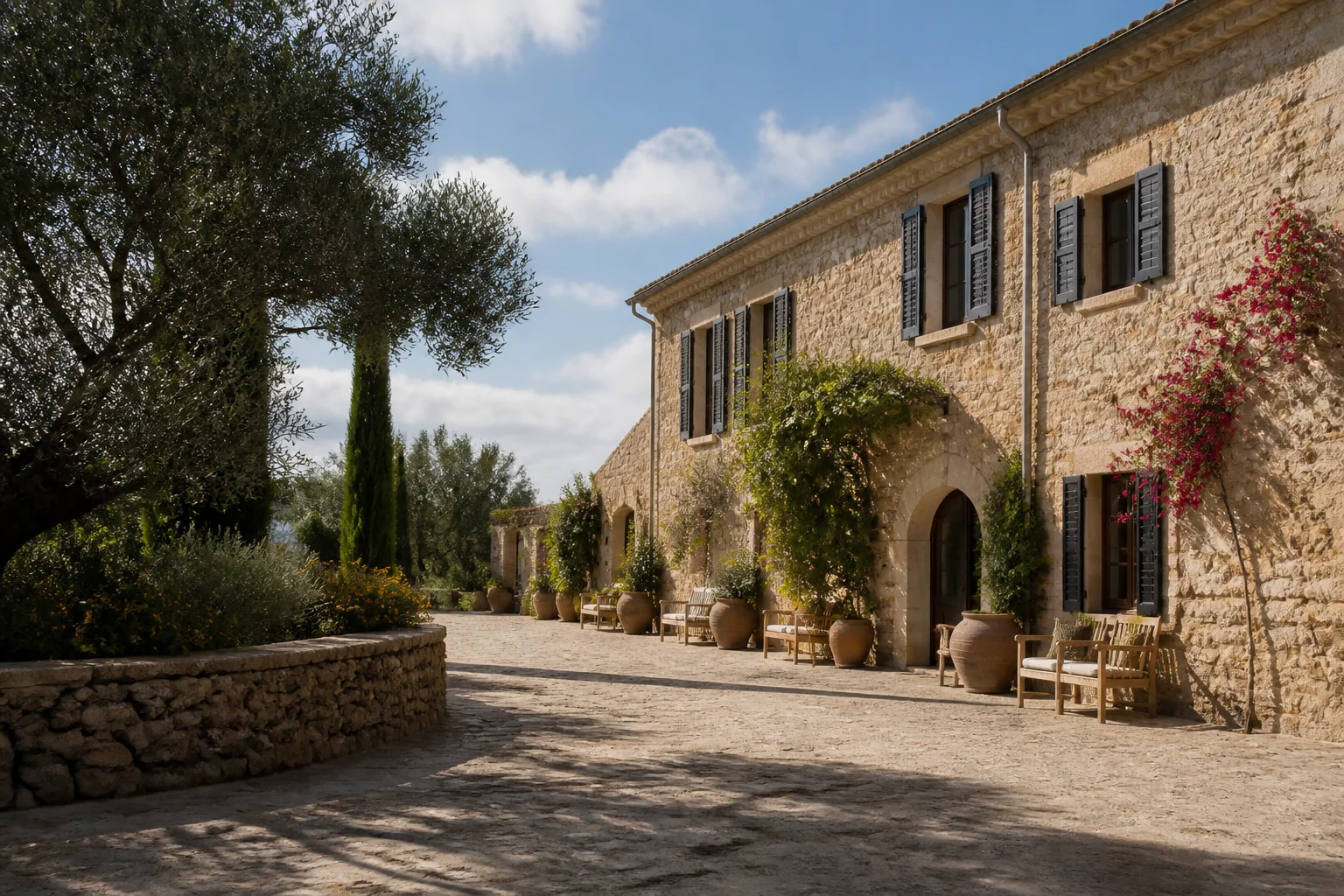
Stone walls, olive trees and a pool say nothing about who brings coffee, solves a late-night fault or secures a last-minute table. Five stars do not guarantee silence or generous private space either. Compare how the stay operates: independent house, serviced villa, agriturismo or integrated hotel. Staff, responsibility and daily flow come first. Architecture and view become meaningful only after that structure is understood.
The short answer: A finca particularly suits families, friends and longer stays when shared space and a self-directed day matter more than on-demand services. A luxury hotel excels for short breaks, couples, wellness, dining and guests who want to hand over the organisation. Between them sits the serviced villa: private, but supported by a precisely defined team.
In Mallorca, the word may describe a historic estate, holiday house, luxury villa or small rural hotel. The label alone cannot support a booking. Establish whether use is exclusive, how many units occupy the estate, when staff are present, what catering exists and who handles emergencies. Guests expecting a private home should not discover on arrival that owners, other travellers or a restaurant share important parts of the property.
Mallorca maintains public records covering tourism businesses, accommodation and homes marketed for tourist stays. The actual property name, address, category and permitted capacity should be traceable. Registration does not certify luxury, but it removes a fundamental ambiguity. Licence reference, contracting party and invoice issuer need to align. Any discrepancy is resolved in writing before money is sent; a platform badge is not adequate evidence.
A three-generation holiday needs different operations from an anniversary weekend for two. Friends may enjoy shopping and cooking together, while an exhausted family needs breakfast and a kids' club. Define who is willing to decide, drive, shop and coordinate. Luxury is neither the absence nor abundance of service in itself. It is the removal of the particular friction that would most disturb this group.
Five controls clarify the choice: Privacy: must the entire estate be exclusive, or is a private suite sufficient Service: what help must be available without notice Community: does the group need its own table and sitting room, or multiple hotel retreats Mobility: how often are beach, Palma and restaurants planned Responsibility: who handles provisions, transport and small failures Once these are ranked honestly,
“finca or hotel” stops being a style debate. The real decision may turn on a driver, pool heating or a service window rather than architecture.
The occasion decides which friction is worthwhile
A couple rarely uses every room of a large house but still inherits its logistics. A hotel makes breakfast, spa, pool care, bar and dinner immediately available, creating spontaneous days without shopping or transport planning. A compact finca can still be right when total seclusion and a private pool are the purpose. Support should then be discreetly on call rather than requiring long notice for every request.
A private villa allows breakfast in robes, uninterrupted pool time and evenings without an audience. A hotel offers a different choreography: prepared suite, spa appointment, aperitif, excellent dinner and return to a refreshed room. Romance depends on the couple. Those who enjoy being looked after may experience self-catering as work; those avoiding every social setting may find even immaculate hotel service too present.
In a finca, naps, kitchen, washing machine and separate living rooms can transform daily life. Pool fencing, stairs, terraces, cots, highchairs and overnight help are not automatic. A family hotel offers a kids' club and several points of assistance but introduces walking and consideration for other guests. Decide by children's ages and supervision needs, not by the imprecise phrase “family-friendly”.
Grandparents, parents and children benefit from shared salons alongside separate sleeping zones. A house prevents family time being confined to restaurant tables and corridors. It works only if some rooms are on the entry level, bathrooms are safe and night routes are lit. A resort with connecting suites may be better for mobility. The ideal plan creates closeness without compulsion and retreat without difficult stairs.
A finca is strong when ten friends want to dine together, play music and use their own pool. Bedrooms are rarely equal, however. Cost allocation, master suite, single occupancy, provisions and drivers should be settled early. Hotels solve inequality through clear categories and individual bills, but fragment the gathering. A staffed villa may combine both benefits if service hours and gratuities are transparent.
A birthday, wedding or anniversary changes visitor count, music, catering, parking and liability. Permission to rent a property for holidays does not automatically permit an event. Owner, operator and any relevant authority must approve it in writing; local noise and safety rules remain. Hotels have established event systems but also curfews and minimum spend. Sending invitations before securing permission makes the entire occasion vulnerable.
Across three nights, shopping, house handover, driving and checkout weigh disproportionately. A strong hotel turns the first hour into holiday time and keeps spa, dining and concierge immediately available. A finca can still succeed when it is close to the airport, fully prepared and gives the group a clear shared purpose. Usable time matters more than a theoretical price per bedroom.
Stable Wi-Fi is required throughout the house, not only beside the router. Add desks, supportive chairs, mobile signal, printing, quiet video-call zones and a power-failure plan. A hotel offers technical help and alternative workspaces but perhaps less acoustic privacy. A finca gives a team room while demanding evidence of performance. “High-speed internet” without measurement or backup is not a business-ready product.
Hotel, finca or serviced villa
Reception, housekeeping, engineering, spa, restaurants, drivers and concierge work inside one system. That makes change easier: later breakfast, a rainy-day massage or a midnight replacement key. The trade-off is other guests, set opening hours and less exclusivity in shared areas. The best hotel is not the one with the longest service list, but the one whose operation matches the guest's actual day.
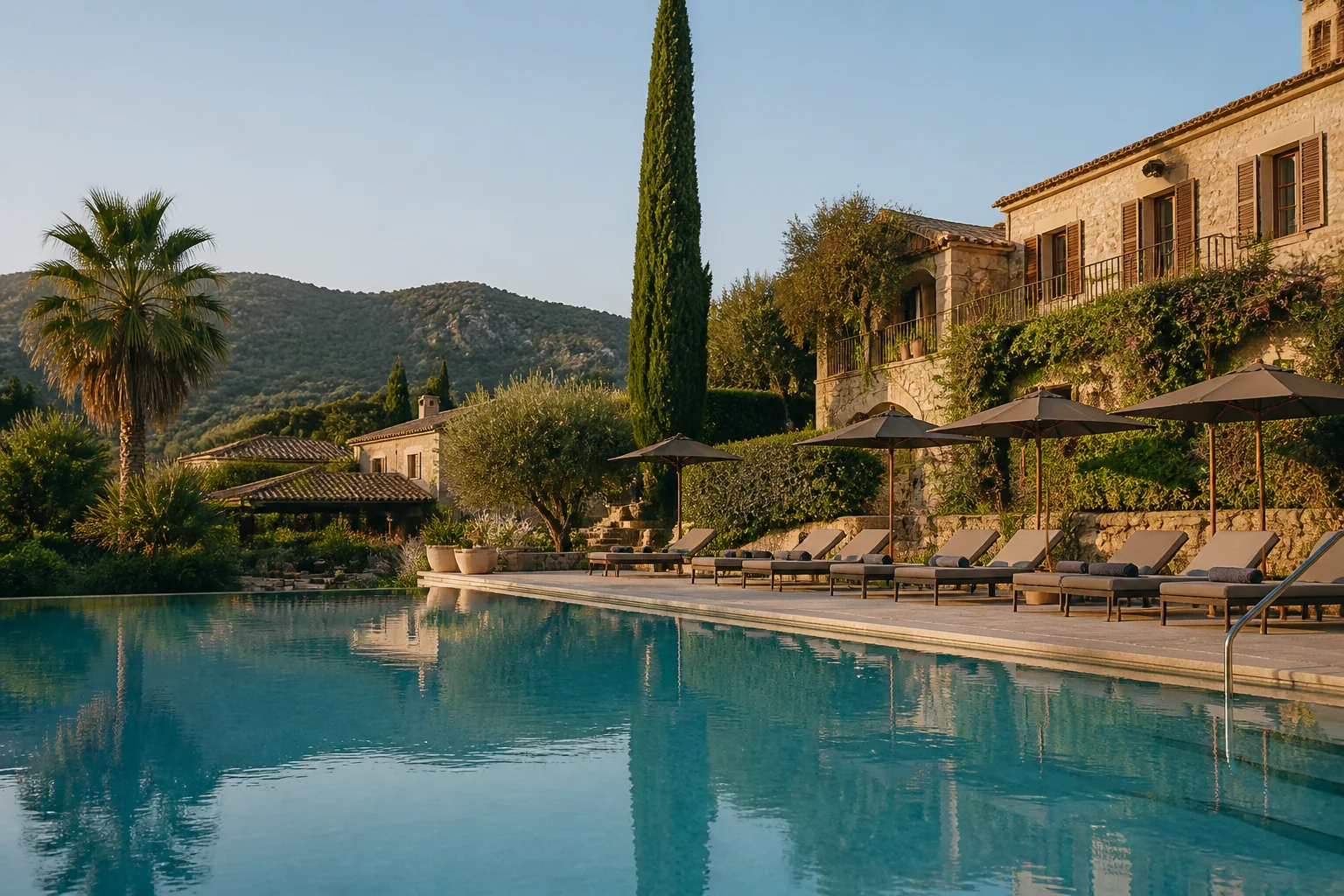
No one queues for a pool chair or reaches breakfast before closing. Children can eat inside, friends linger at the table and music remains private within agreed rules. Freedom generates small decisions about coffee, ice, bins, keys, temperature and driving. A house feels luxurious when those responsibilities are resolved invisibly. Without that support, privacy can quickly become self-management.
It combines exclusive use with contractually defined support. Son Bunyola, for example, publishes daily housekeeping, 24-hour concierge help, a simple breakfast provision and heated private pool for one villa; another is normally self-catering, with all-inclusive only on request. The contrast makes the principle clear: inspect service house by house. A branded estate does not guarantee an identical package in every villa.
Staff and local reach define the service
“Daily housekeeping” may cover beds, bathrooms and light cleaning but not laundry or a kitchen after dinner. Confirm team size, entry times, turn-down, towels and weekends. Some guests want invisible morning service, others complete quiet. Staff should not move unexpectedly through private areas, while the operator needs defined access for maintenance and emergencies. A written routine prevents friction on both sides.
A domestic kitchen is not automatically equipped to serve twelve guests professionally. Refrigeration, tableware, worktop, extraction, delivery route and cleaning shape the possible menu. A chef may cover selected dinners, daily breakfast or full board; shopping and drinks are billed in different ways. Hotels have established kitchens and several venues. For allergies or complex diets, the documented preparation chain matters particularly.
A villa manager can arrange drivers, boats, groceries and restaurants, but cannot create a table in every fully booked room. Ask whether the concierge is on the island, centralised or office-hours only, and who answers overnight. Hotel teams often hold long partnerships while serving many rooms. In both models, important reservations are secured before arrival. Concierge solves problems; it cannot repeal capacity.
Pool, rooms, location, quiet and security
The pool in a photograph may be cold in April, unlit or unsecured for young children. Confirm heating, target temperature, supplement, operating months, depth, alarm or fence, cover and night lighting. A hotel may supervise the area with staff, although not necessarily a lifeguard. In a finca, responsibility sits more heavily with the group. Equipment never replaces attentive adult supervision.
Historic houses often have a superb principal room and smaller secondary bedrooms with different bathrooms, cooling or access. A ten-person property may not accommodate five couples equally well. Request floor plan, bed dimensions, bathroom allocation, blackout and images of every room. Hotels offer more standardised categories but can scatter families across floors. The real room matrix matters more than maximum occupancy.
Gravel, old steps, narrow doors and slopes are part of Mallorca's character but may restrict movement. A level bedroom is insufficient if pool, dining terrace or driveway remains inaccessible. Hotels more often provide lifts and designated rooms, yet historic sites can also be complex. Confirm door width, grips, shower, gradient and vehicle access. “Suitable for older guests” is not a useful specification.
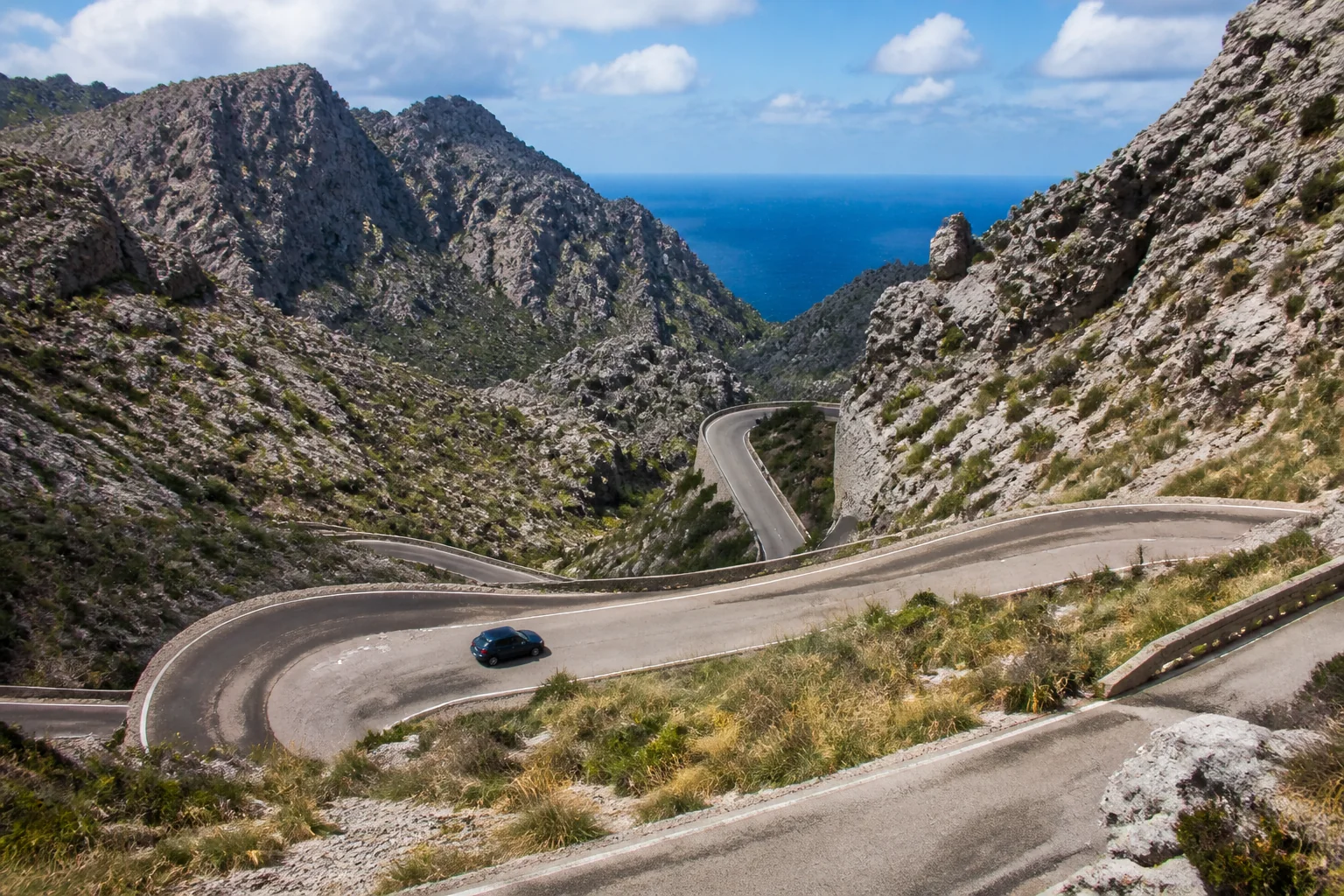
A peaceful inland finca may sit 20 minutes from a good restaurant, beach or supermarket. Mountain roads around Deià and Valldemossa create different journey times from an address near Palma. Hotels consolidate facilities or occupy a walkable settlement. Plot every intended movement: breakfast supplies, beach, dinner, market and return. If a daily driver creates the desired freedom, include one in the true price.
“Near the sea” can mean a view, a steep footpath or 15 minutes by car. Private coastal access should not be confused with a private beach. An inland finca with pool serves a different holiday from a waterfront hotel with bathing platform. Check walk, gradient, parking, shore type, shade and seasonal services. Anyone intending to swim daily should not book from an aerial photograph alone.
Restaurants, galleries and bars are walkable from a well-placed Palma hotel. From a rural finca, every evening becomes a transport exercise; one guest should not have to be permanent driver. Pre-arranged cars are valuable in high season and late at night. A coastal resort reduces outside travel when its dining is strong. Decide whether nightlife is part of the core product or an occasional excursion.
Seclusion does not guarantee silence. Cockerels, dogs, farming, roads, aircraft routes and village festivals belong to island life. Hotels add deliveries, events, pools and neighbouring rooms. Ask about current noise and works without demanding impossible guarantees. For sensitive sleepers, bedroom position, windows, cooling and blackout matter more than the phrase “untouched countryside”.
A hotel keeps staff, replacement keys and engineering assistance available around the clock. A finca manager may be 30 minutes away. Confirm alarm, safe, exterior lighting, gate, first aid, emergency number and response time. Concierge is not medical assistance. Families also examine pools, windows, roof terraces and property boundaries. Discretion is no reason to leave safety procedures vague.
Complete cost and the decision before deposit
A finca rate spreads across bedrooms and can look attractive for groups. Add final cleaning, deposit, energy, pool heating, groceries, chef, staff, drivers and agency fees. A hotel includes housekeeping and infrastructure while suites, restaurants and spa raise spend. Compare the same guest count, bathrooms, meals, driving and cancellation terms. An unused room is paid space, not value.
Two nights in Palma and five in a finca pair spontaneous city evenings with private rural life. A coastal hotel plus Tramuntana villa creates sea and mountains. The move is worthwhile when contrast is real and each stop receives several nights. On a short trip, packing twice breaks the rhythm. Luggage, rental car and check-in times should be synchronised so the transfer does not consume a day.
Verify registration, exact address, exclusive use, capacity, floor plan, staff hours, cooling, pool, Wi-Fi, security, noise, road access and distance to planned places. Put total price, deposit, cancellation, damage, event permission and local contact in writing. For hotels, add connecting-room confirmation, opening dates and renovation work. A high-quality booking makes the operation as clear as the images.
A finca does not win automatically through privacy, nor a hotel through five stars. The decision rests on which responsibilities the travellers want to carry. For shared space and a private rhythm, an excellent house is difficult to beat; for short, culinary or wellness-led journeys, a hotel liberates. The most sophisticated answer may be a staffed villa. Deluxetargets chooses the operating model first, then the address.