
Three nights can be an excellent wellness stay. They are not an Ayurveda course. A meaningful duration follows the objective, medical intake, intensity, response and follow-up rather than a universal number. Official programmes at established retreats range from five or seven nights for an introduction to 21 or 28 days for intensive panchakarma formats. Longer is not automatically better; it needs clinical justification and a daily routine the guest can genuinely follow.
The honest short answer
- 3–5 nights
- Rest, orientation and a small number of mild treatments; useful as wellness, but not a credible substitute for a complete course.
- 7 nights
- A structured introduction with consultation and daily rhythm; appropriate for gentle programmes, not automatically for panchakarma.
- 10–14 nights
- More time for adaptation, review and a coherent restorative plan.
- 21–28 days
- The range published by selected physician-led properties for intensive panchakarma programmes, only after careful suitability assessment.
Nights in residence are not treatment days
A seven-night package includes arrival and departure. The first consultation may occupy part of arrival day and the final review the last day. Some treatments cannot begin until the physician has completed the intake. The confirmation should therefore state not just nights but actual consultation and treatment days.
Travel time also belongs in the equation. Someone arriving exhausted after an overnight flight is not necessarily ready for an intensive schedule. Some retreats require arrival by a particular time; Santani, for example, publishes a 2pm arrival requirement for its Personal Dosha programme. An early check-in, quiet first night or pre-stay may be more sensible than filling the first day to capacity.

3 to 5 nights: meeting the method and the property
A short stay can reset sleep, meals, yoga and a few treatments. It allows a guest to learn how the retreat works, meet the physician and discover whether the routine is tolerable. For a first experience or as one part of a longer journey through India or Sri Lanka, that can be an honest format.
The problem begins when a hotel promises “complete detoxification” or major medical change within that period. A short experience should remain mild and be described as wellness or introduction. Santani’s published Personal Dosha offer begins with a five-night minimum – an example of an individualised entry point, not a universal healing duration.
7 nights: structure with little reserve
A week permits intake, several consecutive programme days and a final conversation. Ananda officially offers a number of programmes for seven, 14 or 21 nights, demonstrating that seven nights can be a recognised product tier. It does not show that every medical objective can appropriately be addressed in one week.
The week works best for a restorative, stress-oriented or introductory format where the responsible doctor agrees. There is little spare time if treatments need adjustment or interruption. Excursions, work calls and nightly restaurants remove the very time intended to make the programme coherent.
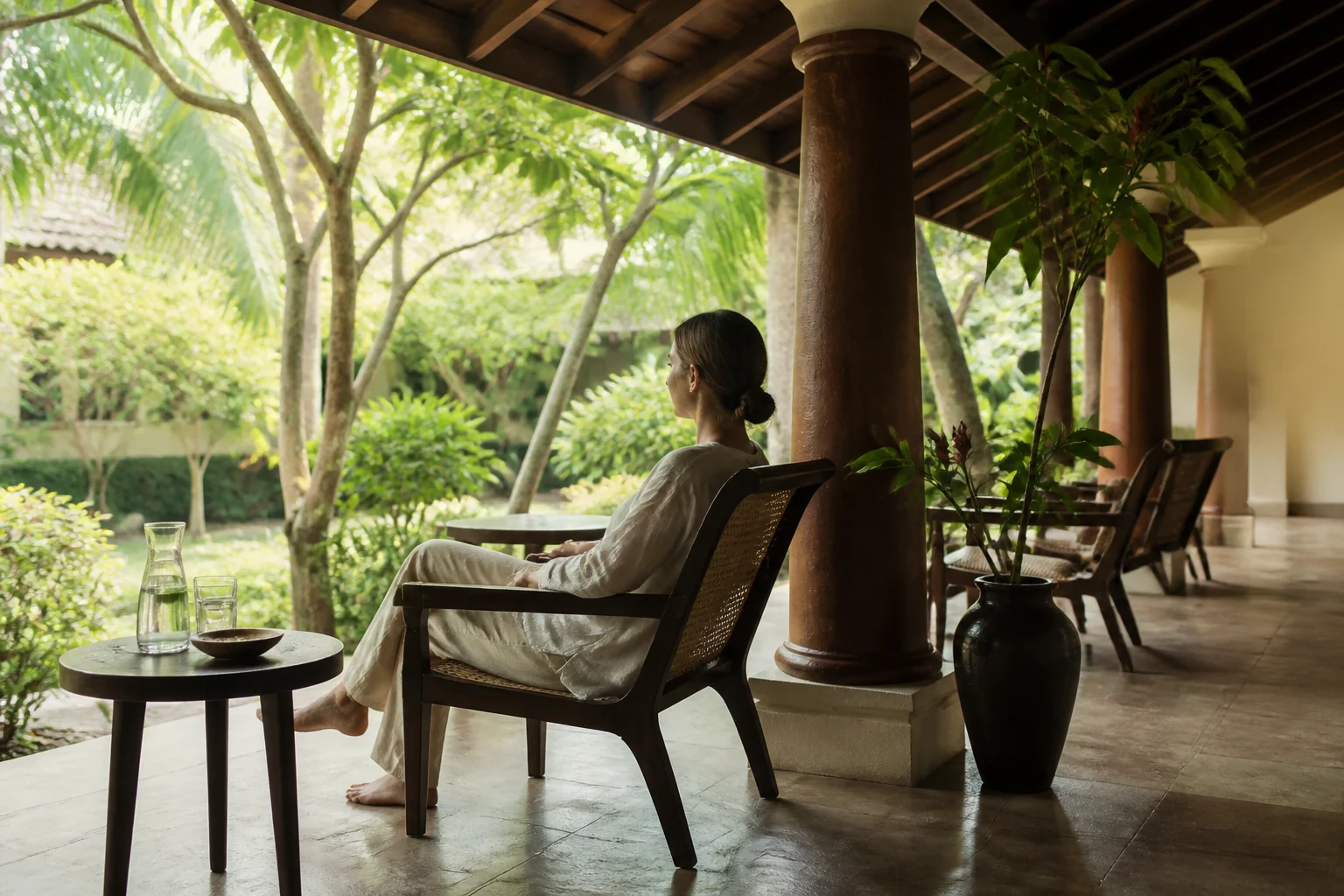
10 to 14 nights: the realistic middle for many luxury travellers
Ten to 14 nights create a complete travel arc without pretending to be a long clinical course. Early days allow intake and adjustment, the middle supports a regular plan, and the end leaves room for review and transition. For sleep, stress, movement routines or physician-supervised rejuvenation, this period can be more operationally credible than one week.
It still requires discipline. A luxurious room does not change the relationship between meals, sleep and treatments. A guest intending to work every day, drink alcohol or tour several sights should choose a lighter wellness programme rather than dilute the rules of a treatment course.
21 to 28 days: panchakarma is not a long spa holiday
Six Senses Vana describes a 21-night Ayurveda Panchakarma. CGH Earth publishes a 21- to 28-day duration for its panchakarma treatment. Those lengths arise from the structure of the individual programmes and the physician’s assessment. They should not be read as blanket recommendations for every guest.

An intensive programme may have preparatory, central and recovery phases. Food, activity and daily rhythm become more restricted, and some traditional procedures are unsuitable for certain people. A serious property refuses a requested treatment when intake argues against it. Paying for 28 days does not buy a right to maximum intensity.
Working during such a stay can conflict with the purpose of rest. Conference calls, time zones and continuous decisions disrupt sleep and recovery. Device rules, connectivity, visitors, companions and the possibility of switching to a lighter programme should all be understood in writing.
| Duration | Realistic purpose | Main limitation | Appropriate format |
|---|---|---|---|
| 3–5 nights | Rest and introduction | Little time for review or adjustment | Destination spa or mild programme |
| 7 nights | Structured start | Arrival and departure reduce treatment time | Physician-supported wellness programme |
| 10–14 nights | Coherent restorative work | Requires real separation from daily life | Retreat with reviews and a continuation plan |
| 21–28 days | Intensive multi-stage programme | Not medically suitable for everyone | Qualified physician-led Ayurveda institution |
The duration is assessed before payment
A serious provider requests a health questionnaire and may require a physician call or records before arrival. Chronic conditions, current symptoms, surgery, allergies, pregnancy and every medication or supplement need full disclosure. The retreat should explain how the information is held confidentially and who can access it.
Conventional medical access matters as much. How far away is an appropriate hospital Who decides on transfer Is a physician reachable at night Which travel insurance covers a pre-existing condition or programme interruption A beautiful treatment room answers none of those questions.

Recovery belongs in the booking
A long-haul flight only hours after the final intensive treatment may create an unnecessarily hard transition. Whether a recovery interval is medically necessary is for the physician to decide; it should at least be discussed in planning. A quiet airport hotel night or gentle final day may be more appropriate than an immediate travel marathon.
After the return, a good programme supplies realistic instructions: which dietary elements are practicable, which products are meant to continue, which symptoms require medical review and when follow-up occurs. Advice should be written and compatible with existing conventional care.
What belongs in the price comparison
- Nights, actual treatment days and number of physician consultations.
- Which treatments are included and which remain subject to intake.
- Food, preparations, laboratory work, transfers and follow-up.
- Cost if the programme is medically reduced or changed.
- Cancellation after physician refusal or acute illness.
- Accommodation for a companion and access to meals or yoga.
- Extra nights before treatment begins or after it ends.
Duration red flags
Exercise caution when a property sells intensive panchakarma without health screening, names the same duration for every diagnosis, guarantees cure or advises stopping conventional medicine. Unclear product lists, invisible physician credentials and no emergency pathway are equally serious concerns.
The World Health Organization defines minimum practice standards while NCCIH notes limited evidence for many conditions and possible risks from some preparations. A retreat cannot resolve that tension through marketing. It has to manage it professionally.
The Deluxetargets view
Five to seven nights may be sufficient for a first gentle experience. Ten to 14 nights often make a more honest plan for a coherent restorative stay. Twenty-one to 28 days belong in a qualified physician-led institution and assume that the person, objective and daily life suit the programme.
The correct duration is not maximised according to budget. It is limited by suitability, programme depth, recovery and a safe return. Luxury means having enough time – and knowing when less is the more responsible choice.