
Bora Bora is one of the rare destinations where the wrong villa can disappoint despite a perfect view. A celebrated resort name and a jetty above turquoise water are not enough. Orientation, wind, privacy, water depth, distance from the main facilities and the resort’s natural rhythm determine how the stay feels. Resolve those details before booking and the journey becomes more than the postcard seen on the first morning.
The decisions that matter
- 4 nights
- The minimum for a focused stay; after a long journey there is little resilience for weather or fatigue.
- 5–6 nights
- The best default for the lagoon, unstructured time, one or two meaningful experiences and genuine rest.
- 7 nights or more
- Right for very slow travel, families or an exceptional villa; otherwise combine Bora Bora with Taha’a, Moorea or a Tuamotu atoll.
- The essential question
- Not “Which is the best hotel?” but “Which location and villa type suit this particular guest?”
Geography determines the character of the stay
Bora Bora is formed by a volcanic main island crowned by Mount Otemanu, a protected lagoon and an outer reef dotted with motu. Many luxury resorts occupy those islets and look back towards the mountain. This creates the famous perspective, but also separates guests from Vaitape and from spontaneous evenings at local restaurants.
A resort on the eastern lagoon can frame Otemanu with great drama. A southwestern position may prioritise sunset and open horizon instead. Main-island accommodation makes local access easier, while a motu works as a self-contained resort world. Neither is inherently superior; each answers a different intention.
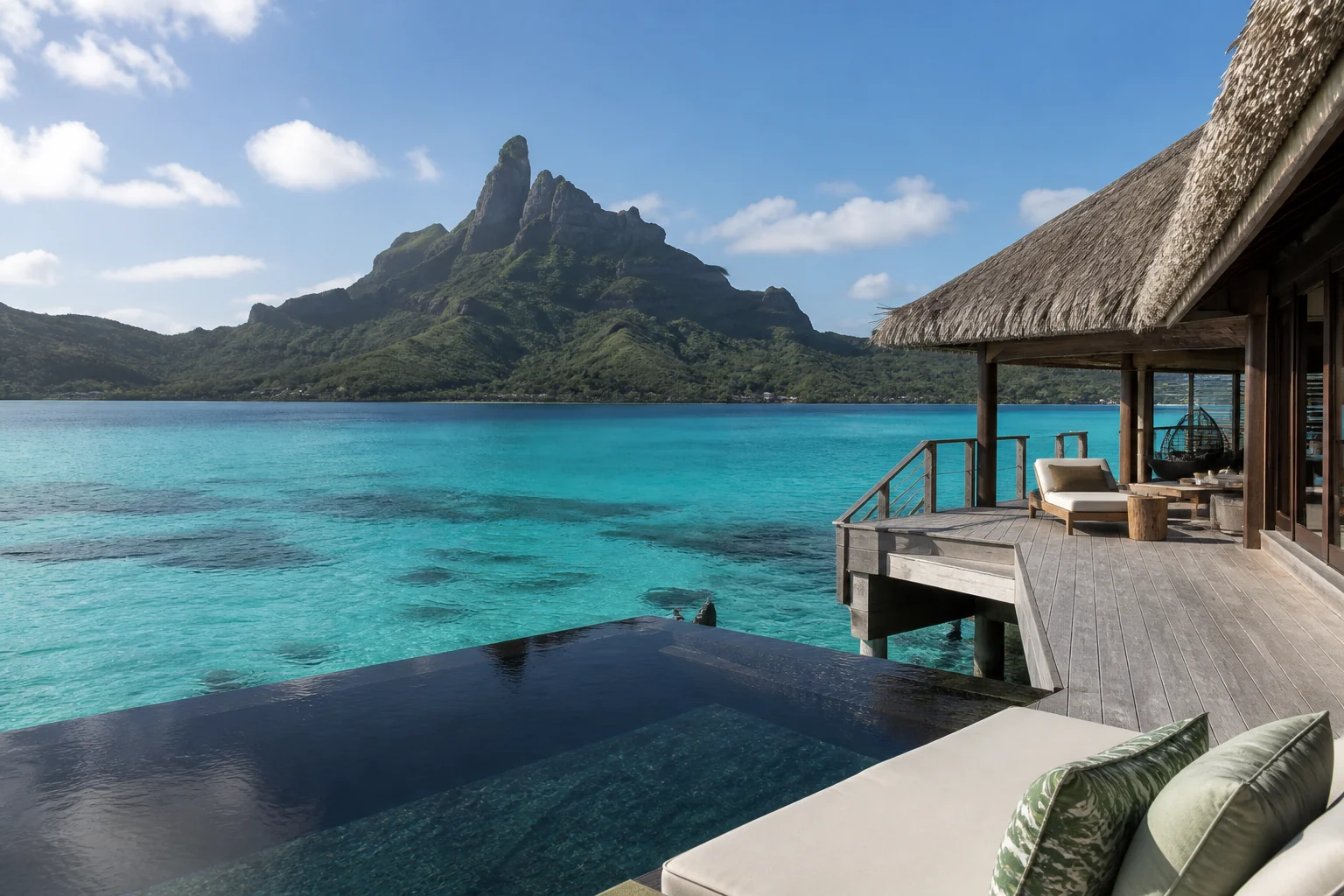
Overwater villa or beach villa
The overwater villa is Bora Bora’s emblem. It offers direct lagoon access, broad views and the improbable morning light for which many guests travel. It can also be windier, require a long walk along the jetty and offer less privacy than photographs imply. Water below a private deck is not automatically the resort’s finest snorkelling area.
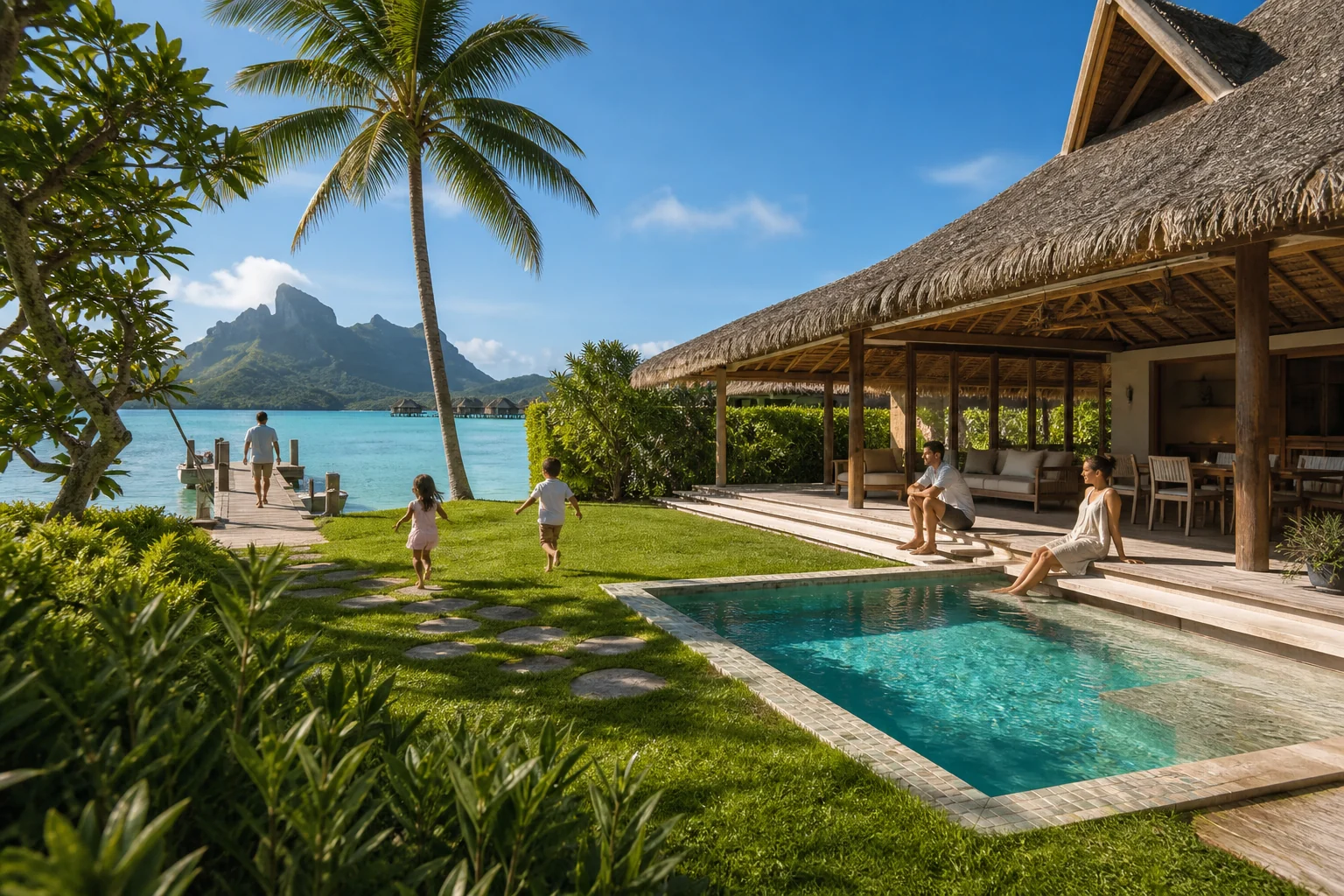
A beach villa is often the stronger choice for families, guests with limited mobility or travellers who value a substantial pool, garden, sand and true indoor-outdoor space. It may be more protected in strong winds and does not place children directly above deep water. The trade-off is the loss of that permanent suspended-over-the-lagoon sensation.
On longer stays, a planned split between overwater and beach can work, provided the move does not consume half a day.
| Villa choice | Principal strength | Verify | Best suited to |
|---|---|---|---|
| Otemanu-view overwater | Iconic mountain composition | Privacy, sun path, wind and boat traffic | First visits, photography, honeymoon |
| Sunset overwater | Evening light and horizon | Limited mountain view, afternoon heat | Couples, quiet evenings, long terrace time |
| Overwater with pool | Lagoon plus private cooling | Pool size, shade and overlooking | Guests who do not want every swim in the lagoon |
| Beach villa estate | Space, sand, garden and larger pool | Beach footfall, view and distance | Families, friends, longer stays |
| Hillside or garden | More land-based atmosphere, sometimes superb views | Steps, distance and no direct water entry | Value-led luxury or a split stay |
The resort map matters more than the category name
Two villas in the same category can feel entirely different. One sits at the end of a pontoon with open horizon; another is close to a restaurant, service route or landing stage. One faces Otemanu head-on, another looks diagonally past neighbouring decks. An advisor should therefore rank practical priorities rather than simply request “Otemanu View”.
- Morning or evening sun; mountain composition or open sunset.
- A wind-protected deck and enough afternoon shade.
- Distance from main jetty, restaurant, boat channel and service traffic.
- Water depth, current, ladder and usability at low tide or in rougher conditions.
- Sightlines from boats, neighbouring terraces and public areas.
- Long walk to the resort centre versus desired seclusion.
- For families: rails, lockable doors, pool security and direct-water risk.
Four Seasons and St Regis: Otemanu, consistency and large villas
Four Seasons Resort Bora Bora occupies Motu Tehotu and places Mount Otemanu views at the centre of its identity. Accommodation ranges from overwater bungalow suites to two- and three-bedroom beachfront villa estates. The resort can therefore serve not only honeymooners but families and private groups.
The Otemanu Overwater Bungalow Suite with Plunge Pool combines direct lagoon entry and a private pool; beachfront estates prioritise gardens, substantial pools and secluded beach space. A protected lagoon sanctuary, marine-biologist-led discovery and private motu dinners add structure. Four Seasons works particularly well when service consistency and broad facilities matter more than a deliberately tiny hideaway.
The St. Regis Bora Bora Resort combines overwater bungalows and land villas with a private-island spa, Lagoonarium, several restaurants and bars. Its official villa information includes one- and two-bedroom overwater options with private pools or whirlpools. It is a compelling choice for travellers seeking substantial living space and a complete resort programme.
Scale is both strength and potential weakness. Guests seeking absolute intimacy need especially careful villa positioning; those who value dining, spa and activity choice may find the infrastructure reassuring. Here, the right villa is chosen not only by square metres but by distance and sightline.
Conrad and Westin: sunset or emphatic overwater design
Conrad Bora Bora Nui is set at the southwestern end of Motu To’opua. Its experience is consequently oriented towards open horizon and sunset rather than the classic frontal Otemanu postcard. Hilton identifies two-storey overwater villas, pool villas and hillside suites; the large infinity pool also celebrates the evening view.
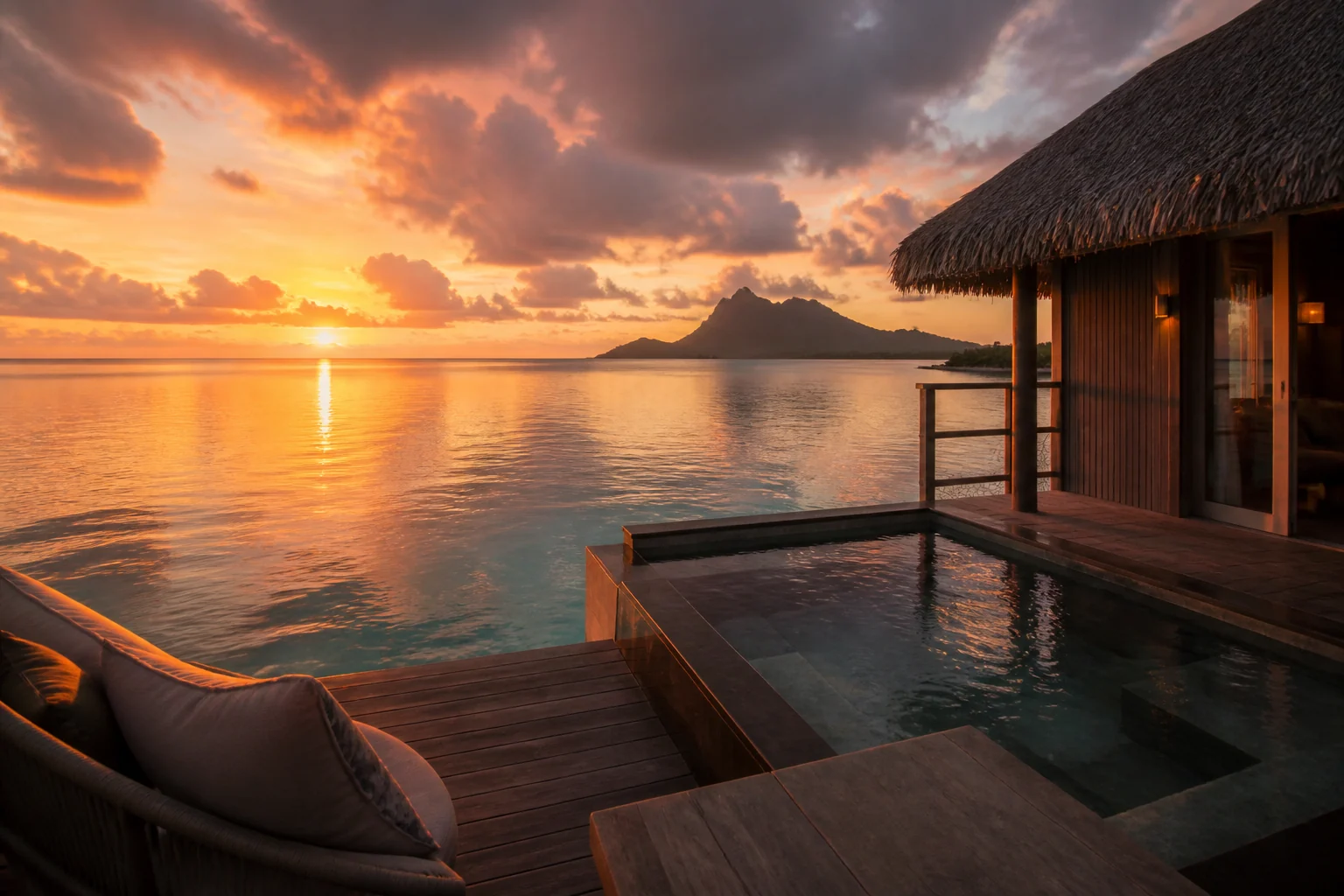
This resort suits guests drawn to contemporary villa design, dramatic sunsets and a self-contained cove. Anyone expecting Mount Otemanu directly in front of the deck must examine category and orientation carefully. “Bora Bora view” is not a standardised promise.
The Westin Bora Bora Resort Spa is a current, modern option. Marriott describes it as offering the island’s largest number of overwater bungalows; its room information states that 62 overwater bungalows and villas have private plunge pools. Beach villas and a turtle sanctuary broaden the offer.
The quantity of overwater inventory creates choice, but makes exact pontoon position even more important. Westin suits travellers wanting contemporary design, wellness and a larger resort. Guests seeking boutique intimacy should not book solely because the hardware is new.
The journey does not end at the airport
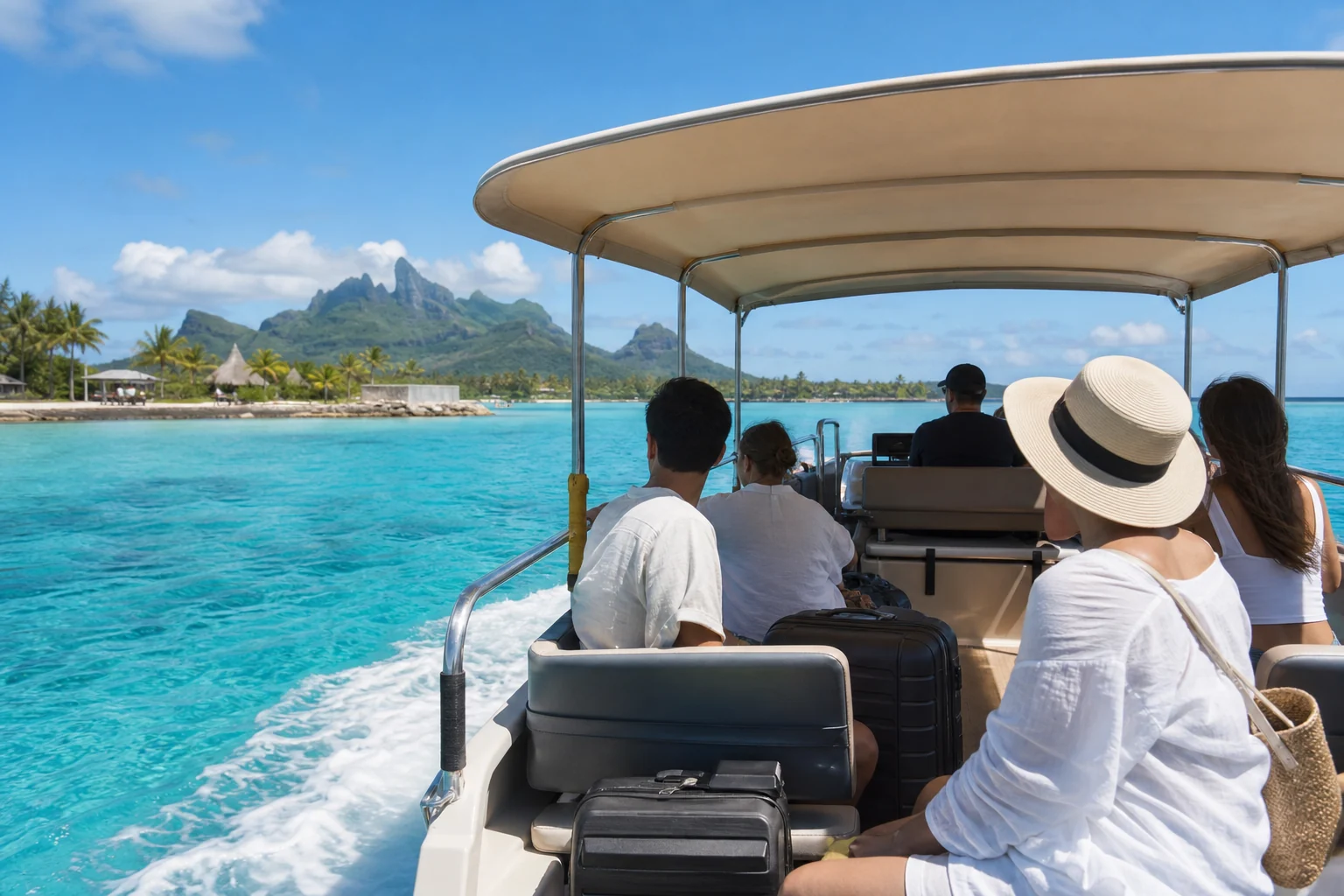
An international arrival in Tahiti is followed by a domestic flight to Bora Bora. Tahiti Tourisme gives approximately 50 minutes for a direct service and up to 90 minutes when the flight stops en route. Bora Bora’s airport sits on a small motu. A public shuttle crosses to Vaitape, while many luxury-resort guests are met directly by resort boats.
The final boat sector must appear clearly in the proposal: price, baggage policy, private or shared operation, waiting time and the procedure after a delayed flight. Arriving after dark loses the landscape of the first crossing, though a well-managed welcome can still be comfortable. Nothing fixed should be booked for the first evening after a long-haul journey.
Five experiences worth leaving the villa for
- A private lagoon journey with an excellent naturalist: choose snorkelling sites for conditions rather than follow an inflexible circuit.
- Marine biology instead of animal theatre: understand coral and lagoon ecology; never touch, feed or crowd wildlife for photographs.
- A motu lunch with time: one beautifully handled long lunch is preferable to three rushed boat stops.
- Sunset on the water: especially worthwhile when the villa faces morning light or the mountain.
- The main island with a local guide: Vaitape, Matira and island history provide context beyond the resort.
Helicopters, jet skis and large group excursions may be exciting, but they also alter the lagoon’s atmosphere. The best activity is not necessarily the most expensive; it reveals what cannot be understood from the private deck.
When to travel
Official tourism guidance distinguishes a drier, less humid season from May to October and a warmer, wetter period from November to April. Temperatures remain tropical year-round; the drier months also attract higher demand. Wet-season showers can be brief, but may equally change several planned hours on the water.
Wind matters at least as much as rain. An exposed deck can become markedly less usable on individual days. Festive dates, honeymoons tied to a specific week and coveted villa positions should be booked early. Weather, visibility and a glass-calm lagoon can never be guaranteed.
A well-paced six-night stay
- Day 1: boat arrival, settle into the villa, early evening.
- Day 2: an unscheduled lagoon day.
- Day 3: private lagoon journey and long motu lunch.
- Day 4: spa, resort and a free afternoon.
- Day 5: main-island or guided cultural visit; sunset cruise.
- Day 6: weather reserve and final full villa day.
- Day 7: boat and flight with a robust onward buffer.
The schedule is intentionally light. Booking a boat excursion every day means paying for an extraordinary villa while barely inhabiting it.
When another island is the better answer
Bora Bora excels at visual drama, refined lagoon resorts and special occasions. Taha’a, Huahine or Moorea may suit deeper everyday contact, independent exploration or smaller-scale hospitality. Serious divers often gain more from a Tuamotu atoll. Tetiaroa presents another interpretation of the secluded private island.
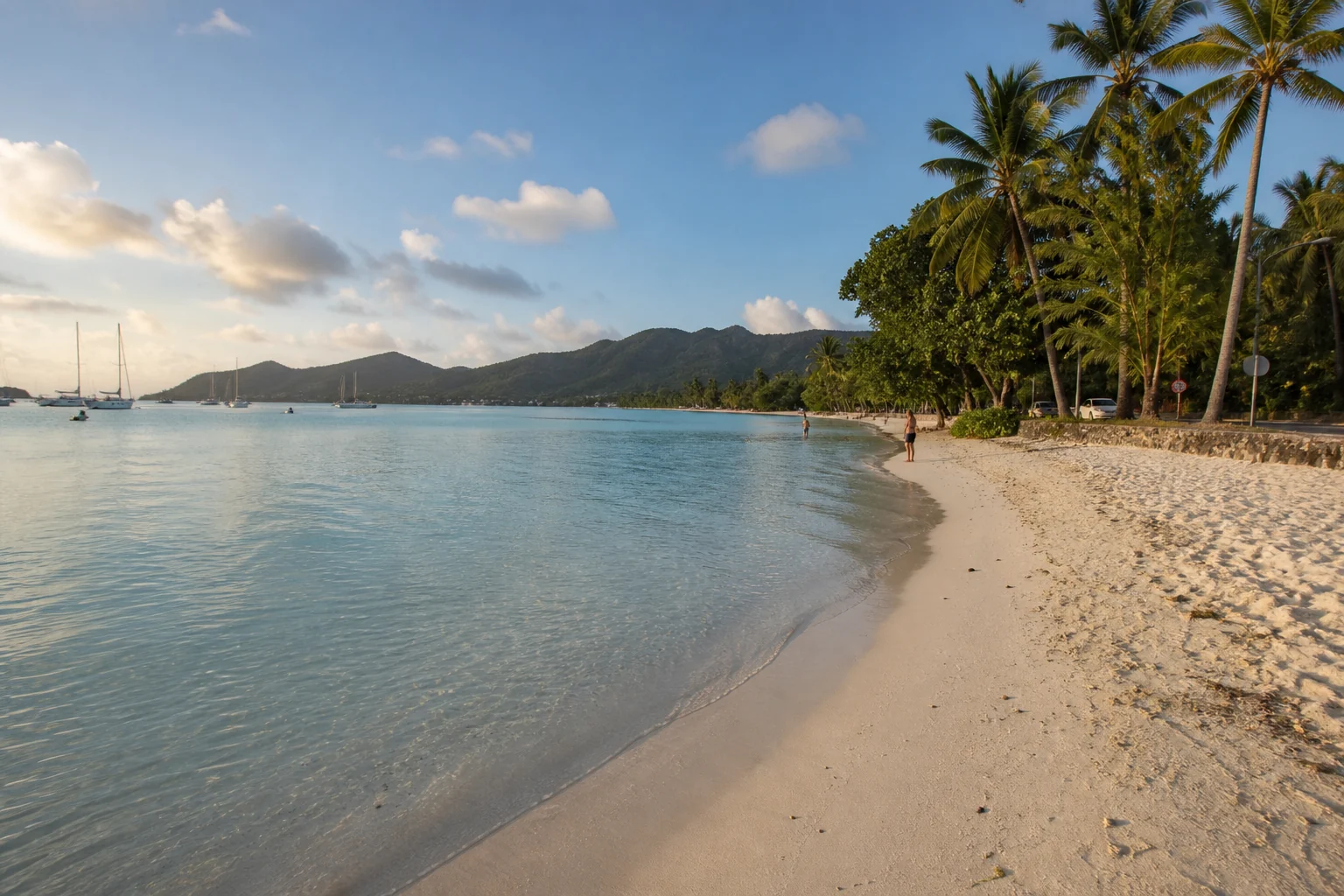
The most elegant French Polynesia itinerary often combines functions: one island for landscape and local life, Bora Bora for the iconic lagoon and—when time allows—an atoll or private island for contrast. Bora Bora does not need to do everything.
The Deluxetargets recommendation
We would first establish five or six nights, the desired view and the daily rhythm. We then compare Four Seasons, St. Regis, Conrad and Westin by the role each plays for the specific guest, never as a generic ranking. Only after that comes villa category—and within it, the positioning request. In Bora Bora, true luxury is not the costliest label.
It is a terrace that reveals precisely the right view at precisely the time the guest wants to be there.