
An overwater villa can be magical for a family. It can also turn a holiday into continuous surveillance. The decision is not settled by price or a universal minimum age. It depends on the individual child, the exact floor plan and how easily water can be reached at night, unseen or in one impulsive moment. The most luxurious family villa is the one whose architecture does not fight the parents.
Permitted is not automatically suitable
Overwater can work with water-confident older children who follow safety rules reliably, especially in a category designed for families. A beach villa is often calmer for toddlers, non-swimmers, sleepwalkers, highly impulsive children or siblings with very different abilities. Permitted occupancy or a signed waiver establishes that a booking is allowed; it does not prove that the accommodation suits your family.
Age, occupancy and liability policies vary by resort and category. One&Only Reethi Rah currently permits families with children in all Water Villas, but its booking terms require a legal waiver at check-in. That distinction matters. The room can be sold while parents explicitly accept the water exposure. A responsible recommendation must therefore go beyond the booking engine.
Age reveals surprisingly little. Does the child stop immediately when asked Do they climb, wander or experiment with locks Can they orient themselves after an unexpected fall Do they sleep soundly in unfamiliar rooms How does jet lag affect behaviour Parents know these answers better than any age threshold, and an advisor should ask before naming a villa.
Sea depth, current, waves and a sudden fall differ from a lesson pool. The World Health Organization associates children's interaction with water outside active adult supervision with increased drowning risk. The CDC recommends close supervision even when lifeguards are present. Swimming ability, barriers and properly fitted life jackets are valuable layers; none gives permission for unsupervised access.
“We will watch them” sounds straightforward until one adult showers, another opens luggage and a child finds the terrace. A suitable villa makes responsibility easier through clear sightlines, manageable doors and a limited number of water exits. If the adults must constantly divide attention among a pool, deck, ladder and several bedrooms, the plan is demanding by design.
Terrace, rails, water access and sleep plan
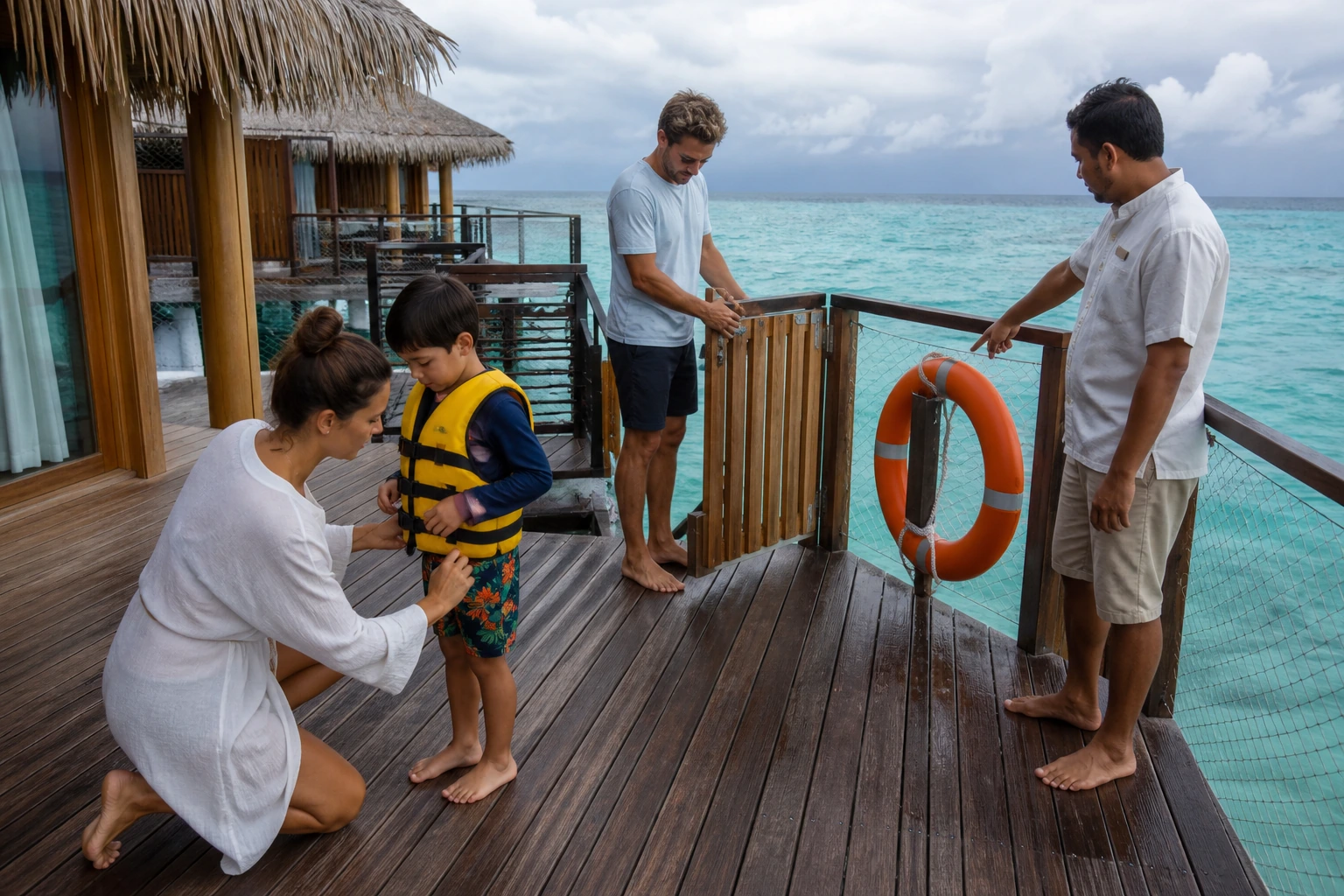
Establish which interior spaces open directly to the deck, pool or overwater net. Can a child reach and operate the handle Is there a functioning adult-height latch Can it secure the door without creating an unsafe emergency arrangement “Family friendly” is not an answer. Request a current close-up of the actual mechanism and written confirmation for the booked category.
Rope rails, horizontal bars and generous openings can look beautiful while inviting a small body to pass through or climb. Ask about height, gaps, flexible sections and exposed deck edges. A frontal hero photograph cannot resolve these questions. Side views, stairs and every transition between bedroom, terrace, pool and sea are more useful than a perfect sunset.
Many water villas have a metal or timber ladder into the lagoon. Some can be raised; others remain permanently accessible. Gate, latch, non-slip surface, handrail, water depth and low-tide conditions all matter. A narrow lower platform becomes harder in chop. The resort must describe the precise category, not another water villa photographed elsewhere on the island.
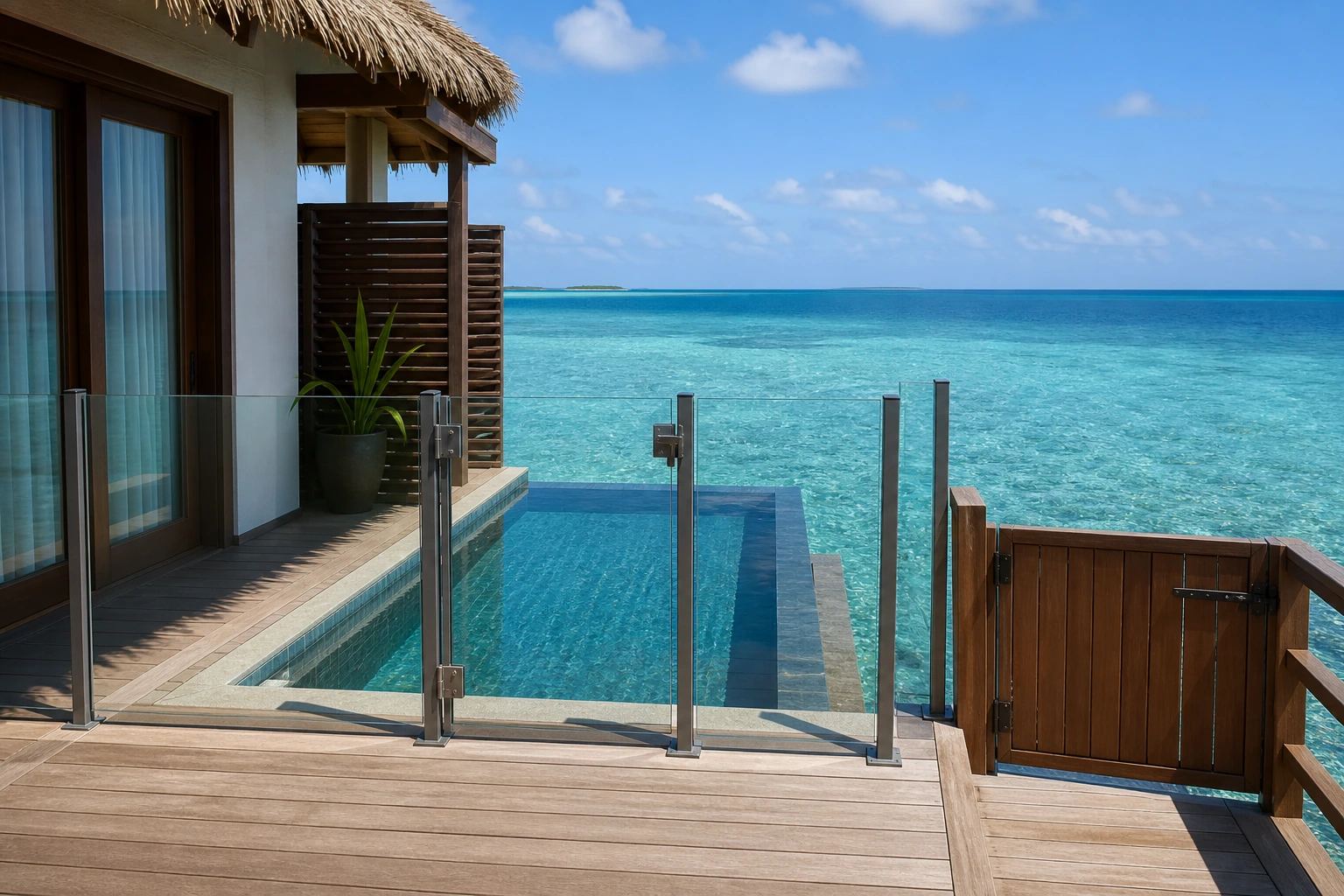
A pool does not solve the marine risk; it creates a second exposure. A shallow shelf may appear child-friendly while remaining constantly accessible, and infinity edges can confuse depth perception. The CDC identifies barriers as an important prevention layer. A secure, fully enclosed pool area can help. A decorative glass strip, planting bed or low rope cannot be treated as a protective fence.
Some resorts genuinely design overwater accommodation around families. Four Seasons Landaa Giraavaru, for example, lists a Sunset Family Water Villa with a separate study and sofabed, multiple family occupancy combinations and two bathrooms. That is a more thoughtful starting point than simply admitting children to a couple's villa. Deck, pool, net, sea access and sleep plan still require individual review.
A sofabed in an open living area may sit beside the terrace door. A separate children's room is useful only when its exits can be controlled and the bathroom is practical. Decide exactly who sleeps where, what doors lie between them and whether an adult would hear an opening. Do not infer bed sizes or privacy from the maximum occupancy number.
After a long-haul flight and boat, seaplane or domestic connection, children can be exhausted and overstimulated. They wake in a strange room with water audible outside. The first night is the wrong time to test complicated rules. Beginning in a beach villa or choosing a very legible layout may be wiser. Known sleepwalking deserves a robust professional plan, not furniture improvised against a door.
Technology may help parents hear a sleeping child but cannot prevent a door from opening. Battery, connection, placement and resort Wi-Fi can fail. Portable alarms are equally secondary, assuming the property permits them. Physical access control, named adult responsibility and proximity remain central. A gadget can support good architecture; it cannot repair unsuitable architecture.
The CDC recommends life jackets for water activities. Ask whether the resort stocks suitable children's sizes, who checks the fit and where they are kept. Inflatable armbands and pool toys are not equivalent. Even a properly fitted jacket does not make it acceptable for a child to be alone on the deck or in the sea.
Lagoon, villa number and jetty shape daily life
A shallow sandy lagoon creates a different entry from a villa perched near a reef drop-off. Tides change depth; wind exposure and boat traffic alter calm and visibility. Ask about depth at the ladder, current, coral, tides, seasonal wind and designated swimming zones. “Direct ocean access” describes an amenity, not the safety of using it.
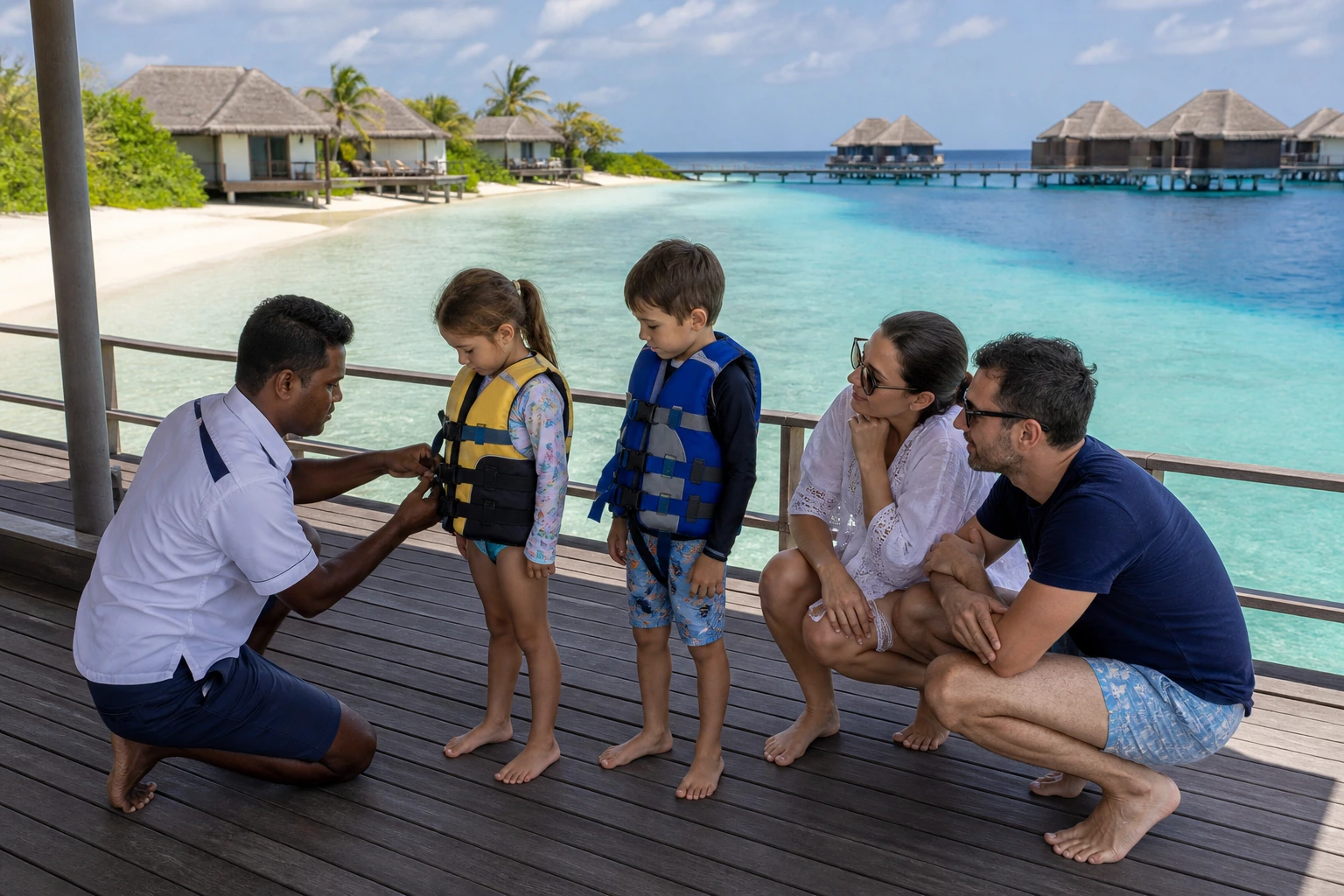
Near the start of a jetty, restaurants and the children's club may be closer, though buggies and passers-by are more visible. At the far end, privacy grows alongside the walk in heat, rain or tiredness. Wind and water can vary along the same structure. Villa position is therefore family logistics, not a romantic afterthought.
Open sides, oncoming buggies, wet boards and low night lighting feel different with a young runner than on a resort film. Confirm railings, distance, lighting and buggy service. A child who loves scooters or sudden races needs a simple rule. If every dinner begins and ends with tense crowd control, the location is not delivering ease.
Supervision operates within set hours, age bands and registration rules. The family still occupies the villa in the early morning, evening and between sessions. Review opening times, collection procedures and distance, but assess the accommodation independently. A superb children's programme cannot convert an unsuitable water villa into a suitable one.
Beach villa, residence or a contained split stay
Sand, shade, garden and shorter routes to facilities can give children more natural movement without turning each terrace door into an airlock. Beach does not mean risk-free: sea and pool may remain accessible. The advantage is often legibility—parents may be able to see, define and control the outdoor area more naturally.
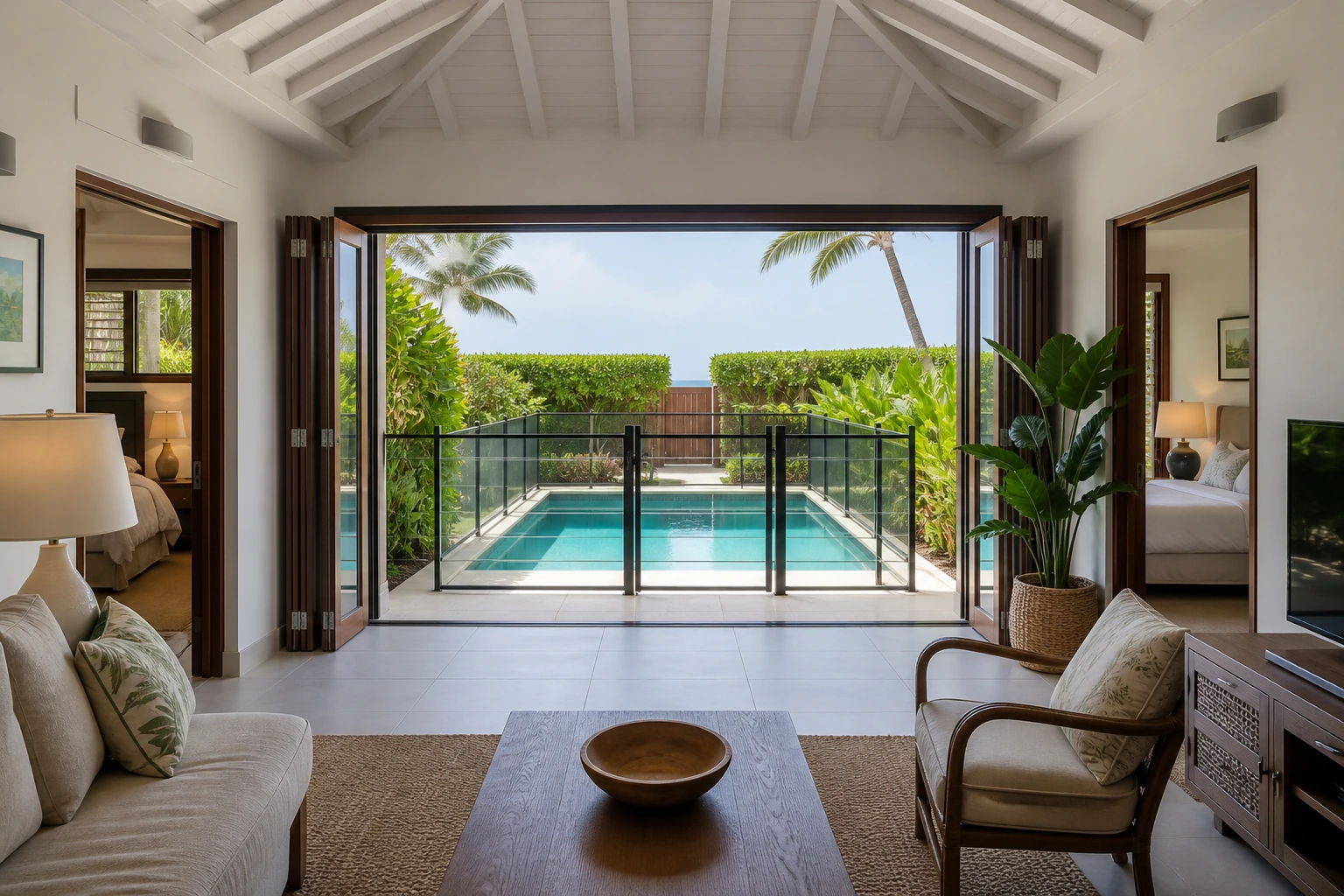
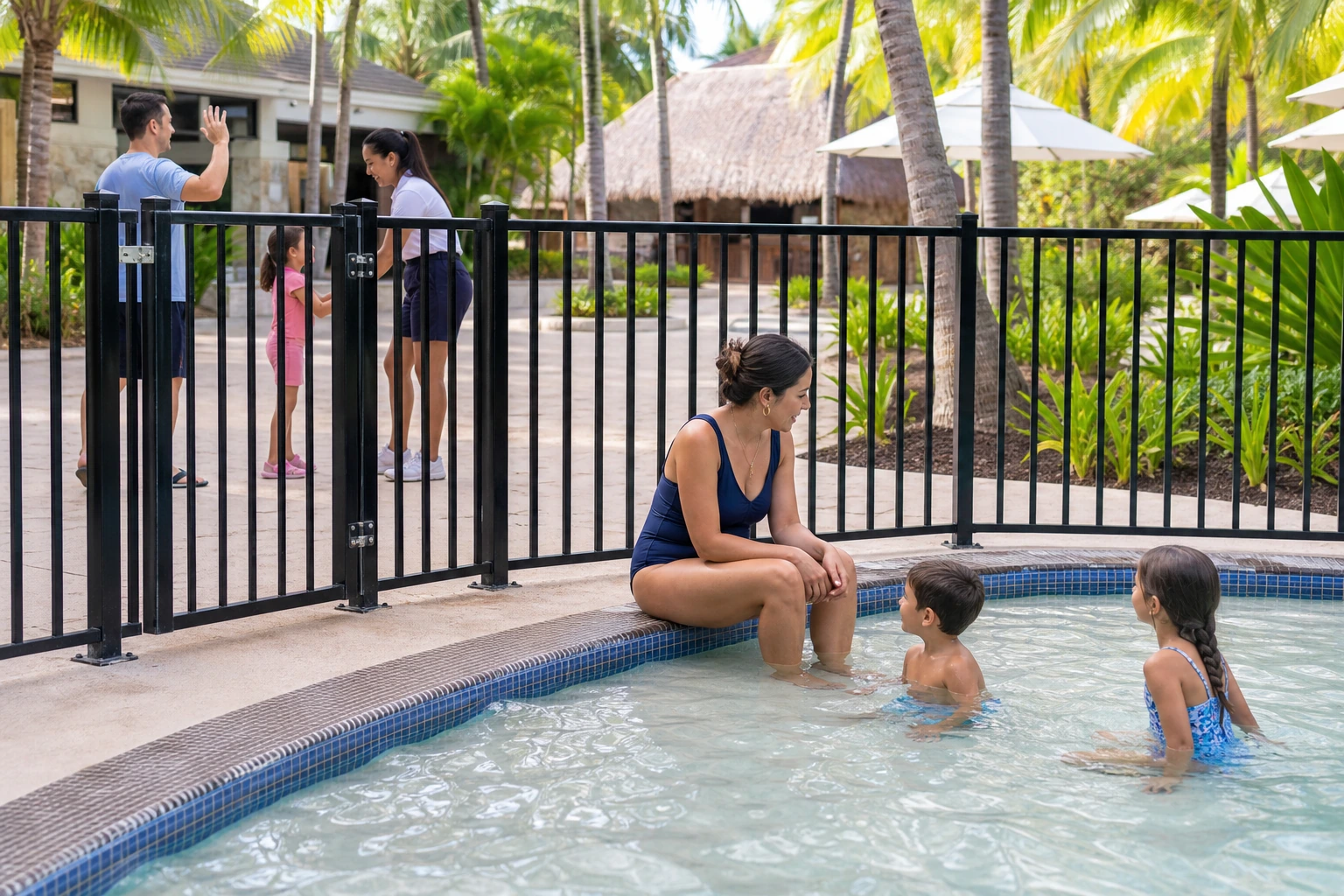
A properly enclosed pool zone can reduce unplanned access if the fence, gate and latch work. The current live article includes an attractive image of a fenced pool, but it identifies no resort and proves no specification. For a real booking, obtain dimensions and current photographs of the chosen villa. A garden pool is not automatically safer than a lagoon.
Two bedrooms, a shared interior and controlled outdoor areas can be more valuable than one spectacular bungalow when ages differ. Yet establish whether bedrooms connect internally or across an exposed path. One&Only's terms explicitly note that some residences comprise separate villas linked by an external walkway. The word “residence” does not guarantee the family circulation you imagine.
Some families spend most nights on the beach, moving overwater for a finale. With older children, that can provide the icon without asking it to carry the entire holiday. It also means packing, a timed room move and a second safety orientation. Change only when the water segment fulfils a real wish and the resort manages the transition smoothly.
Overwater accommodation differs by lagoon, tides, jetty construction, transfers, island scale and building tradition. A Bora Bora image cannot explain a Maldivian deck. Categories within one resort may also date from different generations. There is no credible global age formula. Destination, property, category and exact position need four separate checks.
A long-haul arrival followed by a seaplane, domestic flight or speedboat can stretch the first day. Delayed luggage, heat and hunger amplify tiredness. Families arriving after dark should not have to discover complicated deck geometry for the first time. Last transfer, waiting conditions, arrival time and disruption plan are part of choosing the villa.
Wind and rain make timber, stairs and ladders more slippery; waves can make direct access unattractive or temporarily restricted. A strong resort communicates limits, but the villa also needs a good interior and compelling land-based alternatives. If the entire premium rests on stepping into the sea, remember that the sea does not follow the brochure.
The honest decision before confirmation
Photography suggests parents reading while children play independently in the water. That depends on age, skill and a clear division of supervision. Butlers and housekeeping do not assume that duty. Genuine rest is more likely to come from planned childcare, a secure zone and adults taking turns than from adding square metres above the lagoon.
We request a floor plan, current images, handle and latch height, rail gaps, pool enclosure, ladder arrangement, water depth, tide and current information, children's life jackets, sleeping configuration, jetty distance and the written age or waiver policy. We also confirm occupancy, transfers and alternative categories. A vague answer should not transfer the burden of proof to the family.
Useful facts include age, height, swimming ability, impulse control, night behaviour, additional needs, number of adults and preferred sleep arrangement. We also need to know who will supervise when, and whether the holiday is designed around substantial unstructured villa time. This is not a judgement of the child. It is how a beautiful image becomes a defensible recommendation.
We would decline to recommend it when a child can leave unnoticed, is strongly drawn to water without stable rules, sleepwalks, or when the floor plan cannot be verified. An exhausting arrival, separate bedrooms connected outside and several uncontrolled water exits can also change the decision. The prestige of the category never outweighs daily tension.
It works when children understand the hazard, adults organise supervision clearly, access can be controlled and the family genuinely wants to spend time in and around the water. A family-designed villa, calm lagoon position, practical jetty and generous interior can then create a rare island experience. Safety and delight need to be visible in the same plan.
We start by comparing two exact floor plans: the strongest water option and the strongest beach or residence alternative. Then we ask where parents will need to police less and the family can experience more together. If the beach villa wins, it is not a compromise. It is the more luxurious decision because it gives the holiday back to everyone.