
Responsibility begins before offsetting
A journey is not virtuous because it carries a green label, nor consequence-free because emissions are offset. Credibility comes from reducing avoidable impact, measuring transparently, supporting effective conservation and ensuring economic value reaches the place visited.
Avoid and reduce before offsetting
Every long trip uses energy, space and resources. The serious question is not how to purchase innocence, but which journey merits its cost and how avoidable impact can fall.
A precise reason protects against interchangeable flights. Knowing why this place matters enables clearer decisions about length, route and provider.
Unneeded sectors, empty vehicle movements and repeated hotel changes can disappear. The remaining transport and operations can then be selected for lower impact.
A rarer, longer journey spreads arrival and departure over more meaningful time. It does not make the flight emission-free, but challenges the pattern of repeated short trips.

The IPCC describes growing aviation and shipping emissions and finds efficiency insufficient on its own. Demand, mode, technology and energy supply must be considered together.
Nonstop service, connection, distance, aircraft and cabin influence the calculation, while crude rules can mislead. Use one transparent methodology when comparing options.
More space per passenger changes allocated emissions. This is not a moral verdict on comfort; it is material information to place beside price and sleep quality.
Avoiding one high-impact sector while dispatching empty vehicles for hours is incoherent. Rail, shared transfers, vehicle size and local logistics belong in the design.
Record the reduction decisions before calculating residual emissions: journey combined with another purpose, extra nights instead of a second trip, removed sector, rail substitution, shared arrival and fewer hotel changes. This produces an auditable hierarchy and prevents a later credit purchase from becoming the entire sustainability story.
Hotel impact needs clear system boundaries
“Carbon per night” means little without the included scopes. Energy, refrigerants, procurement, construction, staff travel and guest transport may be present or absent.
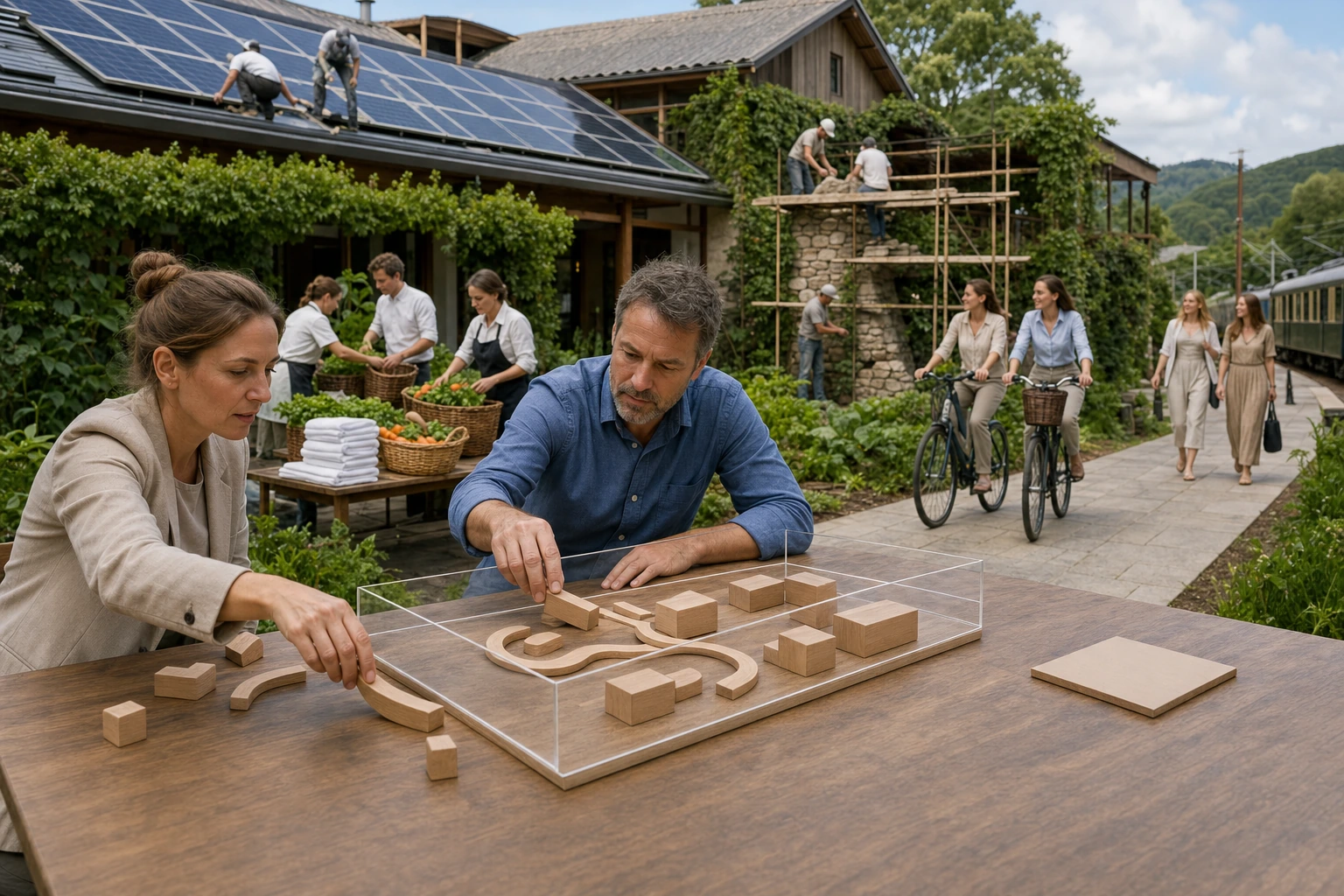
Skipping daily towel changes is sensible but rarely the largest lever. Electricity mix, heating, cooling, hot water and efficiency dominate operational impact.
A pool has a different significance in a rainy region and on an arid island. Source, desalination, leakage, wastewater and community effects require context.
Refillable bottles are visible; packaging, construction waste and food surplus often are not. A strong property measures, prevents and reports several material streams.
Season, origin, menu design and food waste matter. “Local” alone proves neither low emissions nor fair production; supplier relationships need substance.
Renovation, adaptive reuse and durable materials do not remove every impact, but pose different questions from a new build. Embodied emissions belong in the architectural story.
Ask for one boundary table with reporting year, organisational perimeter, scopes included, occupancy basis, absolute totals, intensity metric, baseline, target and independent assurance. Then note exclusions such as guest flights or outsourced boats. Comparability begins with knowing what the attractive number refuses to count.

Read standards and certification precisely
The GSTC Hotel Standard covers management, local benefits, cultural heritage and environmental impacts. GSTC explicitly notes that standards say what should be done, not whether the goal has been achieved.
Who certified, against which standard, for which site and until when Logo, audit scope, conflicts and publicly available performance remain open to scrutiny.
Conservation begins with a defined problem
Species, habitat, water, human-wildlife conflict and ranger funding are different tasks. A percentage contribution without objective, baseline and owner is not a strategy.
Does the trip finance an action that would not otherwise occur, or substitute for an existing duty Budget, governance and multi-year continuity provide evidence.
IUCN presents tourism as a potential force for conservation and a source of substantial impact. Capacity, routes, season, infrastructure and rules must serve the protected area.
No feeding, touch or photograph justifies stress or altered behaviour. Qualified guides, group size and clear stop rules are quality signals.
A credible conservation claim follows a chain: defined threat, baseline, intervention, responsible organisation, community authority, financing, monitoring frequency, measured outcome and course correction. Visitor fees may support this work, but the hotel should distinguish its own duty, guest contribution and external project funding.

Work, procurement and culture distribute value
Leadership roles, wages, training, contracts and progression matter. Many local employees in insecure positions do not establish fair value distribution.
Food, craft, cleaning, boats, guides and maintenance can strengthen regional businesses. The share and durability of relationships say more than souvenir sales.
Ceremony, knowledge, names and design are not decoration. Participation in decisions, payment and control over representation belong to cultural responsibility.
Offsetting remains the final instrument
The Oxford Offsetting Principles put emissions cuts first and stress integrity, durability and greenwashing risk. A certificate does not render the trip climate neutral.
Additionality, conservative accounting, monitoring, permanence, double counting and social effects must be understood. Project quality matters more than a low price per tonne.
For any credit, request the standard, project identifier, vintage, methodology, quantity allocated, public registry and evidence of retirement against the purchaser. Ask how reversal risk, leakage, local rights and grievances are handled. A donation receipt or portfolio label is not the same as a uniquely retired credit.

Thoughtful planning, durable design, fair work and excellent local food can improve the stay. Waste is not an essential ingredient of luxury.
A metric becomes useful when method, baseline, target, progress and absolute movement are visible. Percentage efficiency can be cancelled by rapid growth.
The questions before booking
What is measured, what has been reduced, who benefits locally, which conservation problem is addressed and what results are public Numbers and accountable owners beat emotional claims.
Vague carbon neutrality, wildlife contact, displaced communities, depleted water or a conservation surcharge without accountability are warnings. A beautiful property does not cancel them.
Travel less often, stay longer and demand transparency. Reduce first, assess conservation as real management work, and treat offsetting as a limited instrument for the residual impact.