
The Venice Simplon-Orient-Express is not worthwhile because it is the most comfortable way between two cities. It earns its price when dressing for dinner, dining, conversation, motion and historic space are themselves the destination. Travellers seeking contemporary volume, flawless sleep or maximum scenery for their money need a more exact calculation.
The short answer: yes, for the right occasion
As a singular event—a birthday, anniversary or overture to Venice—the train has genuine dramatic force. As transport alone, it is difficult to defend. Value resides in atmosphere and participation, not speed, room size or a hotel night saved.
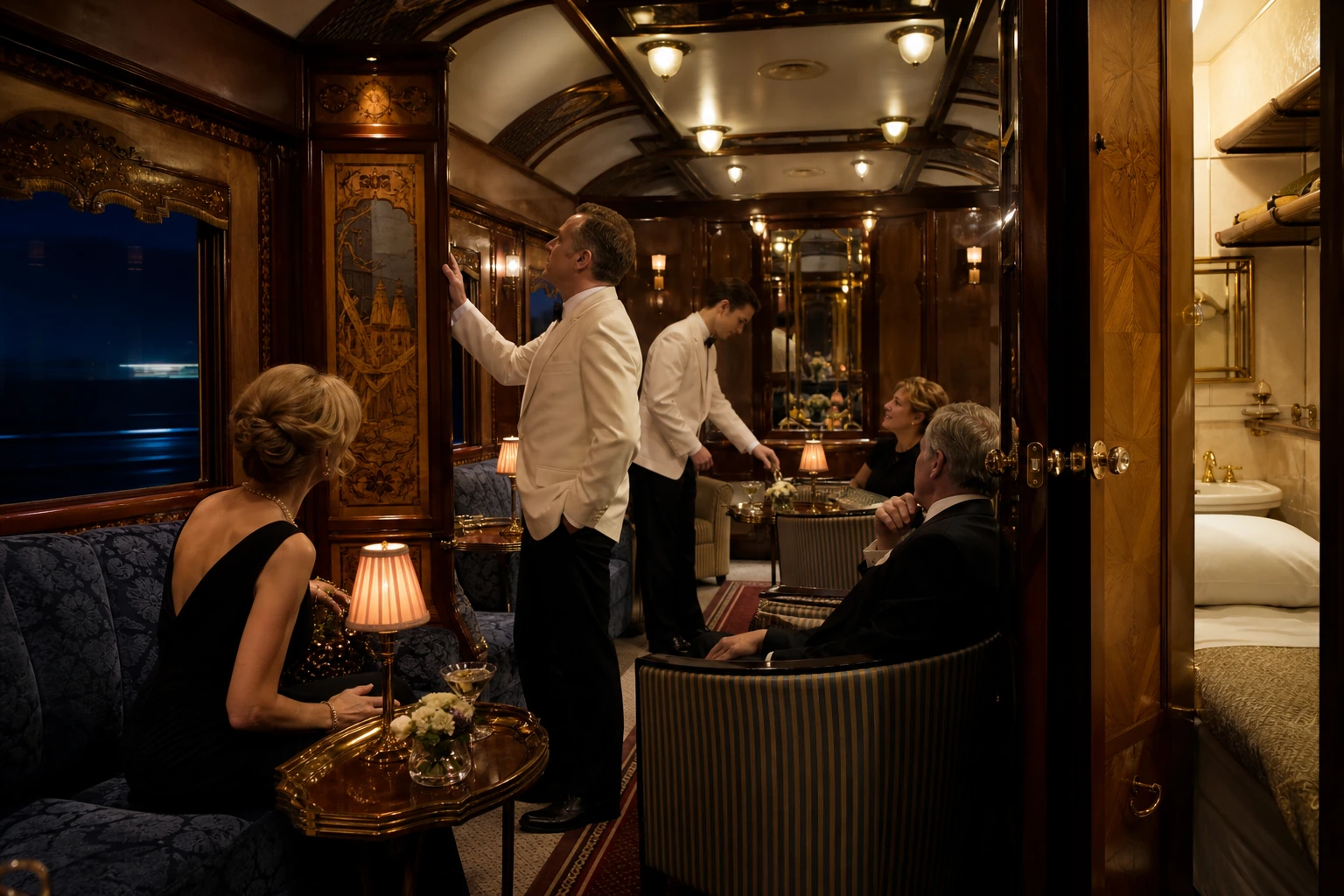
A shared performance begins on the platform. Uniforms, restored carriages, evening dress, dinner and bar work because guests agree to enter the scene. Privacy remains possible; anyone who finds ritual inherently contrived is probably paying for the wrong element of the experience.
Belmond operates restored 1920s carriages alongside accommodation categories created or renewed for modern travellers. Today’s Venice Simplon-Orient-Express is not one original train continuing unchanged through time. Its credibility lies in genuine historic cars and restoration, with contemporary engineering, service and new suites deliberately layered in.
Historic services, trademarks and new trains are easily conflated. A booking must state full operator and train name, exact route, date and accommodation. An image of brass and marquetry does not prove which railway product is being sold.
Route and duration come before the cabin
A classic journey to Venice bears little resemblance to an occasional multi-night passage towards Istanbul. Origin, direction, nights, border or transfer elements and arrival time establish how much train experience is actually present. Only then does a cabin comparison become useful.
On a typical one-night trip, boarding, dressing, aperitif, dinner, bar, sleep, breakfast and arrival follow closely. The compression can feel electric or exhausting. Guests who need pauses should read the rhythm ahead and resist filling every minute with photographs, cocktails and courses.
On a longer route, bed, bathroom, storage, temperature and private time matter much more. A Historic Cabin that feels charmingly disciplined for one night can read differently after several. Price comparisons therefore begin with route and number of nights.
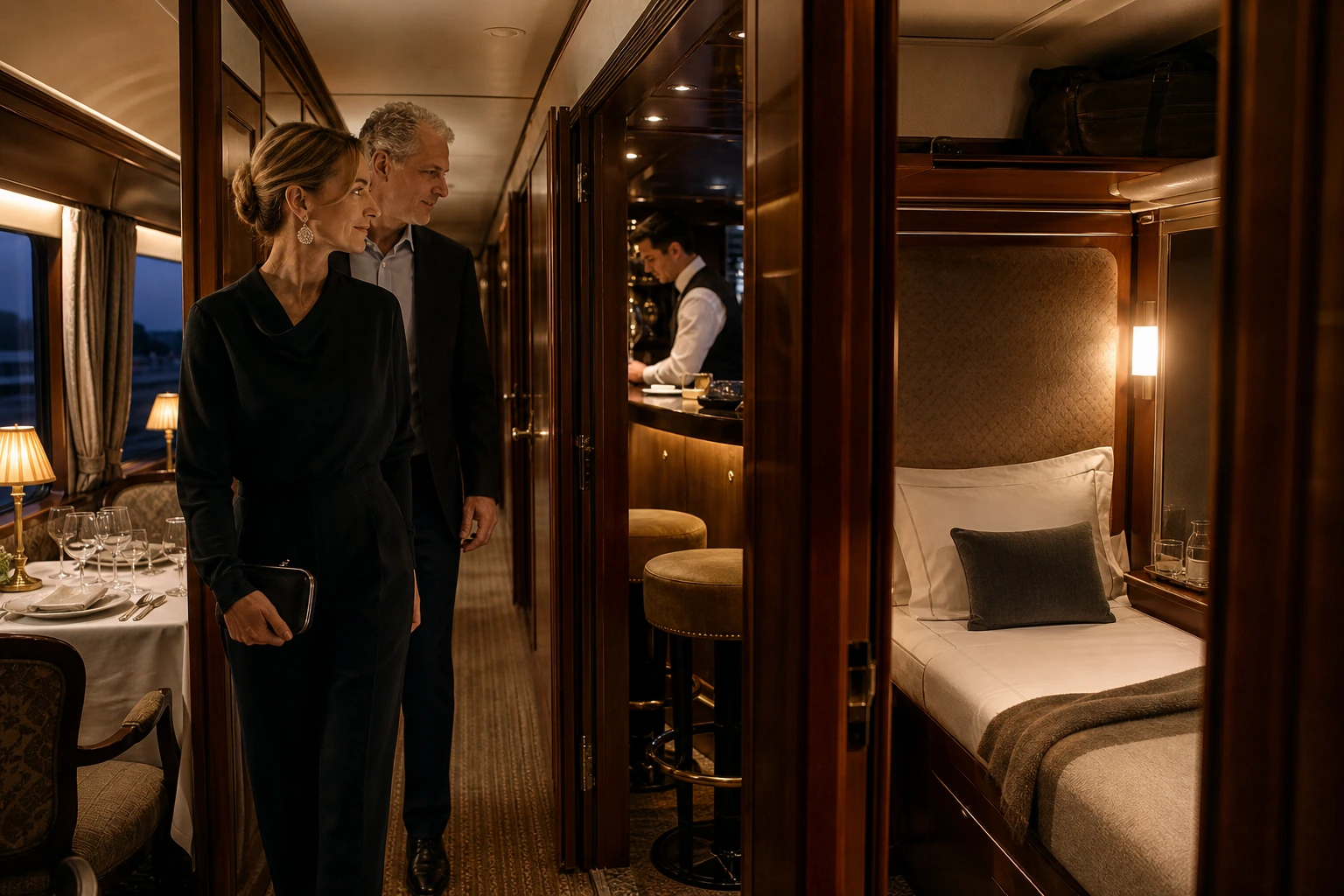
The operator’s FAQ describes the traditional journey as two days with one night aboard. For London-linked departures, exact train sections, Channel arrangements, luggage handovers and meeting points must be read from current documents. A famous name should never make logistical transitions invisible.
For travellers wanting the continental overnight without the London prelude, this often supplies the cleanest form. Calendar, station, direction and times still vary. A serious proposal shows precise duration rather than relying on two evocative city names.
Light, boarding mood, dining hours and the onward itinerary alter its character. Either city can be prologue or finale. The stronger direction begins without a rushed arrival and leaves at least two unhurried nights at the destination.
Occasional multi-day departures towards Istanbul are not simply an extended one-night ride; they are a separate grand tour. Accommodation, excursions, borders, luggage and pre- and post-travel become more consequential. Stations, availability and inclusions require confirmation for the specific date.
Four cabin worlds, four kinds of experience
Banquette seating converts into upper and lower berths at night. The official description promises a washbasin but does not list a private en-suite. That spatial discipline may be central to the romance—or make the fare incomprehensible if a private bathroom is essential.
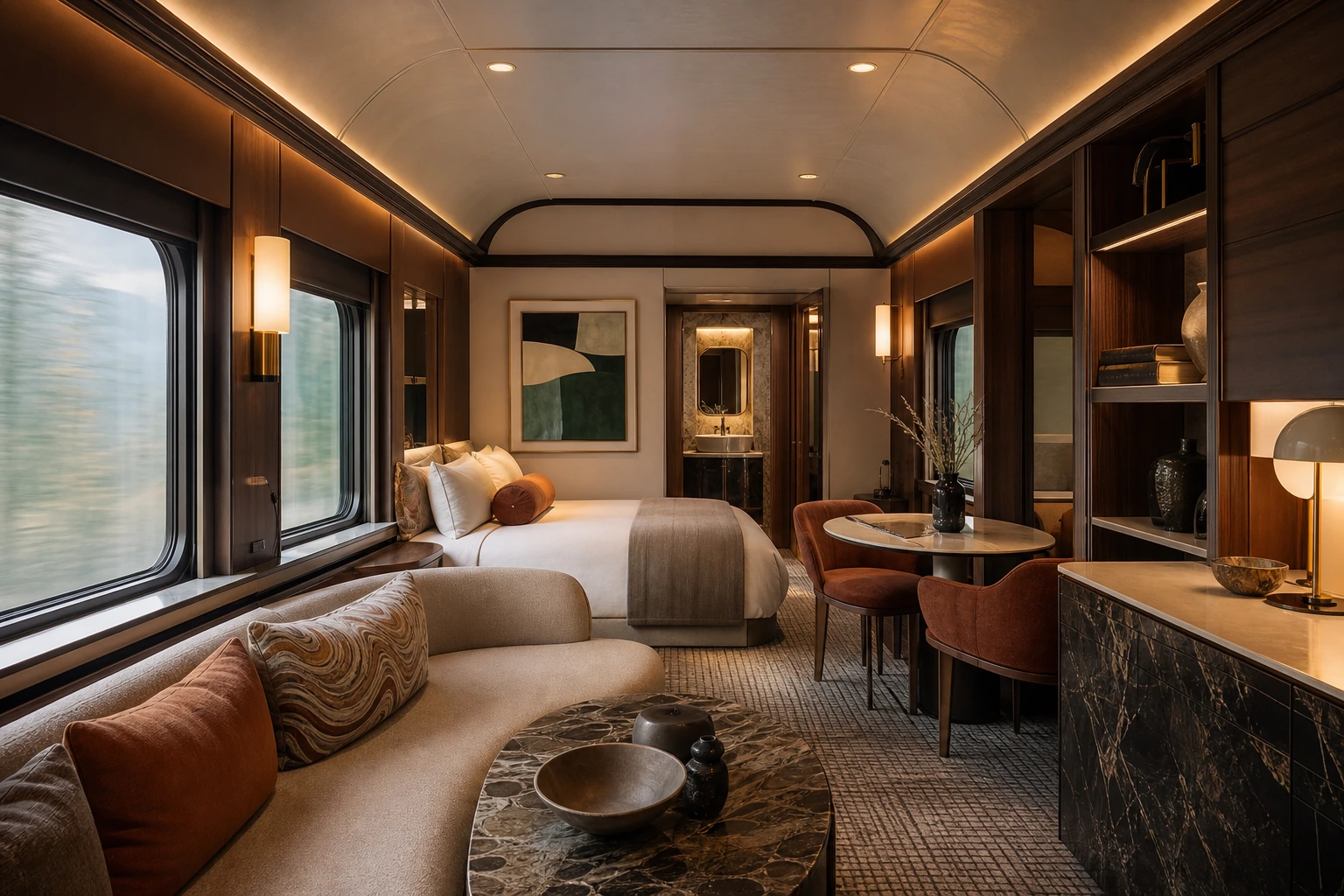
It offers double or twin beds and a private marble en-suite. For many couples this is the most rational upgrade because it changes night-time function, not merely decoration. The exact layout and bedding should be confirmed for the named suite.
A separate living feel, double bed, marble bathroom, butler service, private dining option and category-specific benefits change one’s relationship with the train. It explains itself best over several nights or for guests who retreat often. Travellers living in the bar and dining cars may use little of the premium.
Designed with JR, the residence occupies an entire carriage according to Belmond, combining bedroom, lounge, private dining, bathroom and library. It is not a linear upgrade from a Historic Cabin but a different proposition for extreme seclusion. Route, occupancy, transfer radius and fare require individual confirmation.
Historic Cabin, Suite, Grand Suite and L’Observatoire differ functionally, not just hierarchically. Our dedicated cabin guide compares beds, bathrooms, daytime conversion, storage and movement. Here the useful question is simpler: which missing comfort would diminish the occasion
Sleep, temperature and view remain those of a historic railway
Track, couplings, braking, curves and nocturnal operations remain part of the night. A beautiful bed cannot abolish movement or noise. Light sleepers should carry earplugs, avoid a punishing early connection and never equate the experience with a silent hotel suite.
Belmond describes centrally controlled cooling; individual cabins do not have independently set cooling, although guests can alter the airflow at a vent. Layers are sensible. Anyone requiring precise temperature control for health or sleep should discuss suitability before booking.
Europe passes through classic windows while much of the journey unfolds at dinner, in conversation or after dark. This is not purely a scenic train. Daylight, direction and season affect what can be seen; the train itself remains the principal view.
Dinner, bar and dress carry the theatre
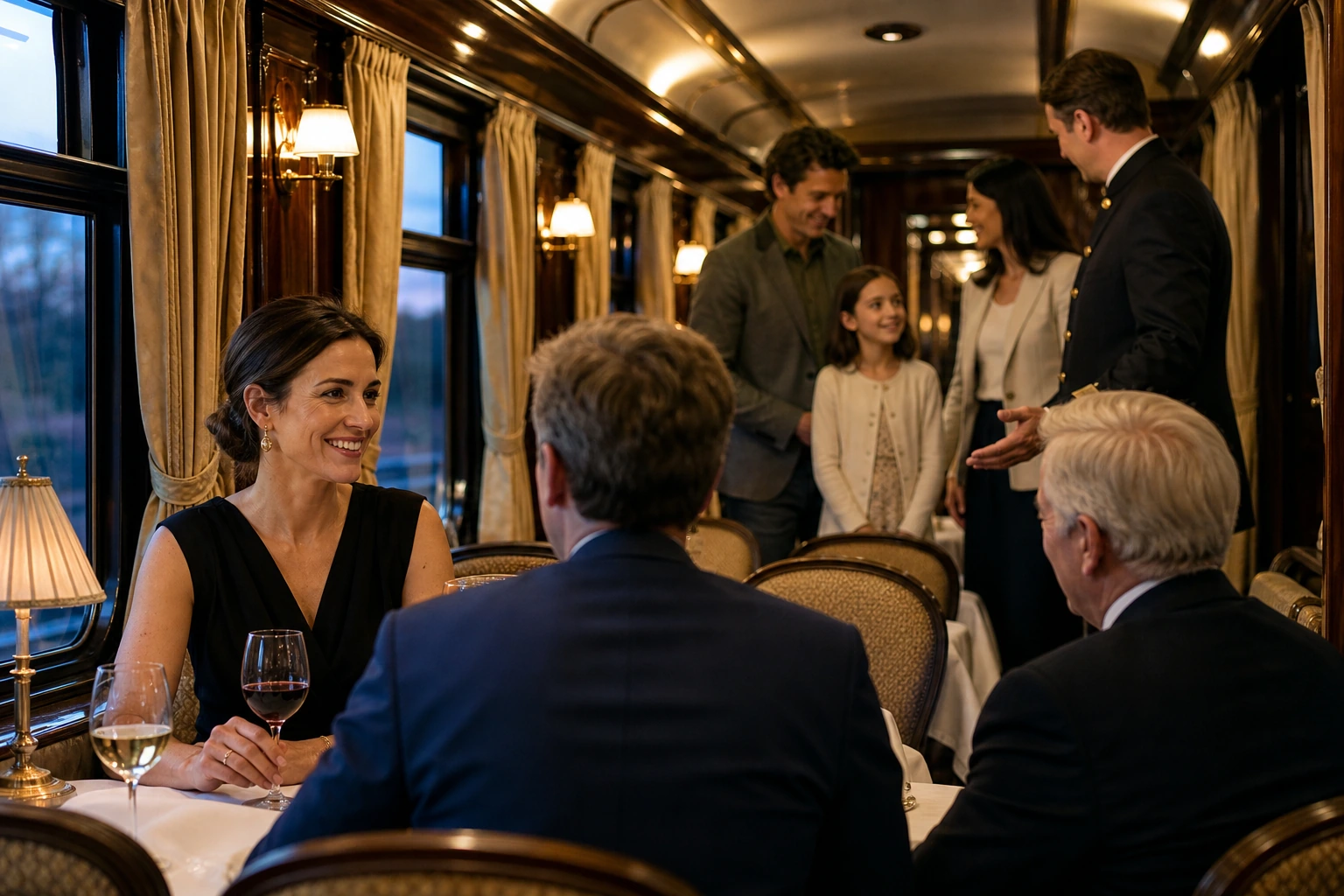
Restored dining cars, formal service and cooking within a compressed moving kitchen create authentic fascination. The operator describes seasonal menus and produce loaded en route. Sample menus inspire; they do not guarantee a dish, producer, wine or table.
Piano, cocktails and new acquaintances make Bar Car 3674 the emotional centre for many. Others find the proximity intense. Those seeking the social story stay after dinner; early sleepers should discuss accommodation position and possible sound routes.
Belmond asks for formal evening attire at dinner and smart dress by day; its FAQ says jeans are not accepted at any time. This is not a casual suggestion. Travellers who dislike black tie, gowns or an equivalent degree of ceremony may experience a core feature as obligation.
Elegance still needs mobility: narrow corridors, steps and a moving floor reward secure shoes and uncomplicated clothes. A second look can be delightful but must fit the overnight bag. Irons and laundry are not assumed onboard solutions.
Luggage and connectivity need their own plan
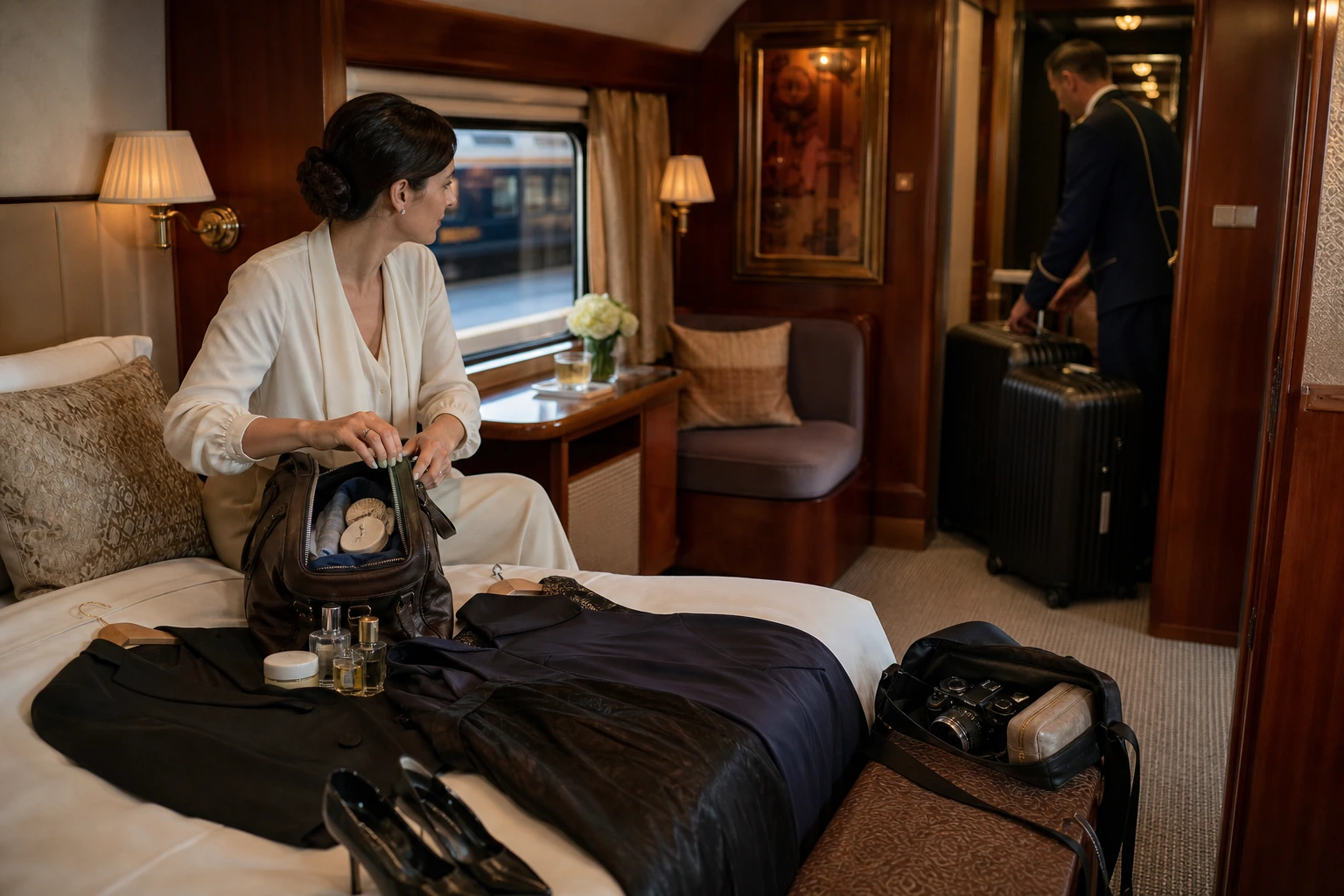
The official FAQ distinguishes hand luggage, cabin or overnight luggage, and through luggage. The last is inaccessible en route. Medication, documents, jewellery and camera remain with the traveller; evening clothes, sleepwear and toiletries go into a compact, well-organised suit carrier or overnight bag.
The baggage car accommodates stored luggage, but guests cannot retrieve it during the journey. A longer European itinerary therefore needs a deliberate repacking point. A good advisor creates a list by luggage type and marks everything that must not enter the through case.
Wi-Fi is officially available in guest cabins, though its mobile connection can be intermittent in rural country. Devices should largely be used in private out of respect for the ambience. It is a poor place for a crucial video call and an excellent one for an evening offline.
Service, inclusions and value live in the public cars
Stewards transform cabins, serve breakfast and choreograph a confined train. Butler and in-suite services differ by category. “Twenty-four hour” never means limitless: celebrations, allergies, privacy and unusual requests need briefing in advance.
Menus, selected drinks, transfers or champagne can vary by route, category and offer. Grand Suites and L’Observatoire carry different benefit profiles from Historic Cabins. Read the confirmation line by line, separating rail service, hotel package, transfer and discretionary spend.
A comparison with a hotel suite almost guarantees the train loses. Ask instead which event it replaces: gala dinner, private celebration, iconic overnight and transport at once. Yet the premium remains real; symbolic value is not permission to ignore an unsuitable budget.
Historic Cabin and suite guests share key elements: dining rooms, bar, service and progress through the train. Travellers who inhabit those spaces can find compelling value in the smaller cabin. Those needing seclusion should invest where it creates functional privacy.
An entire carriage creates calm but may reduce the accidental sociability for which the train is known. A small cabin, conversely, encourages life in the public rooms. Luxury here is not only square footage but desired proximity to the evening.
Solo travellers, children and mobility
A structured night, social rooms and attentive service remove much of the empty administration of travelling alone. Single occupancy, current fare, dining arrangement and appetite for conversation remain decisive. Offers or supplements are date-specific, never universal assumptions.
The operator welcomes children, but describes an adult-oriented ambience and notes that access to bar and restaurant cars may be at the Train Manager’s discretion. Age alone is inadequate. Our family guide examines sleep, meal length, cabin geometry and shared-space behaviour in depth.
Historic cars mean narrow corridors, steps and restricted turning space. Belmond asks guests requiring assistance to contact reservations so journeys and support can be reviewed. Wheelchair dimensions, walking distance, transfer help, lavatory access and evacuation must never be inferred from a general promise of luxury.
Arrival, disembarkation and the last mile need margin
A delayed feeder can destroy a rare, costly boarding. At least one night in the departure city is usually the elegant answer; after long-haul travel or an unreliable link, choose two. Station, meeting point and baggage acceptance come from final documents.
Driving straight to an airport cheapens the transition and adds risk. Two or three nights in Venice or Paris give the railway a destination. Choose a hotel that supports the handover with baggage acceptance, private transfer and no overambitious dinner on the first evening.
Station, boat, bags and hotel door must be designed as one movement. Water access differs by property, while weather and traffic can change timings. The train ends at the platform; the quality of arrival is decided afterwards.
A fine hotel, private transfer, correct cabin and one personal gesture may create more impact than the top category alone. Ask where the couple intends to spend time. The occasion should shape the choreography, not anxiety about having booked “too small”.
The cars are intensely visual, but narrow and communal. Guests, staff and private cabins require consent. A brief, planned period for images protects the rest of the evening; perpetual production turns a salon into a set.
Who the ritual suits, and whom it does not
Travellers moved by Art Deco, craft, evening dress, service choreography and conversation will find layers. Railway history also matters when context is valued above technical perfection. The train rewards attention to detail.
If value means square metres, bathroom volume and eight uninterrupted hours, even a suite involves compromise. A modern luxury train or excellent rail-and-hotel journey may make greater sense. Prestige should not override physical needs.
Same-day boarding after long-haul travel, one train night and an immediate flight home creates more logistics than magic. The VSOE needs anticipation, a calm beginning and a genuine destination stay. Otherwise the photograph costs more than the memory.
A contemporary Italian train, long African crossing, Scottish house-party or daytime panoramic service is not a cheaper imitation. Each changes landscape, cabin and social rhythm. Our alternatives guide therefore begins with the traveller’s desire, not a ranking.
Booking horizon, contract and twelve proof questions
Rare routes and very limited top accommodation may disappear early; flexible one-night departures have another pattern. Calendar, fare, cancellation and category should be read together. A current offer is valuable only if the underlying route already fits.
Verify train, date, direction, boarding, arrival, accommodation, bed, occupancy, bathroom, meals, drinks, transfers, luggage, cancellation and insurance. London-linked journeys add transitions and baggage handling. Marketing copy is not treated as a service promise.
What occasion, route, number of nights, direction, bed, bathroom, tolerance for imperfect sleep, appetite for formality, luggage, mobility requirement, pre- and post-programme, and total budget Only then can “is it worth it?” receive a personal answer.
The verdict depends on journey length
Yes, when the guest sees the train as evening event, salon and historic overnight, and intends to live in the public cars. Probably not when the cabin is judged as a luxury hotel room or the destination remains scenery. The Suite is often the functional sweet spot; the Historic Cabin the bolder atmospheric choice.
Bathroom, bed, storage and retreat become more important. A higher category can explain its premium over time, although the total rises sharply. Route and stops must be independently compelling; the name alone cannot carry several days.
Its strength is rare concentration: historic space, exacting service, formal dinner, bar and European movement compressed into a night. Its limitations are equally real. Travellers who understand and even relish them are buying more than a train ride—they are accepting a role in a beautifully constructed evening.