
In the Maldives, two villas in the same category can produce very different holidays. Sun, jetty position, wind, beach, service routes and neighbours may matter more than extra square metres. The best villa is chosen by its exact setting, not its label alone.
Location is the invisible villa category
A private pool, generous bathroom and polished interior are easy to compare in a brochure. What lies beyond the terrace, behind the entrance and beside the villa is harder to read. A Sunset Water Villa may sit near a bar, at the start of a jetty or far into the wind. A Beach Villa may face beautiful sand or a narrow, seasonally altered shoreline. Location is not a post-booking detail; it is part of the product.
“Sunset”, “Lagoon”, “Ocean”, “Reef” and “Private” sound precise, but are not standardised. Each operator defines them within its own island. Six Senses Laamu currently places its named Sunset category in a particular end position on Jetty A; other resorts divide sunrise and sunset villas between arms or island sectors. Only the current map, category description and actual villa number reveal what the name means for one stay.
Mark north, sun direction, arrival and service jetties, restaurants, bars, spa, kids' club, dive centre, staff areas and seaplane zone. Then add villas and paths. A decorative map may shorten distances or omit technical areas. Cross-check it with a recent aerial view, resort information and current local knowledge. Straight-line distance is not enough: vegetation, walls, bends, channels and the angle of the terrace decide what a guest sees, hears and walks past.
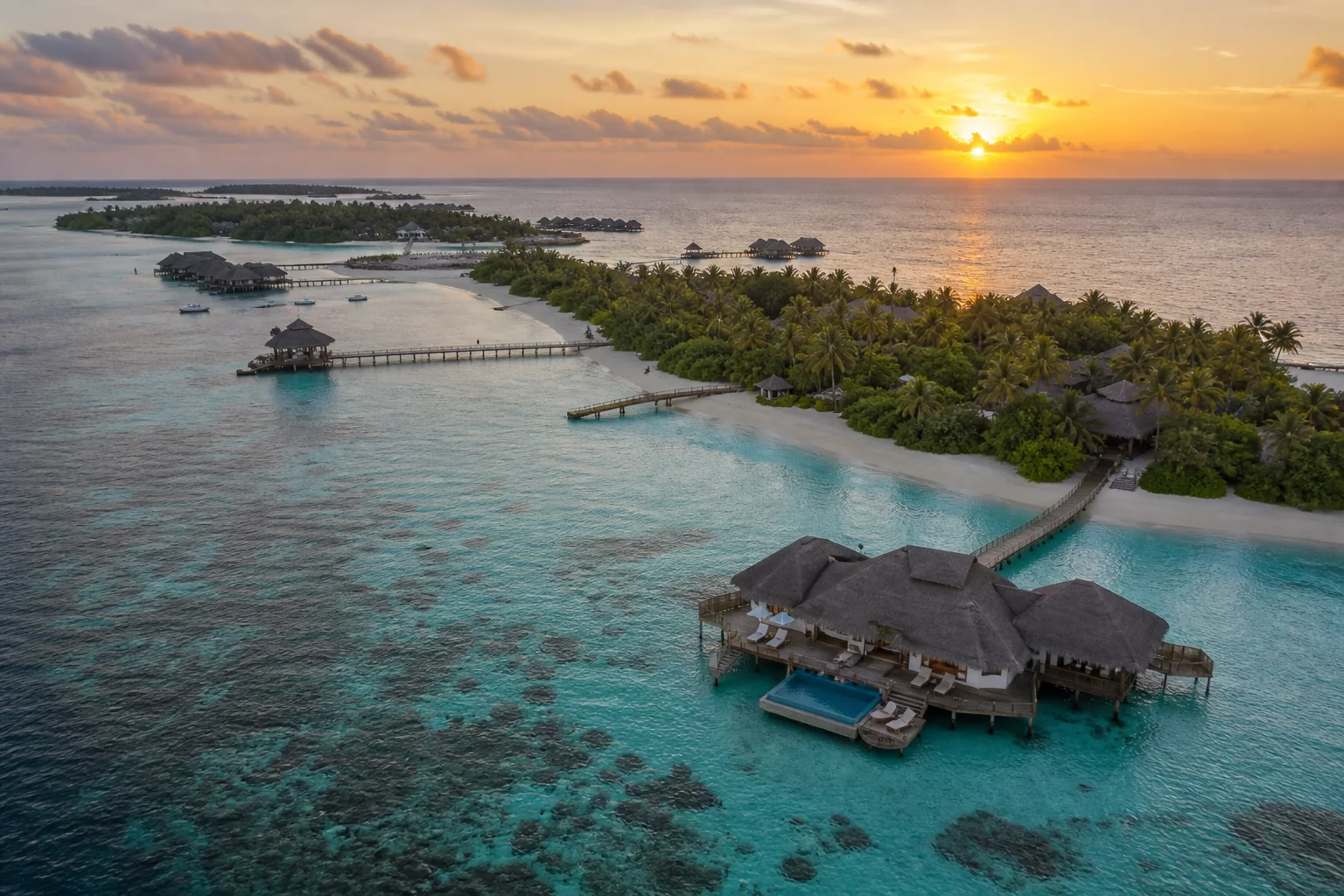
The sun sets in the west, but its point on the horizon moves through the year. On a curved island or angled jetty, a villa marketed as sunset-facing may see it obliquely rather than straight ahead. Palms, neighbouring roofs and cloud alter the scene again. Do not request an astronomical guarantee. Ask for an honest description: direct evening sun, a side view, a seasonal limitation or predominantly warm afternoon light.
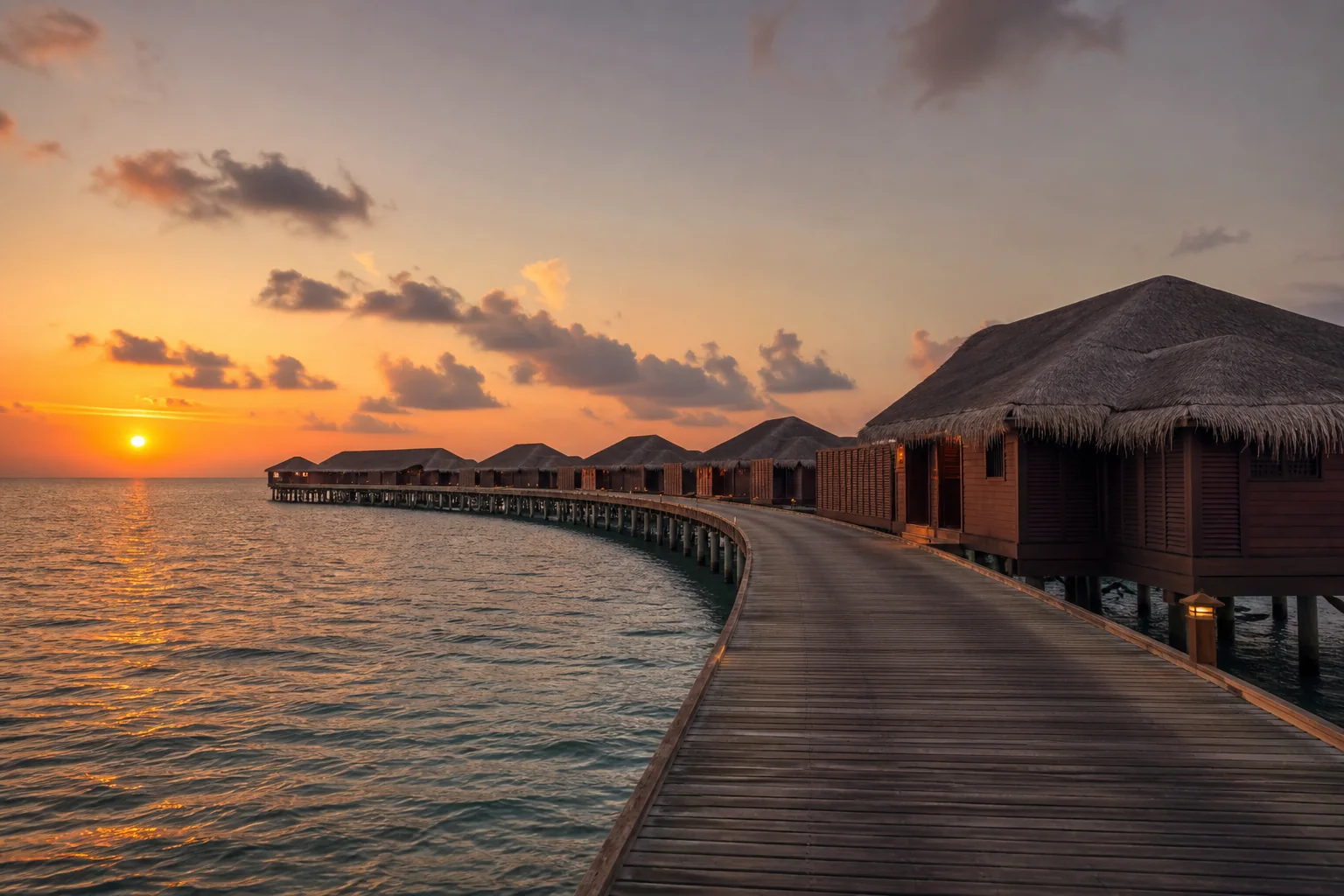
For a honeymoon, aperitif and photography, sunset carries undeniable allure. It may also bring more afternoon heat onto the deck, glass and pool. Some sunset sides sit close to a bar or boating route because public spaces value the same view. Travellers who spend much of the day in their villa might rank shade and cooler morning conditions more highly. The right choice emerges from a daily rhythm, not from the more prestigious word in the room name.
Early risers can take coffee, swim or practise yoga in soft morning light. By afternoon, the terrace may be more comfortably shaded—valuable for families with young children or sun-sensitive guests. A sunrise villa is not inherently less romantic; it moves the private highlight to another hour. If sunset drinks happen at a bar or beach, little is lost. In exchange comes an island morning before paths, jetties and lagoon become busier.
The Maldives Meteorological Service broadly defines the drier northeast monsoon from January to March and the wetter southwest monsoon from mid-May to November. Transition periods and individual years vary; weather is never a promise. For villa selection, this means prevailing wind, showers, waves and humidity change seasonally. A position that feels sheltered in February may behave differently in August. Travel month belongs on the same map as villa number.
Windward means facing the current wind; leeward means facing away. Because wind changes with monsoon, weather system and island geometry, “the leeward side” is not a year-round guarantee of stillness. Buildings, planting and jetties redirect air. Ask how the chosen villa normally feels in your month and in stronger weather. A breeze may cool the deck beautifully; complete shelter may make heat and insects more noticeable. Neither condition is inherently better.
A lagoon side often appears paler, shallower and visually calmer. An ocean- or reef-facing villa may offer deeper blues, more wave sound and easier access towards the outer reef. Yet every resort uses these terms within its own bathymetry, channels and reef passes. Someone who wants to stand in luminous waist-deep water needs a different location from a confident snorkeller. Both can be luxurious; they simply answer different ideas of the sea.
Read the jetty, operations and neighbours
Straight, curved and branching jetties create different sightlines. On opposing rows, roofs or terraces may enter the view. A bend may open the horizon while bringing one neighbour closer. The jetty entrance makes restaurants and island facilities convenient; its end buys distance and a broader outlook. Request an up-to-date numbered plan and establish the direction faced by bedroom, pool and sea steps. The arrow of the jetty alone does not describe the villa.
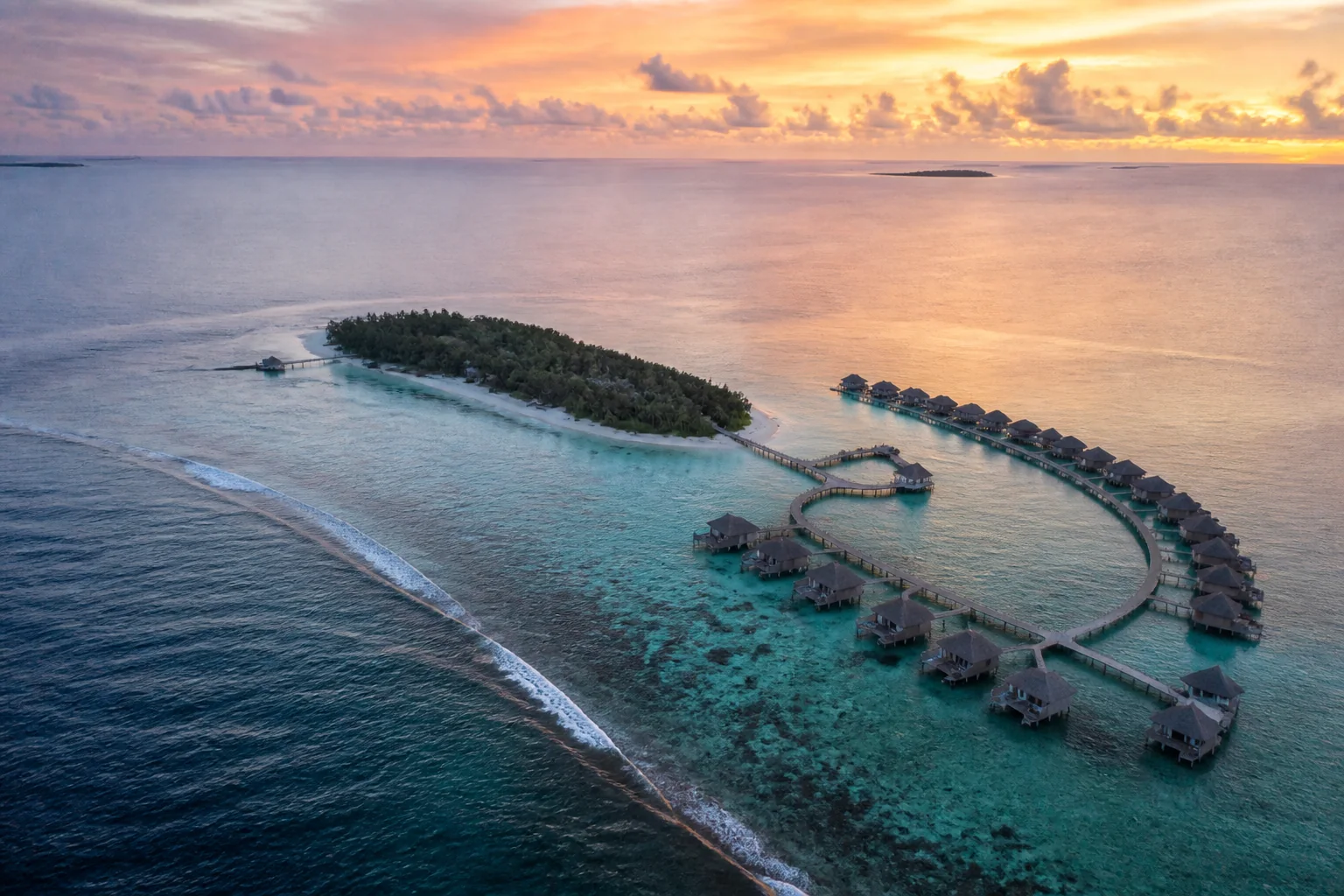
The last villa often enjoys fewer passers-by, freer views and water on more than one side. It may also meet wind, waves and storms more directly. Breakfast is farther away and buggy service becomes more relevant. At some resorts, water is deeper at the outer end; at others the entire lagoon remains shallow. “End of jetty” is not an automatic upgrade. It is a bundle of privacy, distance and greater exposure to the marine environment.
A villa near the bar is ideal when aperitifs, music and short walks belong to the holiday. The same position frustrates someone expecting absolute quiet by 9pm. Ask about hours, live music, private events and speaker direction. Sound carries readily across water. Even a restaurant without entertainment creates delivery, tableware and guest movement. A useful map shows how buildings are used, not merely where their roofs appear.
Arrival launches, excursion boats, dive dhonis and supplies operate at particular hours. In larger atolls, seaplanes use designated landing areas or platforms and may be brief but clearly audible. The question is not whether an island ever hears an engine, but how often and when. A villa near arrival is wonderfully convenient; a distant sector may be worth more to a late sleeper. Current operations should be checked directly with the resort rather than inferred from old reviews.
Food, linen, waste and engineering must reach every resort island. An operational loop therefore exists behind the idyllic map. Villas near a service jetty, stores or staff route may hear more early movement. Good resorts screen these areas carefully, but distance and wind still count. Ask neutrally about delivery times, planting and route design. Operational proximity may also produce exceptionally fast service; it is a trade-off to understand rather than a stigma to hide.
Electricity, desalination and repairs do not happen invisibly. Technical areas are usually consolidated and acoustically treated, yet may be perceptible depending on wind, vegetation and distance. Renovation or coastal work can temporarily transform a location. Before booking, ask about construction, dredging, beach nourishment and engineering projects during the stay. A current phone photograph can be more valuable than a flawless aerial image captured five years earlier.
A remote villa sounds exclusive until every breakfast, kids' club visit and forgotten item requires a buggy. Families, travellers with limited mobility and guests visiting the spa or dive centre several times a day may benefit from a central position. Establish whether paths are level, lit, shaded and pleasant on foot. Quiet and convenience need not conflict when vegetation and architecture shield a well-situated central cluster.
Generous spacing alone does not guarantee privacy. A raised deck, side-facing pool or water stair may create direct lines of sight. Family villas may generate more activity; honeymoon categories may stand close together. Check views from bed, bath, pool and outdoor shower separately. Kayaks and paddleboards also pass overwater decks. Good privacy does not require an empty lagoon. It controls views precisely where exposure would change how a guest uses the villa.
Dense tropical planting makes a Beach Villa intimate, filters wind and creates shade. It may also reduce the sea view, encourage insects or leave the pool darker. Newly opened islands often have less mature planting; established resorts feel lusher, but not every villa sees open water. Define the desired balance: fully screened, a filtered view or an uninterrupted horizon. “Private” and “ocean view” naturally pull in opposite directions.
Beach, swimming and reef are dynamic
Sand shifts with waves, wind and current. Maldivian environmental documents identify coastal erosion and unbalanced sand movement as genuine island processes. An aerial photograph from another season cannot prove the beach width in front of one villa today. Resorts protect, replenish or manage shores in different ways. Ask about current beach condition, sandbags, groynes and planned work—and accept that nature cannot provide a centimetre-perfect guarantee.
In front of a Beach Villa there may be coral rubble, seagrass, a small drop or an extensive shallows at low tide. Beautiful sand does not automatically create good swimming. High-tide photographs omit the low-water view. Families often need a gentle entrance and visible depth; snorkellers may prefer a nearby channel. Request recent images and a description of the seabed. Reef shoes or designated access points may be advisable.
An Overwater Villa's steps reach the sea, but depth, current and waves determine whether that access is usable. At low tide the water may be too shallow; in stronger wind it may be unsettled. Some areas close temporarily for safety or conservation. The dive or marine-biology team understands current conditions better than a room photograph. Non-swimmers and children must never confuse direct ocean access with the controlled environment of a pool.
A close house reef delights snorkellers but may involve deeper water, coral underfoot or more current. A broad sand lagoon offers easy bathing while the reef edge requires a boat. Ask about distance to entry, marked channels, tides, supervision and current reef condition. “House reef” in a resort profile does not establish that it is conveniently accessible from a particular villa. The correct side depends on the abilities of every guest, not the strongest swimmer alone.
The ocean side sounds more forceful, especially in wind and near a reef edge. Many guests find it restorative; light sleepers hear constant noise. Fluttering awnings, pool equipment and air conditioning add further layers. Ask about bedroom orientation and glazing rather than accepting “quiet location”. A protected lagoon villa may be acoustically calmer, while a Beach Villa brings insects and birds through the planting. Quiet is personal and multidimensional.
Pool, shade, family and mobility
A west-facing pool receives powerful afternoon sun. A shaded pool may suit young children but feel cooler. Wind accelerates evaporation and influences whether lunch, a book and a parasol remain relaxed on deck. Check pool size, heating, depth, shade hours and protection.
A spectacular infinity view has little value if the terrace is uncomfortably hot or exposed during the hours it will actually be used.
Parents consider rails, stairs, open deck edges, water depth, bedroom doors and the route to the kids' club. A couple may prioritise sunset, outdoor shower and distance. A Family Water Villa can be thoughtfully secured and still remain over water; the resort's current age rules apply. Beach Villas often allow easier movement, yet require a safe shoreline and adequate privacy. The most romantic address is not automatically the most relaxed family choice.
A long jetty feels different in sun, rain and evening clothes than it looks on paper. Bicycles are not allowed everywhere or suitable for every guest. Travellers with knee, balance or vision concerns need exact information on steps, rails, lighting and buggy availability. Even the distance from bed to sea ladder matters. Accessibility requirements belong in the initial brief, not as a request after the most remote villa has been assigned.
Priorities, guarantees and current imagery
Some guests divide their stay between Beach and Overwater, or sunrise and sunset. This offers two perspectives but costs time for packing, transfer and a second orientation. Over five nights the disruption is often disproportionate; on a longer stay it may be rewarding. Confirm that both categories are available consecutively, how luggage moves and whether a gap arises between villas. Continuity is also a form of luxury.
A useful enquiry states travel month, daily rhythm, sleep sensitivity, swimming ability, children's ages, mobility and desired walking. Then rank five priorities: light, wind shelter, beach or reef, quiet and access to facilities. “Best villa” gives an advisor nothing to test. “Morning sun, little foot traffic, direct lagoon access and no more than ten minutes to dinner” creates a genuine shortlist. Any conflict between wishes can then be discussed honestly.
Many resorts guarantee the booked category, not every villa number. Preferences are considered subject to availability; maintenance, occupancy and operational needs can change allocations. Distinguish a guaranteed category, a confirmed feature and a non-binding request. For location-critical stays, follow up again before arrival. A written note is stronger than a casual call, but without explicit confirmation it does not become a contractual entitlement.
Renderings and wide-angle photographs explain design, not today's beach, neighbours or planting. For a particular position, dated photographs, a current island plan and an honest resort description are more useful. On an important stay, the on-site team may be able to check the sightline. Weather, vegetation and nature will still move. The aim is not an impossible guarantee, but the best decision from current evidence with uncertainty named clearly.
The right villa works through the whole day
Do not picture sunset alone. Picture 7am with coffee, 2pm beside the pool, 6pm getting ready and 11pm in bed. Are there boats or waves Is the terrace in the desired light Does dinner feel pleasantly close Deluxetargets reads category, map, season and exact location together.
That is how a beautiful villa becomes the one whose everyday rhythm fits the journey—even between the photographed moments.