
Health planning without fear or generalisation
Malaria is neither a reason to avoid Africa wholesale nor a footnote on a packing list. A responsible safari begins with the exact itinerary and an individual travel-medicine assessment – before flights, camps and cancellation deadlines are fixed.
Risk is part of the route
Country, region, altitude, season, duration and activities change the assessment. A general statement about Africa is medically and operationally useless.
Exact camp locations must be clear
A lodge address or the nearest known town can conceal different risk zones. Every camp, transfer, stopover and border crossing belongs in the consultation.
Travellers who address health only after non-refundable bookings narrow their options. Travel-medicine review belongs in the first planning phase.
The consultation dossier should show dated camp coordinates or nearest reliable locations, every overnight transit, road and air transfer, border, planned extension and plausible weather diversion. Give arrival and departure dates, not only country names. When the routing changes, the traveller asks whether the clinical plan also needs review.

Travel medicine is personal
Age, pregnancy, medical history, allergy, regular medication and previous reactions can alter recommendations. An editorial article cannot replace that clinical history.
A qualified professional decides whether preventive medication is advised and which option fits the person and route. Deluxetargets does not prescribe.
Vaccination status, possible medication trials, interactions and supply can need time. Seek advice as early as the current specialist recommends for the departure.
Start, time of day, food, duration after return and response to problems differ. Advice from an earlier trip should never be reused without review.
Sleep, digestion, mood, sun or other medication may matter depending on the product. Expected effects and thresholds for seeking help belong in the clinical conversation.
Leave the consultation with written instructions that fit the actual journey: what has been recommended, how travel days and time-zone changes are handled, what to do after a missed or poorly tolerated dose and which symptoms require contact. Those answers come from the treating professional, not lodge staff or a generic packing note.
Medication does not replace prevention
No preventive regimen makes bites irrelevant. Repellent, clothing, room barriers and behaviour form a second essential layer.
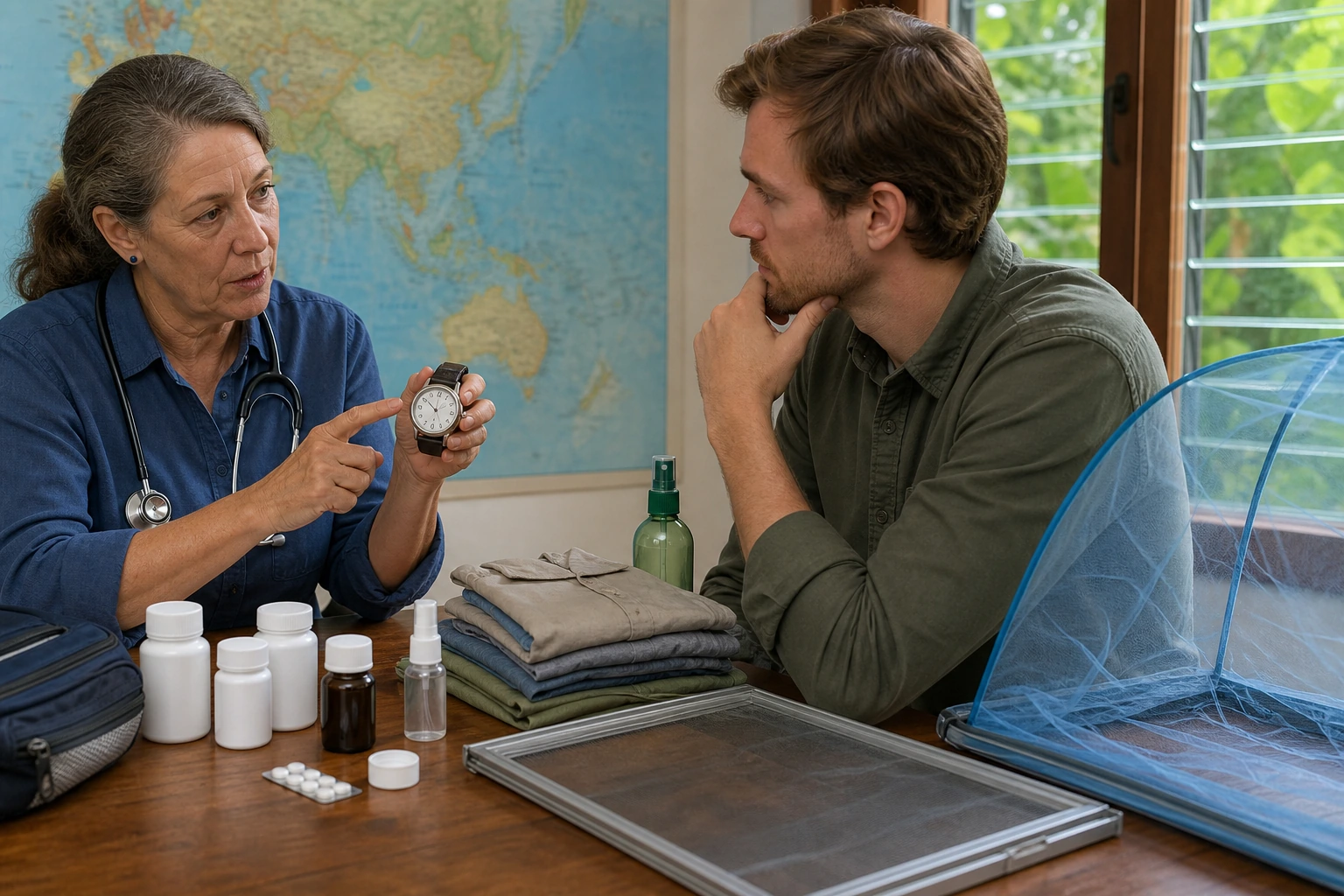
Active ingredient, concentration, age, pregnancy, skin and use with sunscreen require proper advice. Natural on a label does not prove adequate protection.
Long light sleeves, trousers, socks and closed footwear should work for dusk, dinner and night drive. Comfort determines whether protection is actually worn.
Room-level barriers must be transparent
Intact nets, screens, closing doors, fan and air conditioning are different measures. Mosquito net available does not establish that it hangs correctly or fits the bed.
Keep it closed, clear of luggage and inspect for holes. Staff can help with fitting or replacement; improvised spraying is not a substitute for an intact barrier.
Sundowners, outdoor shower, pool, deck dinner and night drive coincide with greater exposure. Apply protection before the activity and keep clothing accessible.
Rainfall can affect vectors, but local ecology and each year differ. Dry season or a cool night does not automatically mean zero risk.
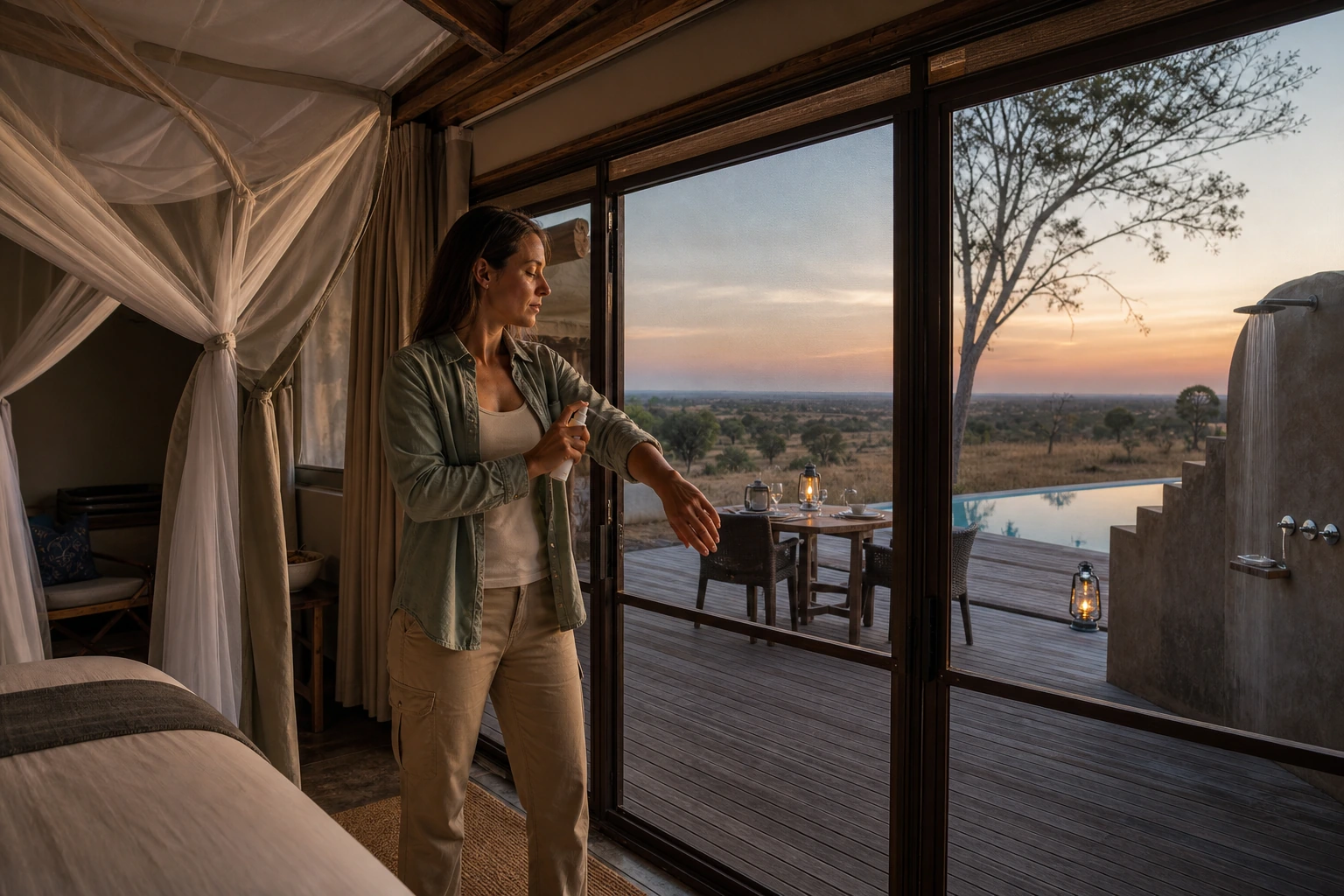
Ask each camp for a room-barrier inventory before arrival and inspect it on the first evening while staff can still correct a problem. Record who replaces a damaged net or repairs a screen after hours. A premium suite with a decorative outdoor bathroom may create more exposure than its photographs suggest.
Malaria-free claims need real evidence
A lodge slogan, reserve name or old map cannot replace current regional medical guidance. Verify every such claim with a recognised health authority.
A combination of Cape Town, Victoria Falls, Chobe and Okavango may bring several profiles into one journey. The whole route matters, not only the longest stay.
An airport night, road transfer, unscheduled stop or weather diversion can affect exposure and medication planning. Contingencies belong in the medical discussion.
Children need dedicated counselling
Age, weight, formulation, dose, ability to swallow and bite prevention differ. A child plan is never inferred from the adult prescription.
Malaria and medicines can carry particular risks. Destination, timing and necessity should be discussed early and individually with qualified professionals.

Heart, kidney, liver, mental health, immune status and other therapies may matter. Bring a complete list of prescribed and over-the-counter products to the consultation.
Prepare adequate supply, original boxes, prescription copy and medical letter according to destination and transit rules. Keep an appropriate portion in cabin baggage.
An emergency medicine can form part of a plan only under individual instruction. It never replaces diagnosis and prompt medical assessment when malaria is possible.
Fever after safari needs immediate action
For fever or acute illness during or after travel, seek prompt medical care and state the complete itinerary. A seemingly long interval does not universally exclude malaria.
Communication, nearest appropriate facility, flight operation, night capability and evacuation partner need definition. Doctor on call is too vague without location and response time.
Run the response as a chain: guest or companion recognises illness, camp contacts qualified care, insurer authorises where required, transport reaches the airstrip or road and the receiving facility accepts the patient. Satellite contact, night restrictions, weather and payment guarantees can all become critical links.
Insurance must cover evacuation
Region, activity, altitude, pre-existing conditions, medically necessary flight and direct payment all require review. Card benefits are not automatically sufficient.
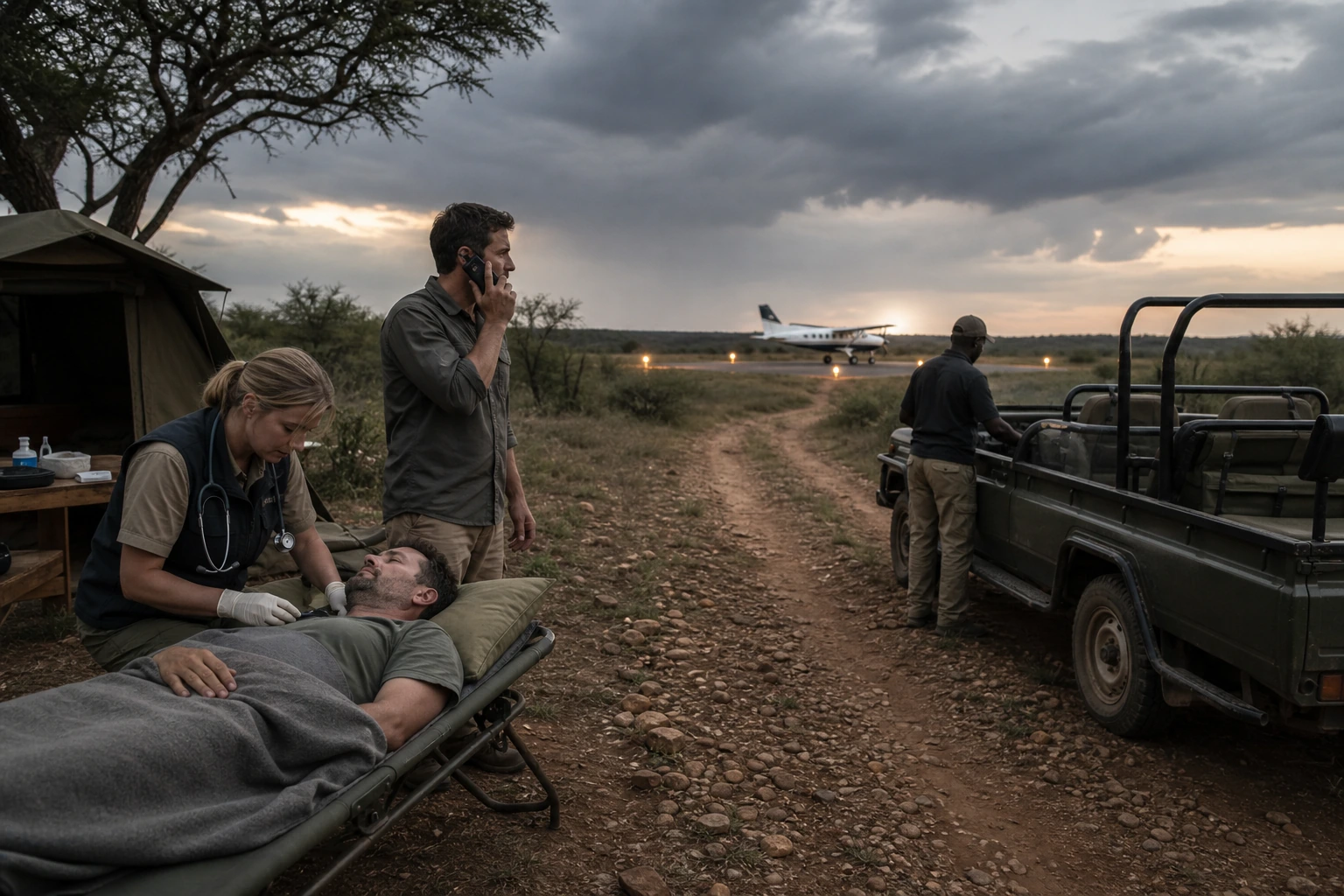
Nets, repellent, transfer and communication are useful services. A camp is not a medical authority and its risk description cannot be the sole basis for a decision.
Insurance number, emergency contact, medication plan, allergies, medically relevant information and route should be available offline. Companions need to know where.
Confirm the evidence the insurer needs before approving assistance, whether the camp or air operator requires payment first and how an accompanying person travels. Exclusions, pre-existing conditions and remote activities must match the itinerary. A high policy limit is not enough if the operational route to care is unclear.
What exact route, individual risk, lead time, bite prevention, medication logic and medical chain apply Only then should the safari be operationally fixed.
The Deluxetargets recommendation
Have the complete itinerary assessed early by a qualified travel-medicine professional. Build medication, bite prevention and evacuation as one system – calmly, in writing and without false certainty.